Trading Card Addiction: When Collecting Turns Compulsive
 Cards Mania Editorial Team
·
·
20 min read
Cards Mania Editorial Team
·
·
20 min read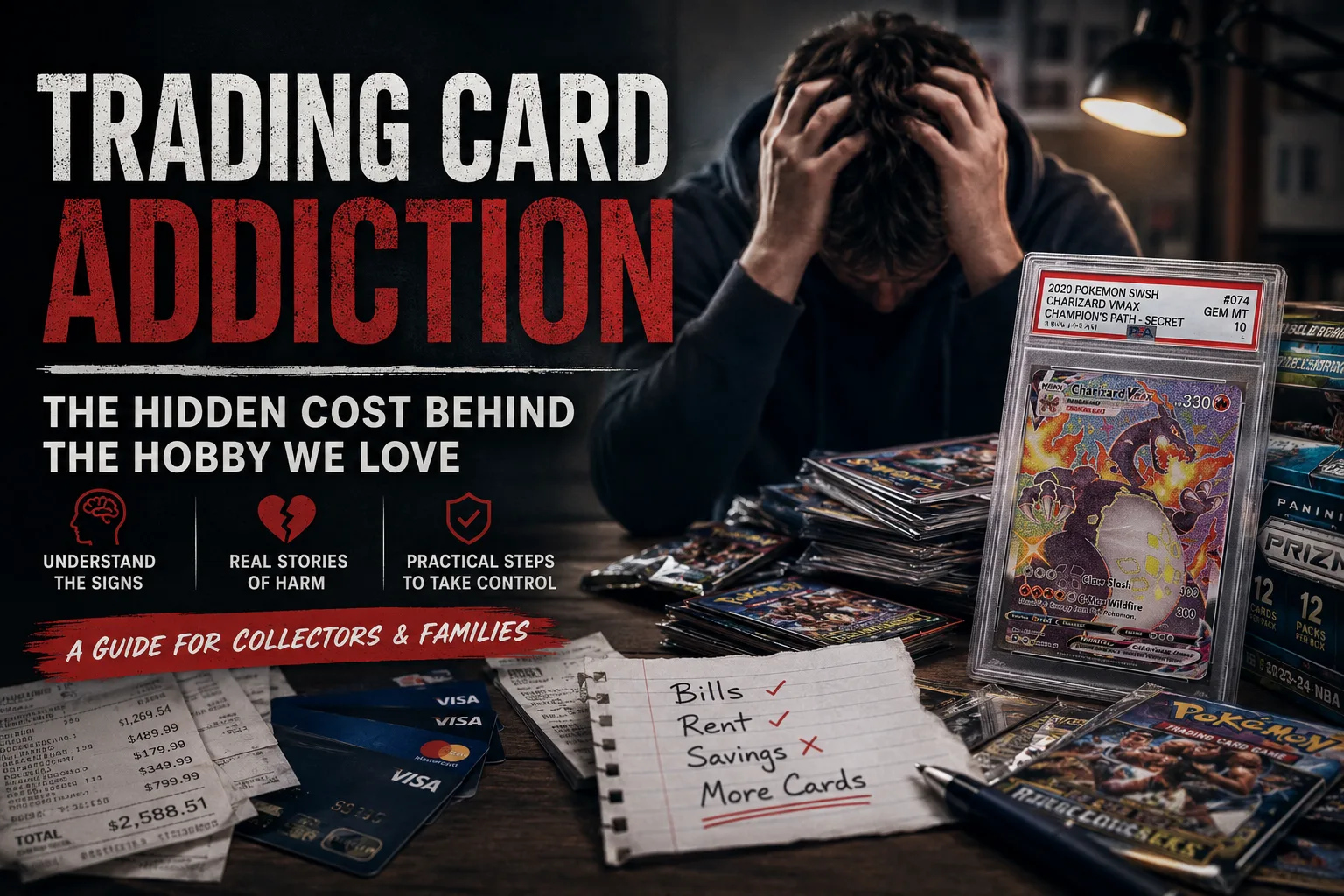
Originally published: September 3, 2025. Substantially updated: July 20, 2026.
Affiliate disclosure: This article contains sponsored marketplace placements and affiliate links. Cards Mania may earn a commission if you purchase through them, at no additional cost to you. These links are included for price research and practical storage supplies, not as encouragement to chase cards or spend beyond your budget. If marketplace prompts make it harder to control purchasing, skip them.
In a first-person essay published in 2024, poet and novelist Kaveh Akbar described pandemic-era basketball-card spending that crossed from disposable income into emergency money, mortgage and student-loan payments, and eventually his retirement account. That is the core of what this article calls trading card addiction: an informal term for card-related buying that becomes difficult to control, is hidden or financed irresponsibly, and continues despite serious consequences.
The term is not a standalone medical diagnosis, and this article does not diagnose Akbar, any other named person, or the reader. Expensive collecting is not automatically harmful. A financially secure collector can responsibly plan a large purchase; another person can be in real trouble at a far lower dollar amount if the spending involves debt, secrecy, repeated failed attempts to stop, or damage to household responsibilities.
Key takeaway
The price tag alone does not tell you whether collecting has become harmful. The more useful questions are about control, concealment and consequences: Can you stop? Are you hiding the true cost? Is the behavior damaging finances, relationships, work, health, sleep or other responsibilities? This is an editorial framework, not a diagnostic test.
Sponsored marketplace placement
What “trading card addiction” means here
“Trading card addiction” is useful search language, but it is not currently listed as a standalone disorder in the American Psychiatric Association’s DSM-5-TR or the World Health Organization’s ICD-11. The APA recognizes gambling disorder as a behavioral addiction. The WHO describes impaired control, increasing priority over other activities, and continuation despite negative consequences as central features of gambling disorder.
Card-related behavior can overlap with different problems. Randomized packs or breaks may resemble gambling-like chasing; repeated purchases of singles may look more like compulsive buying. A resale venture may be a badly managed business or a cover story for spending that has escaped control. Only a qualified professional can assess an individual case.
The distinction matters because collecting itself can be deeply positive. Cards preserve memories, connect fans, teach history, support games and create communities. Many collectors spend within their means, keep honest records and can walk away from a deal. Passion is not pathology.
| Behavior | Healthier pattern | Warning shift |
|---|---|---|
| Collecting for enjoyment | Planned purchases, affordable budget, enjoyment of the collection itself | Buying becomes the main source of relief, excitement or escape and is hard to pause |
| Planned luxury spending | A high-cost card is bought with available money after priorities are covered | The purchase uses debt, household funds or money reserved for essentials |
| Speculative investing | Risk is understood, records are kept, losses are affordable and liquidity is considered | Every purchase is called an investment, losses are denied and more buying is used to “recover” |
| Professional dealing | Separate accounts, inventory controls, taxes, margins and cash flow are tracked | Gross sales are treated as profit, household money funds inventory and unsold stock keeps growing |
| Gambling-like chasing | Entertainment spending is limited in advance and stopping is easy | Losses trigger another box, another break or a larger purchase to get even |
Control, concealment and consequences
1. Control: Can the collector stop?
Loss of control is the repeated failure of limits: opening another box after deciding to stop, bidding beyond the ceiling, returning to a stream after deleting the app, or repeatedly promising that this purchase will be the last. The behavior starts setting the schedule.
2. Concealment: Is the real cost being hidden?
Concealment may involve secret credit cards, packages redirected to work, understated purchase prices, deleted marketplace emails, hidden accounts or the phrase “I traded for it” when money also changed hands. A person may hide losses from a partner, from family members or even from themselves by tracking only the successful flips.
3. Consequences: What is the hobby displacing?
The clearest warning is continued spending after harm becomes obvious: revolving debt, missed bills, depleted savings, relationship conflict, poor sleep, distracted work or neglected responsibilities. A person does not need a formal diagnosis before a serious financial or relationship problem deserves attention.
How ordinary card spending can become compulsive
Sealed packs and hobby boxes
Sealed product sells possibility. The best hits are scarce, yet the spectacular pulls are the ones that get posted. Autographs, low-numbered parallels and one-of-one cards turn an ordinary box into a story about what might be inside. Near misses can also encourage another attempt.
That does not make every pack harmful or every opening session gambling. It means uncertain rewards and highly visible winners can distort expectations. The monster pull gets posted; ordinary boxes disappear into recycling.
A box can leave the buyer with cards whose realistic resale value is lower than the purchase price, particularly after selling fees, grading and shipping. The possibility of a chase card is not a forecast of profit.
For more context, see Cards Mania’s guides to why hobby boxes sell out before release and overprinting and supply risk.
Livestream breaks
Breaks add speed, public attention and social reinforcement. A buyer may purchase a team, player or randomized slot while a host fills the remaining spots, counts down and opens the product live. The chat celebrates hits instantly. A disappointing result can be followed by another opportunity before the first purchase has emotionally landed.
Random-team formats can produce little meaningful value, even when every buyer receives a card. Short auctions, fear of missing out and the desire to stay in the room can make several modest entries feel less serious than one large purchase. The bank statement is less easily entertained.
Are card breaks legally gambling? There is no universal answer. Laws vary by jurisdiction and by the structure of the sale. Payment, chance, prize or value may matter, while guaranteed receipt of a card and local definitions complicate the analysis. In 2026, ESPN and Barron’s reported unresolved legal claims and arbitration proceedings concerning some break formats. These are allegations, not final findings, and Whatnot disputes the characterization of its platform as gambling.
Whatnot’s current card-break policy requires each buyer to receive at least one card for every break purchase. It also prohibits prizes within breaks and paid bounties, guarantees or bonus items tied to particular outcomes. A platform rule is not a court ruling, but it is relevant when describing how the current format operates.
Singles and constant marketplace monitoring
Randomized products are not required for compulsive card buying. Singles create a different loop: saved searches, auction alerts, rare listings and the belief that a bargain will vanish forever. Small purchases accumulate quietly. Set completion becomes “at any cost,” or a PSA 8 is upgraded to a 9, then a 10.
Price tools help until checking values replaces sleep or every market dip feels urgent. Cards Mania’s Card Ladder review explains how sales data can inform buying, while its guide to parallels, short prints and variations shows why similar-looking cards may have different markets. Neither removes the need for a budget.
Mystery packs, repacks and bounty formats
Mystery products add uncertainty because the seller may control both the contents and the advertised ceiling. One headline chase card can dominate the marketing while the typical pack contains far less. Buyers should distinguish verifiable contents from vague “up to” values, bounties or repacks whose expected value cannot be assessed.
Even where a format is lawful and the seller follows platform rules, it can still be financially unsuitable for a particular buyer. Consumer protection and personal control are related questions, not identical ones.
Speculative resale, grading and the “business” label
A resale operation can be legitimate. It can also become a permission slip for unlimited buying. Common failure points include inventory purchased on revolving credit, giveaways used to manufacture attention, unrecorded grading and shipping costs, weak sell-through, taxes ignored until later, and household funds used to cover cash-flow gaps.
Grading creates its own optimism: a raw card is valued as though it will receive the hoped-for grade, while fees and return shipping become footnotes. Cards Mania’s guide to how card grading works and its PSA buyback investigation underline the point: a slab may improve trust and liquidity, but it does not guarantee profit.
Sponsored marketplace placement
“It is an investment” can be the most expensive sentence in the room
Cards can appreciate. Some collectors and dealers make money. That does not convert every purchase into sound investing, and it certainly does not convert debt into a strategy.
The rationalizations are familiar: “It is inventory.” “I can sell it later.” “One big hit will recover the losses.” “I have not lost unless I sell.” “I only need to grade it.” Each contains a fragment of truth, which is exactly why it works so well.
- Asking prices are not completed sales. A listing proves what a seller wants, not what a buyer will pay.
- Outlier sales are not the ordinary market. Exceptional grades, serial numbers, timing and bidding can produce results that do not transfer to another copy.
- Collections are illiquid. A theoretical value across hundreds of cards may be impossible to realize quickly without steep discounts.
- Fees matter. Marketplace fees, grading, shipping, insurance, taxes, returns and supplies reduce the amount actually kept.
- Condition matters. A card that looks mint in a photo may not grade mint, and a lower grade can erase the projected margin.
- Revenue is not profit. Selling $20,000 of cards after spending $24,000 is not a $20,000 business.
- Inventory is not income. Unsold cards cannot pay a bill at their optimistic spreadsheet value.
Calling every unopened box an investment does not make it one. Your closet is not automatically a private equity fund because Pikachu lives there. A serious investor records acquisition cost, transaction costs, realistic sale value and net return. Avoiding those numbers is not analysis; it is negotiation with yourself.
For anyone reselling, practical costs also include secure packaging and claims risk. Cards Mania’s guide to shipping trading cards safely is useful precisely because gross sale prices are only the start of the calculation.
Optional price-research and storage links
These affiliate links are intended for checking realistic market information or protecting cards already owned. Listed prices are not guaranteed sale values, and a marketplace link is not a recommendation to make a purchase.
- Review completed trading-card sales on eBay rather than relying only on active asking prices.
- Compare current listings and market information on TCGplayer. Prices shown there still require attention to edition, condition, language and seller.
- Protect cards already in the collection with toploaders on Amazon or team bags on Amazon. Availability and prices may vary by region.
Sponsored marketplace placement
Three documented accounts of savings, debt and secrecy
These accounts are not prevalence data. They do not prove that card collecting generally causes addiction, debt or relationship breakdown. They do show how different forms of card-related spending can become entangled with existing vulnerabilities, secrecy and attempts to make money.
Kaveh Akbar: emergency money, retirement funds and the fantasy inside the pack
In a GQ essay published April 24, 2024, Akbar described behavior he placed during the 2020 pandemic period. He wrote that his spending moved beyond disposable income into emergency funds and money intended for mortgage and student-loan payments. His spouse separated their finances. He also described emptying his retirement account to buy more basketball cards.
Akbar connected unopened “wax” with paying for the fantasy of what might be inside. He compared the experience with scratch tickets or casino gambling and described his prior history of addiction. Those are his account and interpretation, not an independently audited record or a diagnosis by Cards Mania.
The $26,000 Pokémon debt was also a failed promotion scheme
In the December 9, 2024 episode Building Wealth Starts With Setting Aggressive Goals from The Ramsey Show, a caller identified as Kyle said he accumulated $26,000 in credit-card debt over four months while his wife was pregnant. The headline version of the story makes it sound like he bought $26,000 of Pokémon cards. The fuller call is more complicated.
The caller said he was buying and reselling cards while trying to build a social-media platform. He reported buying followers and spending heavily on Whatnot giveaways in an effort to attract people to his channel. When asked directly, he agreed that he had not simply purchased $26,000 worth of Pokémon cards. He estimated that the remaining cards might bring approximately $5,000.
He also said his wife knew when the balance was around $4,000 to $4,500, but he continued. He stated that the marriage had been troubled before this and that the card-related debt was the final straw rather than the sole cause.
This is a caller’s self-report, not an audited account or a court finding. Its strongest lesson is not “Pokémon caused a divorce.” It is that a business narrative, promotional spending and concealed debt can merge into one increasingly difficult story to stop.
$22,000 from savings for a sports-card resale operation
In an anonymous letter published by MarketWatch on March 6, 2026, a reader said her husband started a sports-card resale business without her knowledge while she was eight months pregnant. She reported that he spent $22,000, including money from their joint savings, and left debt and unsold inventory after she shut the operation down.
The letter is not a court record and the underlying finances were not independently investigated in the published column. It is still a useful example of how “inventory” can become a household loss when purchasing is secret, controls are absent and resale assumptions fail.
Hidden hobby spending can become financial infidelity
Researchers have defined financial infidelity as financial behavior that a person expects a romantic partner would disapprove of and intentionally fails to disclose. The crucial combination is the act plus the concealment. A private discretionary account agreed upon by both partners is not the same thing as a secret credit card or unapproved use of joint savings.
Trading cards can be easy to conceal. Packages are small, trades may mix cards and cash, and marketplace balances blur the trail. Values are debatable, allowing a buyer to quote the best estimate while ignoring the amount paid. Losses remain physically present as “the collection,” creating the illusion that the money has not gone anywhere.
For the partner who discovers the debt, the argument is rarely just about cardboard. It is about bills, shared decisions and whether the disclosed number is finally complete. Rebuilding trust may require full account disclosure, a joint plan and professional relationship or financial counseling.
What peer-reviewed research actually says about packs and gambling
The science is limited and evolving. It does not justify saying that physical booster packs cause gambling disorder. It also no longer supports a confident claim that there is no relationship worth examining.
The 2021 PLOS ONE study found little evidence of a practically important link
David Zendle, Lukasz Walasek, Paul Cairns, Rachel Meyer and Aaron Drummond published Links between Problem Gambling and Spending on Booster Packs in Collectible Card Games: A Conceptual Replication of Research on Loot Boxes on April 6, 2021.
The researchers surveyed 726 adult collectible-card-game players recruited through Reddit. Participants reported past-month spending on physical packs bought in stores or online and completed the Problem Gambling Severity Index. In-store spending had no statistically significant relationship. Online physical-pack spending had a statistically significant but tiny effect, with η² = .008, below the authors’ threshold for practical or clinical importance. Follow-up equivalence testing rejected the proposition that either effect was practically important.
The limitations matter: it was cross-sectional, self-reported, recruited from enthusiast communities, heavily young and male, and included relatively few moderate- or high-risk gamblers. It compared a one-month spending measure with a gambling index covering a longer period. The design could not establish causation.
The later international study found a modest positive correlation
Leon Y. Xiao, David Zendle, Elena Petrovskaya, Rune K. L. Nielsen and Philip Newall later published Physical Card Pack and Especially Video Game Loot Box Spending Are Both Positively Correlated With Problem Gambling but Not Linked to Negative Mental Health: An International Survey. It appeared online on August 21, 2025 and in the February 2026 issue of Psychology of Addictive Behaviors, volume 40, pages 66–85.
The study surveyed 1,961 adult card-game players living in English-speaking Western countries. Problem-gambling severity correlated with spending on physical packs, with r = .15; virtual card packs, with r = .22; and video-game loot boxes generally, with r = .31. Physical packs showed the weakest of the three relationships. The study did not find links between those spending categories and its measures of negative mental health.
Again, this was a cross-sectional self-report survey. A correlation of .15 is modest and does not show that packs caused gambling problems, that gambling problems caused pack spending, or that a third factor influenced both. The study also cannot tell us whether a particular collector has a disorder.
The honest summary
The 2021 study found no practically meaningful association in its sample. The larger later study identified a modest positive correlation between physical-pack spending and problem-gambling severity, weaker than the relationship reported for digital loot boxes. The evidence has developed, but causation remains unproven and individual harm cannot be inferred from a pack receipt.
Warning signs of compulsive card buying
No single sign proves addiction. Several signs occurring together, especially after consequences have begun, deserve a serious response.
- Hiding purchases, packages, cards, accounts or the real price paid.
- Lying about whether a card was bought, traded or won.
- Using joint money without agreement.
- Carrying revolving credit-card debt for cards, breaks, grading or inventory.
- Using emergency, mortgage, education or retirement money.
- Repeatedly exceeding self-imposed limits.
- Buying another box or break immediately after a disappointing result.
- Trying to recover earlier losses through more purchases.
- Calling every purchase an investment without keeping complete records.
- Ignoring bills, work, sleep, caregiving or other responsibilities.
- Constantly monitoring auctions, streams or alerts and feeling unable to disengage.
- Continuing after serious financial or relationship consequences.
- Being unable to complete a planned break from buying.
A partner may notice packages disappearing before they are opened, unexplained transfers, defensive responses to ordinary questions, repeated valuation claims without completed sales, or a sudden emphasis on how much the collection “should” be worth. Approach the situation as a shared financial and health concern, not a courtroom ambush.
Practical safeguards for keeping the hobby under control
These steps are financial and behavioral guardrails, not medical treatment.
- Use a separate hobby account. Fund it only after housing, food, insurance, debt payments, savings and other priorities are covered.
- Set a monthly cash budget. Do not treat unused credit as available hobby money.
- Do not use revolving debt. If a card cannot be paid for in full without disrupting the plan, it is not affordable.
- Protect emergency and retirement savings. Those accounts should not become a source of “temporary inventory financing.”
- Disclose material spending to a partner. Agree on a dollar threshold that requires discussion before purchase.
- Track the total, not just the cards. Include buyer premiums, sales fees, grading, shipping, insurance, supplies, taxes, returns and promotional giveaways.
- Use a cooling-off period. Wait 24 hours for meaningful purchases and longer for debt-sized purchases. A truly rare opportunity is still not worth an avoidable crisis.
- Buy the desired single instead of repeatedly chasing it. This can reduce random spending, although singles still require a limit.
- Mute triggers. Turn off auction alerts, leave break channels and remove saved payment methods when spending starts escalating.
- Never chase losses. A disappointing box does not make the next box more likely to repair the result.
- Run a real business test. Separate business and personal accounts, produce monthly profit-and-loss statements, set inventory limits and stop when the numbers fail.
- Schedule a purchase-free period. If a planned 30-day pause feels impossible, treat that difficulty as information and seek support.
When it may be time to stop buying and seek qualified help
Stop card purchasing immediately if it is being funded by money needed for housing, food, utilities, medical care, taxes or minimum debt payments. The same applies when purchases are being concealed, when a partner has withdrawn consent to use joint funds, or when more buying is intended to recover losses.
Professional help is appropriate when a person cannot maintain a self-imposed stop, continues despite consequences, experiences severe distress or has significant debt. Useful support may include a licensed clinician, an accredited nonprofit debt counselor, a relationship therapist or a peer group. More than one type of help may be needed.
Do not wait for the collection to become worthless. A person can have valuable cards and still be in a financial emergency. The relevant question is whether the household can meet its obligations and whether the buying remains under voluntary control.
Sponsored marketplace placement
Trading card addiction FAQ
Is trading card addiction a recognized medical condition?
No. “Trading card addiction” is an informal term, not a standalone DSM-5-TR or ICD-11 diagnosis. Harmful card spending may overlap with recognized gambling disorder, compulsive buying or other mental-health concerns. Only a qualified professional can assess an individual.
Are card breaks gambling?
Not automatically, and the legal answer varies by jurisdiction and format. Breaks involve payment and uncertain allocation or value, but platform rules, guaranteed items and local definitions matter. Current lawsuits and arbitration claims are not final rulings.
Can opening Pokémon packs become addictive?
Pack opening can become harmful for some people when they lose control, hide spending, use debt or keep buying despite consequences. The fact that the cards are Pokémon, sports, Magic or another brand does not determine the behavior.
Is buying cards with a credit card a problem?
Using a card and paying the statement in full from an existing hobby budget is different from carrying interest-bearing debt. Revolving debt, cash advances, missed payments or using credit to chase losses are serious warning signs.
Are trading cards really investments?
Some cards appreciate, but cards are volatile, condition-sensitive and often illiquid. Asking prices are not realized value, and fees reduce returns. Collecting, investing and operating a resale business should be accounted for separately.
When should a collector stop buying?
Stop when buying threatens essentials, uses joint funds without agreement, creates revolving debt, is being hidden, or continues after serious harm. An inability to complete a planned break is also a reason to seek qualified help.
Sources and Methodology
This article prioritizes peer-reviewed research, official clinical guidance and original accounts. Named first-person stories are attributed as such. Recorded callers are described as self-reporting. Anonymous advice-column letters remain anonymous and are not treated as audited records. Allegations in current legal disputes are not presented as findings. The article does not diagnose any person.
- Kaveh Akbar’s first-person GQ essay
- Official December 9, 2024 Ramsey Show recording
- The Ramsey Show’s later written summary of the recorded caller
- MarketWatch anonymous reader letter
- 2021 PLOS ONE booster-pack study
- 2026 Psychology of Addictive Behaviors study record
- American Psychiatric Association guidance on gambling disorder
- World Health Organization gambling fact sheet
- Journal of Consumer Research paper defining financial infidelity
- ESPN reporting on the legal debate over box breaking
- Barron’s reporting on card spending and legal claims
- Whatnot’s current card-break policy
Support resources
Support resources last verified: July 20, 2026.
Card-related overspending does not fit neatly into one service category. Gambling-support organizations may help when the behavior involves chasing and randomized rewards; debt services can address immediate finances; mental-health professionals can assess compulsive buying or related concerns. Services and eligibility vary by country.
- United States: The National Problem Gambling Helpline offers free and confidential support 24 hours a day at 1-800-MY-RESET and connects callers and texters with local resources across the United States and its territories. For debt, the National Foundation for Credit Counseling connects consumers with nonprofit credit-counseling agencies.
- Great Britain: GamCare’s National Gambling Helpline supports people in England, Scotland and Wales. It is available free, 24 hours a day, at 0808 8020 133 and through online chat. StepChange provides free debt advice.
- Northern Ireland: GamCare states that its one-to-one and helpline services do not currently cover Northern Ireland. Its Northern Ireland support directory lists regional services including Extern and Dunlewey Addiction Services, as well as peer-support and financial-advice options.
- Australia: Gambling Help Online offers free, anonymous support 24 hours a day across Australia. The Australian Government’s Moneysmart financial-counseling page explains free nonprofit financial counseling and lists the National Debt Helpline at 1800 007 007.
- Canada: Services vary by province. ConnexOntario provides free and confidential service navigation for Ontario residents. The Financial Consumer Agency of Canada explains how to find and evaluate credit counseling.
- Collector-specific peer support: Collectors MD provides peer support, education and community resources for collectors affected by compulsive spending, break culture and hobby burnout. It is non-clinical peer support, not a substitute for medical, legal or financial advice.
For urgent financial, medical or mental-health concerns, contact qualified local professionals or emergency services in your country. The services above are not universal emergency lines.
Is there hope?
Trading cards do not have to be cheap, profitless or joyless to be healthy. The hobby becomes dangerous when the collector can no longer choose freely: limits fail, costs are hidden and consequences keep growing.
The useful first step is not calculating every card’s theoretical value. It is calculating the true cost and telling the truth about who paid it. Review the statements, include fees and debt, talk to the person affected, and pause purchases long enough to test whether the pause is voluntary. Support can help the person decide what role, if any, the hobby should play next.
A weekly card rundown is coming
Market movers, set drops, and what is worth watching. Sign-ups open soon — the guides stay free either way.

Cards Mania Editorial Team
Cards Mania is an independent trading card media project covering sports cards, Pokémon, TCG, vintage cards, grading, collecting, card storage and hobby news. Articles are produced by the Cards Mania Editorial Team.
Related reads
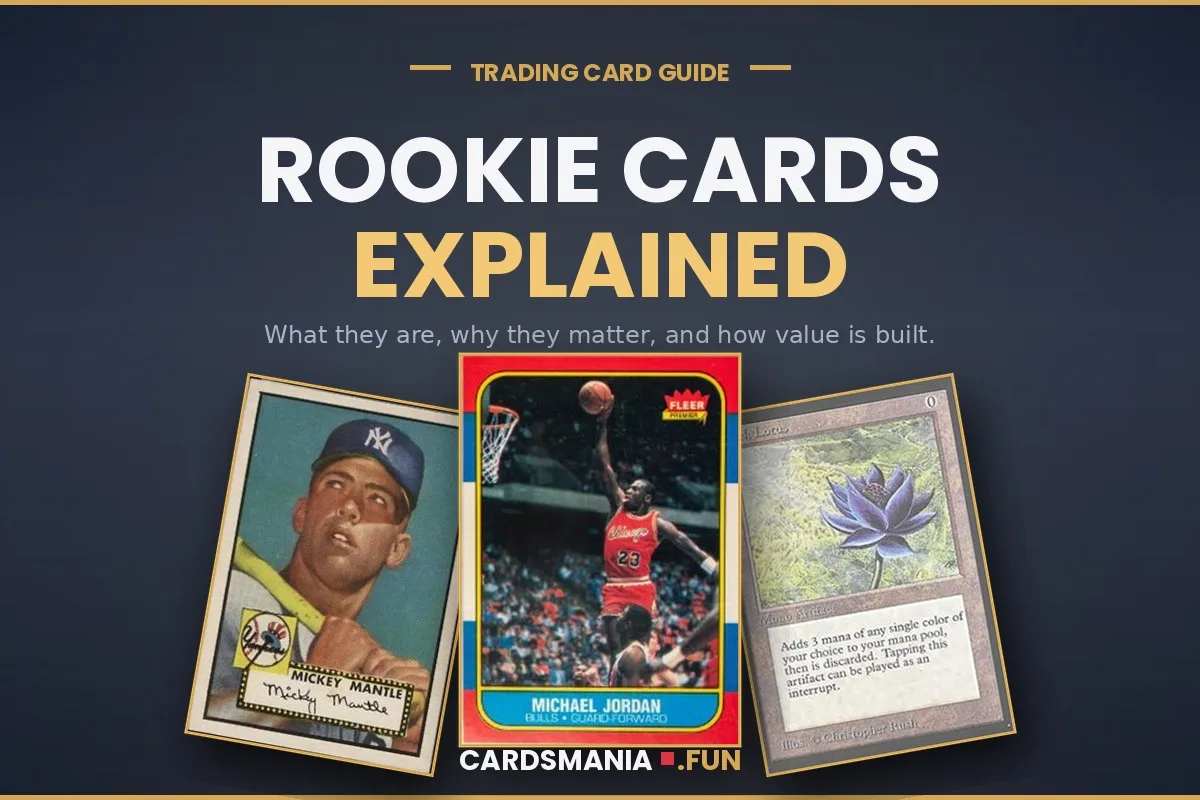
What Is a Rookie Card? Meaning, Examples and Collector Value
A rookie card is generally one of an athlete’s first mainstream cards after reaching the top professional level, but licensing, set type…
Read more →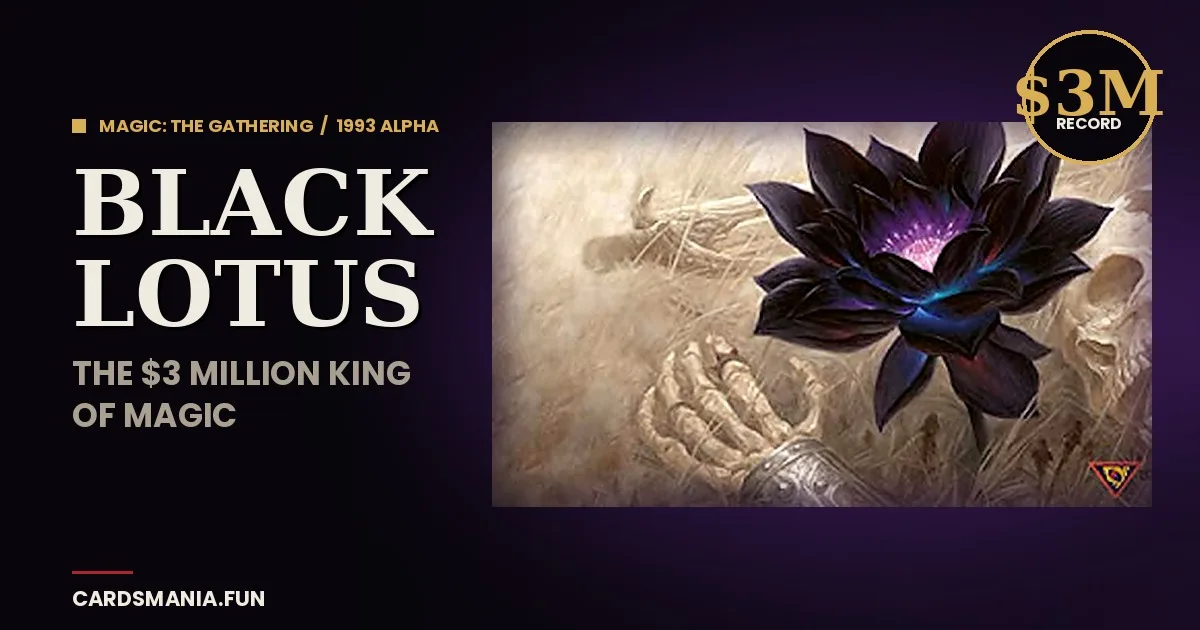
Black Lotus Card: Price, History, Rarity and Record Sales Explained
Black Lotus is Magic’s defining trophy card, led by the original Alpha, Beta and Unlimited printings. This guide covers print estimates, authenticity,…
Read more →
Digimon Trading Cards: The Complete Collector’s Guide (History, Value & Where to Buy)
Disclosure: This post contains affiliate links. If you purchase through them, we may earn a small commission at no extra cost to…
Read more →