
1933 Goudey Nap Lajoie #106: The Card Nobody Could Pull
 Cards Mania Editorial Team
·
·
15 min read
Cards Mania Editorial Team
·
·
15 min read
Collectors could pull Babe Ruth from 1933 Goudey packs. They could pull Lou Gehrig. They could work their way through one of the most famous baseball-card sets ever made.
But they could not pull card #106.
Opening another pack did not improve the odds. Neither did opening a hundred more. #106 simply was not part of Goudey’s 1933 production.
Then, in 1934, the missing card appeared. Goudey printed Napoleon “Nap” Lajoie as #106 and mailed examples to collectors who had written to the company about the gap in the set.
That created one of the better date problems in baseball-card history. The genuine Nap Lajoie #106 belongs to the 1933 Goudey set, yet the physical card was produced in 1934. Nearly a century later, the date can become even more confusing. Search eBay for “1933 Goudey Nap Lajoie #106” and you may find cards priced at $2, $3 or $10.
The genuine card has not suddenly become cheap. Those inexpensive examples are generally later reprints or reproductions, some manufactured decades after 1933 while still carrying the name of the famous set they reproduce.
The Card You Could Never Pull
The 1933 Goudey release was built for pack opening. Goudey Gum Company paired colorful baseball cards with gum, giving children a reason to buy another pack and trade duplicates with friends. PSA lists the cards at approximately 2 3/8 by 2 7/8 inches, substantially larger than many earlier tobacco-era cards.
Today the set is normally treated as a 240-card checklist because Lajoie eventually completed the numbering. During the actual 1933 production, however, there were only 239 different cards.
The missing number was visible. Collectors had cards below #106 and cards above it. They could find four different Babe Ruth cards and two Lou Gehrigs. Jimmy Foxx, Rogers Hornsby, Carl Hubbell, Mel Ott and numerous other Hall of Famers were there too.
If you want the wider context, Cards Mania’s history of trading cards covers the shift from tobacco issues to gum cards and the collecting model companies such as Goudey helped establish.
If a kid in 1933 wanted Ruth, persistence could help.
If that kid wanted #106, persistence mainly produced more gum.
Browse current 1933 Goudey cards on eBay
What the Uncut Sheets Prove
The strongest evidence for what happened is physical.
Robert Edward Auctions has documented a surviving 24-card Goudey production sheet covering card numbers #144 through #165. Babe Ruth #144 appears twice on that sheet. Ruth #149 is there as well, along with Lou Gehrig #160 and several other Hall of Famers.
REA explains that the 1933 set was printed on ten 24-card sheets. That gives 240 printing positions.
But #106 was not printed in 1933.
One position therefore had to contain a duplicate, and the surviving sheet shows exactly where it went: Babe Ruth #144 occupied two positions.
That gets us much closer to the truth than simply repeating the story that has circulated through the hobby for decades.
Why Was #106 Missing?
This is where fact and hobby lore begin to separate.
A familiar explanation says Goudey deliberately withheld one number so children trying to complete the set would continue buying gum. PSA has published this interpretation in historical articles, and it certainly fits the economics of collectible pack sales.
It may even be correct.
What I could not find was a surviving Goudey memorandum, production order, advertisement or company statement proving that this was the reason.
The production sheets tell us what happened. They do not tell us what someone inside Goudey’s office was thinking.
Still a theory: Goudey deliberately withheld the number as a sales tactic designed to keep children buying packs.
The distinction does not make the story less interesting. It just keeps a good mystery from quietly turning into fake certainty.
Collectors Started Writing to Goudey
On the next part, the evidence is much firmer.
The National Baseball Hall of Fame says collectors noticed that #106 was missing and wrote to Goudey to complain. Robert Edward Auctions and PSA describe the same basic sequence.
In 1934, Goudey produced Nap Lajoie #106 and mailed examples to collectors who had contacted the company.
That meant #106 entered collections in a completely different way from the cards around it. #105 might come out of a gum pack. #107 might come out of a gum pack. #106 arrived through the mail after somebody took the trouble to write to the manufacturer.
I could not verify a reliable exact figure for how many copies Goudey distributed this way. Precise print-run estimates appear in hobby discussions, but none of the strongest sources reviewed for this article established an exact number. Grading reports cannot be reverse-engineered into one either.
Odd distribution methods have a habit of creating odd survivors. Cards Mania has looked at another strange early issue in the 1948 Topps Hocus Focus story, where owners actually had to develop the card image themselves.
Lajoie #106 required less chemistry. A stamp helped.
The Physical Card Gives Away the 1934 Story
The date paradox is not confined to catalogues. It is built into the card itself.
PSA’s research on the issue states that Lajoie #106 was printed on the final production sheet of Goudey’s 1934 release.
The front looks like a 1934 Goudey card.
The reverse, however, was designed to match the 1933 series and carries the missing number 106.
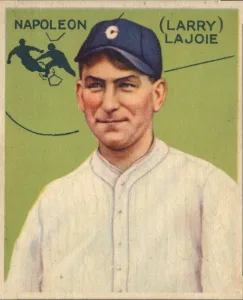
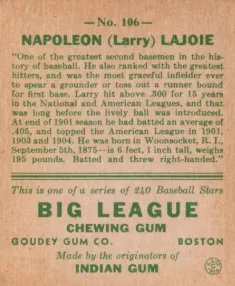
That combination is probably the cleanest way to explain the card to somebody seeing it for the first time. Goudey was not creating another regular 1934 checklist card. It was filling the hole left in the previous year’s set.
This is why calling it simply a “1934 card” loses part of the story, while claiming it was physically printed in 1933 is inaccurate.
A “1933 Goudey” Card Made in 1934
Two statements that sound contradictory are both correct:
- Nap Lajoie #106 belongs to the 1933 Goudey set.
- Goudey physically produced and distributed the card in 1934.
Collectors and catalogues identify it by the checklist it completes. Production chronology answers a different question.
Remember that distinction. It becomes useful again once we get to the $3 reprints.
Why Nap Lajoie?
Napoleon “Larry” Lajoie had been retired from Major League Baseball for years by the time Goudey printed #106, but he was hardly an obscure old player.
The National Baseball Hall of Fame credits him with one of the great offensive seasons of the early American League. In 1901 he won the Triple Crown while batting .426, with 14 home runs and 125 RBI. He finished his major-league career with a .338 batting average and 3,243 hits.
His connection with Cleveland was so strong that the club became known as the “Naps.” Lajoie later entered the Hall of Fame in 1937.
Goudey’s 1933 set already mixed contemporary players with important names from baseball’s past, so using a retired star was not strange in itself.
What remains unknown is why Goudey chose Lajoie specifically to fill #106. PSA has also noted the mystery. His stature makes the choice easy to understand in hindsight, but that is context, not documentary proof of Goudey’s reasoning.
The Paper Clip That Became Part of the Story
Mailing a card worth five or six figures sounds like an event today.
In 1934 it was customer correspondence.
PSA states that many Lajoie #106 cards were mailed with a paper clip attached. The clip could leave an impression on the surface and, in some examples, contribute to the small wrinkles collectors sometimes call spider wrinkles.
That little office-supply detail survived alongside the card.
It should not be turned into an authentication trick. A paper-clip impression does not prove that a card is genuine, and an original without one is not automatically suspicious.
It does explain why a particular type of damage turns up on some authentic examples.
How Rare Is an Authentic Lajoie #106?
Rare enough that there is no good reason to manufacture a dramatic survivor count.
As of August 14, 2026, PSA’s live CardFacts data lists no Gem Mint 10 examples and shows nine PSA Mint 9s and eight PSA NM-MT 8s. PSA also lists populations across a range of lower grades and authenticated examples.
Separately, SGC’s official 1933 Goudey population report lists 46 grading entries for #106.
Those numbers should remain separate.
A grading-company population is not the same thing as a census of every card that exists. Resubmissions, crossovers, cards graded by other companies and raw examples complicate any attempt to convert pop-report data into an exact surviving population.
So you will not see “only X copies exist” here.
What the grading data does confirm is that authentic examples are scarce across a market where demand for the missing card is exceptionally strong.
For a card at this value level, professional authentication should be treated as part of the transaction. The holder deserves scrutiny too. Cards Mania’s investigation into forged PSA labels and certification fraud explains why a certification number should be verified directly rather than trusting the plastic on sight.
What Is a Real Nap Lajoie #106 Worth?
There is no useful single-number answer.
Condition, grade, eye appeal, surface problems, centering, provenance, auction timing and bidder competition can all move the result. Recent completed auctions illustrate the range better than an asking-price screenshot.
| Grade | Grader | Sale Date | Auction House | Realized Price |
|---|---|---|---|---|
| Poor 1 | PSA | July 11, 2026 | Heritage Auctions | $47,580 |
| EX 5 | PSA | December 7, 2025 | Robert Edward Auctions | $159,900 |
| NM-MT 8 | PSA | August 25, 2024 | Heritage Auctions | $180,000 |
These are completed auction results, not current asking prices. The figures above use the sold totals displayed by the auction houses. Past sales do not guarantee future prices.
The July 2026 sale is especially useful because the card was graded PSA Poor 1 and still realized $47,580.
A low technical grade does not make an authentic #106 ordinary.
The PSA 5 result is interesting for a different reason. REA reported $159,900 in December 2025, substantially above some earlier sales in comparable numerical grades. That is a reminder that grade is only one part of a vintage-card auction result.
Transaction costs matter as well. Buyer’s premiums, seller commissions, taxes, insurance and shipping all affect the economics on either side of a sale.
See current graded Nap Lajoie #106 listings on eBay
Current marketplace listings are asking prices unless a completed sale is specifically identified.
Why Can I Find a “1933 Goudey Lajoie #106” for Under $20?
Because inexpensive examples are generally later reprints or reproductions of #106, not authentic Goudey-issued originals.
A fresh eBay check on August 14, 2026 found clearly identified reprints at ordinary collecting-money prices.
Examples included a 1987 Hygrade Famous Reprints Lajoie at $1.79, another Hygrade listing at $2.49, a 1983 Galasso reprint at $3.00, a 1987 Hygrade example at $3.70 and various Galasso listings below $10. Other reproduction listings appeared around the same general range.
Those are current asking prices. They are not completed-sale evidence for the original card.
More importantly, many of the titles themselves explain the apparent contradiction:
1983 Galasso 1933 Goudey Reprint #106 Nap Lajoie.
The card is from 1983.
“1933 Goudey” identifies the design and original set being reproduced.
There is nothing inherently dishonest about that wording when “reprint” is stated clearly.
Marketplace Metadata Can Make It More Confusing
One current eBay listing is a particularly good example of why new collectors should read more than one field.
Its title begins with “REPRINT 1933 Goudey Nap Lajoie #106.”
That part is clear.
But the item specifics simultaneously identify the set as “1933 Goudey Gum” and contain an “Original/Licensed Reprint” field marked “Original.”
Those fields contradict the title.
That does not automatically prove fraud. Marketplace metadata can be entered incorrectly, generated from product catalogues or simply handled badly. It does prove that the information box underneath an eBay listing should not be treated like a grading-company authentication record.
Read the title. Read the description. Look at the front and back. Check the listed manufacturing year. Ask the seller if necessary.
If serious money is involved, verify independently.
Why Do Modern Reprints Still Say “1933 Goudey”?
This is the second date problem surrounding #106.
The genuine card can legitimately be called “1933 Goudey” even though Goudey printed it in 1934 because it completes the 1933 set.
A reproduction made in 1983 can also contain “1933 Goudey” in its name because it reproduces the 1933 Goudey design.
Same words. Completely different reasons.
- Original #106: belongs to the 1933 Goudey checklist but was physically made in 1934.
- 1983 Galasso reprint: physically made in 1983 and reproduces the 1933 Goudey card.
- 1987 Hygrade reprint: physically made in 1987 and reproduces the famous Goudey design.
The question that clears up most confusion is simple:
When was this particular piece of cardboard manufactured?
Original vs Reprint: What Can You Actually Check?
Start with the easy things, but do not mistake them for a complete authentication system.
PSA lists the original Goudey cards at approximately 2 3/8 by 2 7/8 inches.
One current reproduction listing checked during this research openly lists its dimensions as 2.5 by 3 inches. That particular example can be ruled out quickly by size.
Other reproductions may be much closer.
| What to Check | Authentic Original | Later Reprint or Reproduction | The Catch |
|---|---|---|---|
| Dimensions | Approximately 2 3/8 by 2 7/8 inches | Some later copies use different dimensions | A reproduction can be made at the correct size |
| Front design | Period 1934-style Goudey presentation | May copy the design closely | Artwork alone does not prove age |
| Back | 1933-style reverse numbered #106 | Some reprints identify a later maker or reprint issue | Others reproduce the original reverse |
| Card stock and printing | Period materials and printing characteristics | Modern stock or printing may differ | Photos can hide useful details |
| Wear | May show genuine age and handling | Can be artificially aged | Old-looking is not proof of old age |
| Paper-clip impression | Seen on some originals because of the mailing method | Can be absent, copied or artificially created | Never use it as a stand-alone authentication test |
| Professional authentication | Established third-party authentication materially reduces uncertainty | A reprint may also be encapsulated and identified as a reprint | Verify the holder and certification number too |
The original-versus-reprint problem cannot safely be reduced to “check this one thing.”
A potentially genuine raw #106 can represent tens of thousands of dollars. That is exactly the wrong situation in which to rely on somebody’s five-point Facebook authentication checklist.
If there is a realistic chance the card is original, professional authentication is the sensible next step before original-card money changes hands.
Once you own a serious vintage card, storage becomes less theoretical too. Cards Mania’s long-term trading-card storage guide covers light exposure, humidity, sleeves, holders and shipping protection.
Is a Cheap Lajoie #106 Reprint Worth Owning?
As a substitute for an authentic Goudey-issued #106, no.
It is a different object with a different history and a completely different market value.
As a cheap collectible? Absolutely.
A $2 or $5 reprint lets you put the famous design in a binder, study the card without a slab between you and the artwork, and own a physical reminder of one of the strangest checklist stories in baseball cards.
A 1983 Galasso or 1987 Hygrade copy can be fun precisely because nobody has to pretend it is the original.
Buy it because you like Lajoie. Buy it because you collect famous designs. Buy it because explaining why your “1933 Goudey” card was printed in 1987 is an unusually efficient way to confuse somebody at a card show.
Just buy it as a reprint.
Its case for ownership is enjoyment, not the hope that cheap reproduction cardboard somehow becomes a substitute investment for the real #106.
See current Nap Lajoie #106 reprints on eBay
Buying a Lajoie #106: Four Very Different Situations
Professionally Graded Authentic Original
This is the cleanest route for a serious purchase. Use an established grading company, verify the certification number on the grader’s own website and examine the actual card rather than buying the number on the label.
For major purchases, a reputable vintage auction house or established dealer also gives you a clearer trail of provenance and transaction history.
Raw Card Represented as Original
Slow down.
Ask for high-resolution front and back photographs, exact dimensions and whatever provenance the owner can provide. None of those things replaces authentication.
A suspiciously low price does not prove you found the estate-sale miracle everybody else missed. It may simply prove that the seller owns a suspiciously low-priced card.
Clearly Identified Reprint
This is the easy version.
Check which reprint it is, make sure the price makes sense for a later reproduction and decide whether you want it. Current Galasso and Hygrade examples show that recognizable later versions can be collected for very little money.
Ambiguous Reproduction
If the listing keeps shouting “1933” but never clearly explains when the physical card was made, ask.
If the answer remains vague, either walk away or pay only what you would be comfortable paying for a reproduction.
Missing a cheap card hurts considerably less than discovering that the expensive “original” you bought was printed while Ronald Reagan was president.
The Missing Card That Finished the Set
Nap Lajoie #106 occupies a strange little corner even by pre-war-card standards.
It belongs to a 1933 set but was printed in 1934. Its front looks like 1934 Goudey while its back was built to repair the 1933 checklist. Collectors could not pull it from the packs they were trying to complete. They had to contact Goudey and wait for the mail. Some surviving examples apparently still carry marks from the paper clips used in that correspondence.
Then the same date problem resurfaced decades later.
Modern reprints kept “1933 Goudey” in their names because that is the card they reproduce. So a marketplace can now show a $3 “1933 Goudey Nap Lajoie #106” near records of genuine examples selling for tens or hundreds of thousands of dollars.
There is no contradiction once the cardboard gets a date of its own.
The genuine card was made in 1934.
A Galasso reprint may have been made in 1983.
A Hygrade reprint may have been made in 1987.
“1933 Goudey” tells you what card or set you are dealing with. It does not, by itself, authenticate the age of the object in front of you.
If missing issues and cards that escaped normal distribution are your kind of rabbit hole, Cards Mania’s Lost Topps Sets article follows several other releases collectors could not simply walk into a store and buy.
Sources and Research
Historical claims, population information and auction results were checked against institutional, grading-company and major auction sources. eBay marketplace observations were refreshed on August 14, 2026.
- PSA CardFacts: 1933 Goudey set profile
- PSA CardFacts: Napoleon Lajoie #106
- PSA: 1933 Goudey production and #106 research
- PSA: 1934 Goudey production sheets and Lajoie #106
- Robert Edward Auctions: 1933 Goudey uncut production sheet
- National Baseball Hall of Fame: Nap Lajoie biography
- National Baseball Hall of Fame: Lajoie #106 mailing story
- SGC Population Report: 1933 Goudey
- Heritage Auctions: PSA 1 Lajoie sale, July 11, 2026
- Robert Edward Auctions: PSA 5 Lajoie sale, Fall 2025
- Heritage Auctions: PSA 8 Lajoie sale, August 25, 2024
A weekly card rundown is coming
Market movers, set drops, and what is worth watching. Sign-ups open soon — the guides stay free either way.

Cards Mania Editorial Team
Cards Mania is an independent trading card media project covering sports cards, Pokémon, TCG, vintage cards, grading, collecting, card storage and hobby news. Articles are produced by the Cards Mania Editorial Team.
Related reads
Find The Reggie: The 1990 Upper Deck Reggie Jackson Autograph Story
In 1990, Upper Deck hid 2,500 hand-numbered Reggie Jackson autographs inside High Series packs and told collectors to Find The Reggie. The…
Read more →
Did Topps Really Dump Millions of 1952 Baseball Cards Into the Ocean?
Sy Berger said Topps sent hundreds of cases of unwanted 1952 high-number baseball cards into the Atlantic, including cards from the series…
Read more →
1985 Topps Gary Pettis Error Card #497: The Full Story
The 1985 Topps Gary Pettis #497 does not show Gary Pettis. It pictures his 14-year-old brother Lynn, photographed during an Angels Family…
Read more →