
Are Trading Cards Overprinted? A Collector’s Supply Test
 Cards Mania Editorial Team
·
·
8 min read
Cards Mania Editorial Team
·
·
8 min read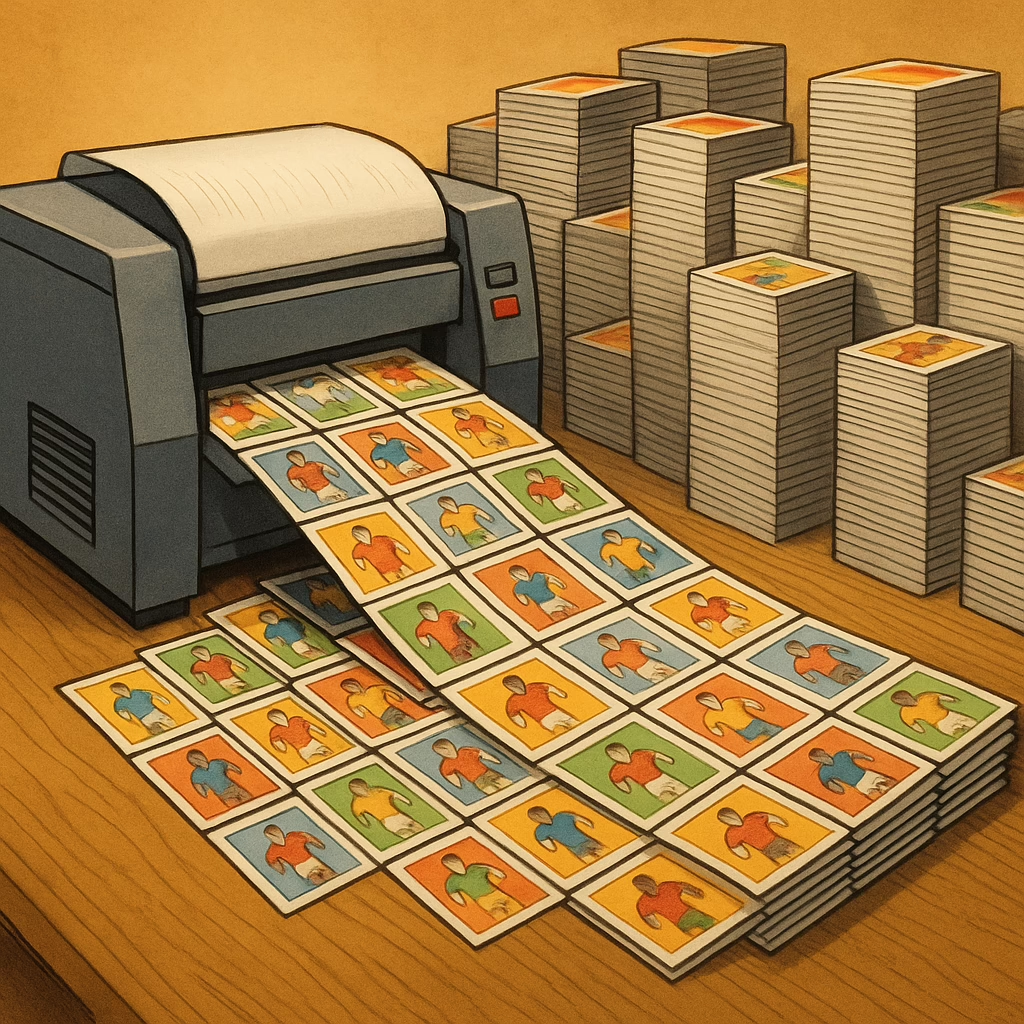
Updated August 16, 2026. Rechecked against current product configurations, published odds and the limits of grading-population data.
Collectors are right to ask whether modern trading cards are being overprinted. The honest answer is not a market-wide yes or no. Manufacturers rarely publish total production for unnumbered cards, and a fast sellout tells us little about the full print run. Supply has to be judged product by product.
What overprinting actually means
A product is not overprinted merely because the manufacturer made more of it than last year. It is overprinted when supply is persistently too large for collector demand at the offered price. That can appear in several places:
- base cards have almost no resale market even for popular players;
- sealed boxes remain widely available after the initial release window;
- frequent discounts replace early sellouts;
- new parallel families make older versions harder to distinguish;
- the checklist grows faster than the number of collectors trying to complete it;
- case hits and autographs become the only cards carrying meaningful demand.
None of those signals proves overproduction alone. A weak rookie class, high box price, poor design, license change or general drop in demand can create the same symptoms. The useful question is whether supply and price make sense for that exact release.
Three kinds of scarcity collectors confuse
| Scarcity type | What it means | Collector takeaway |
|---|---|---|
| Launch scarcity | The first online allocation sells quickly | More stock may still appear through other channels or later waves |
| Channel scarcity | A product is hard to find at one retailer, region or price | Check hobby stores, retail, distributors and secondary markets separately |
| Production scarcity | Few copies were made across all channels | This requires production evidence, not just a sold-out button |
Why total print runs are difficult to prove
Modern checklists mix base cards, inserts, autographs, unnumbered parallels and serial-numbered cards across hobby, retail, jumbo, mega, value and online-exclusive formats. A manufacturer may publish the checklist and pack odds without publishing the total number of packs.
Topps currently provides downloadable checklists and odds for many releases, including its official 2026 Topps Tribute Baseball product page. Those files are useful evidence, but an odds sheet is not automatically a total print-run statement. To estimate production, a collector needs a known card count, the stated odds, the relevant pack configuration and confidence that the odds cover the full distribution channel being measured.
Seven checks for modern card supply
| Check | What it can tell you | What it cannot prove |
|---|---|---|
| Published pack odds | How often a listed insert or parallel should appear in a named format | Total production without enough information about packs and distribution |
| Serial-numbered cards | The maximum copies of that exact numbered card | Scarcity of the player across every other parallel and product |
| Checklist and parallel count | How fragmented the chase has become | Demand for each design or player |
| Format count | How many hobby, retail and exclusive configurations compete for buyers | How much of each format was made |
| Completed sales | Prices at which buyers actually transacted | Unsold inventory or private sales |
| Retail availability over time | Whether supply remains easy to buy after launch | The manufacturer’s total print run |
| Grading populations | How many examples one grader has recorded by grade | How many copies were printed or still exist |
A sellout does not prove scarcity
Release-day inventory is only one slice of a product’s supply. A manufacturer can release a limited allocation on its own site while other boxes are reserved for distributors, hobby stores, retailers, breakers or later waves. A product can therefore sell out in minutes and still have a large overall print run.
Demand can also be concentrated. Buyers arrive at the same announced time, automated tools may add pressure, and breakers can absorb multiple cases. Social video turns the first wave into an event. The sellout proves that the initial offer met enough demand at that moment. It does not reveal how many boxes exist in total.
Live commerce matters because it converts sealed boxes into entertainment and individual team or player spots. If you use Whatnot, compare the full cost of a break spot with the cards you could buy directly. Do not assume a busy stream proves the sealed product is scarce.
Numbered cards can be scarce while the product is crowded
A card stamped 17/25 has no more than 25 copies of that exact version. That is real edition scarcity. It does not mean there are only 25 comparable cards of the player. The same checklist may include versions numbered to 50, 75, 99, 199 and more, plus unnumbered color parallels, image variations, inserts and autographs.
Collectors should measure both exact scarcity and substitute supply. Ask how many visually similar cards of the same player appear in the set, across other formats and across the year’s other releases. A rare serial stamp matters most when collectors also care about that specific design.
PSA population is not a print run
A PSA Population Report counts cards recorded by PSA, broken down by issue and grade. It does not count raw cards, cards graded elsewhere, rejected submissions or copies that have never been submitted. PSA itself warns that low population can reflect low submission demand rather than true scarcity in its guide to putting population data in context.
Grading also does not reduce the number of cards printed. It sorts submitted examples by condition and can reveal a condition rarity, such as a card that is unusually difficult in Gem Mint grade. That is different from production rarity.
Is this another Junk Wax Era?
The comparison is useful as a warning, but it should not be treated as a diagnosis. Late 1980s and early 1990s sports-card supply was enormous, much of it unnumbered, while collectors and speculators stored unopened material in quantity. Many once-common cards remain common because so many survived.
Today’s market has features that did not operate in the same way then: serial numbering, product-specific odds, third-party population reports, online completed-sale data and many narrowly divided formats. Those tools create more visibility around certain cards. They do not prevent oversupply. A manufacturer can keep each parallel technically limited while issuing enough parallels and products to overwhelm demand.
The better phrase is not “Junk Wax 2.0.” It is supply fragmentation. Collectors face more versions, more release channels and more decisions about which scarcity is meaningful.
Which categories are most at risk?
Risk follows product design and demand, not a sport by itself. Baseball can support many prospect products because its collector base values early-career cards. Basketball and football demand can shift sharply with a rookie class. Soccer demand is global but split across clubs, leagues, national teams and licenses. Trading card games have rotation, reprints and playability to consider.
Instead of declaring an entire sport overprinted, watch for this combination inside a release:
- a high box price built around a small number of chase cards;
- many parallel names with little visual difference;
- no published production total and odds that are hard to compare;
- weak completed sales for base cards and ordinary inserts;
- sealed supply that remains abundant after the launch rush;
- another similar product scheduled before collectors finish the current one.
What collectors should do before buying
- Download the checklist and odds. Count the cards you actually want and note which format can contain them.
- Compare completed sales. Listings show seller hopes. Completed sales show transactions.
- Add substitute supply. Count comparable versions of the same player, not only the serial number on one card.
- Wait past release week. A second wave or falling break prices can reveal how much supply is still available.
- Price the singles. If your goal is one player or insert, direct purchase is usually more predictable than opening boxes.
- Buy the product, not the panic. A sellout banner is not evidence that the box will appreciate.
Final verdict
Some modern releases are probably too large or too fragmented for their current demand, but there is no defensible single print-run verdict for every trading card category. The evidence is uneven, and manufacturers rarely publish the total numbers collectors want.
Treat supply as a product-level research problem. Published odds, serial numbers, checklist depth, completed sales and availability over several months tell a better story than a launch-day sellout. The safest collection is still one you would enjoy even if the price chart stayed flat.
Trading card overprinting FAQ
How can you tell if trading cards are overprinted?
Check published odds, checklist and parallel counts, completed sales, format count and sealed availability after release. No single signal proves overprinting.
Does a sold-out hobby box have a low print run?
Not necessarily. A sellout can reflect a limited launch allocation or concentrated demand while more stock remains with other channels or later waves.
Are numbered cards safe from overprinting?
The exact numbered version has a fixed cap, but many other parallels and products can create abundant substitute supply for the same player.
Does a PSA population show how many cards were printed?
No. It shows how many examples PSA has recorded by grade, not the total number produced, surviving or graded by other companies.
Are we in a new Junk Wax Era?
Some warning signs are familiar, but modern serial numbering, odds, varied formats and online sales data make the market different. Judge each product rather than the entire hobby.
Compare current sealed products and singles:
A weekly card rundown is coming
Market movers, set drops, and what is worth watching. Sign-ups open soon — the guides stay free either way.

Cards Mania Editorial Team
Cards Mania is an independent trading card media project covering sports cards, Pokémon, TCG, vintage cards, grading, collecting, card storage and hobby news. Articles are produced by the Cards Mania Editorial Team.
Related reads
What Is a Rookie Card? Meaning, Examples and Collector Value
A rookie card is generally one of an athlete’s first mainstream cards after reaching the top professional level, but licensing, set type…
Read more →
Black Lotus Card: Price, History, Rarity and Record Sales Explained
Black Lotus is Magic’s defining trophy card, led by the original Alpha, Beta and Unlimited printings. This guide covers print estimates, authenticity,…
Read more →
Digimon Trading Cards: The Complete Collector’s Guide (History, Value & Where to Buy)
Disclosure: This post contains affiliate links. If you purchase through them, we may earn a small commission at no extra cost to…
Read more →