
PSA Buyback Scandal: Who Grades the Grader?
 Cards Mania Editorial Team
·
·
11 min read
Cards Mania Editorial Team
·
·
11 min read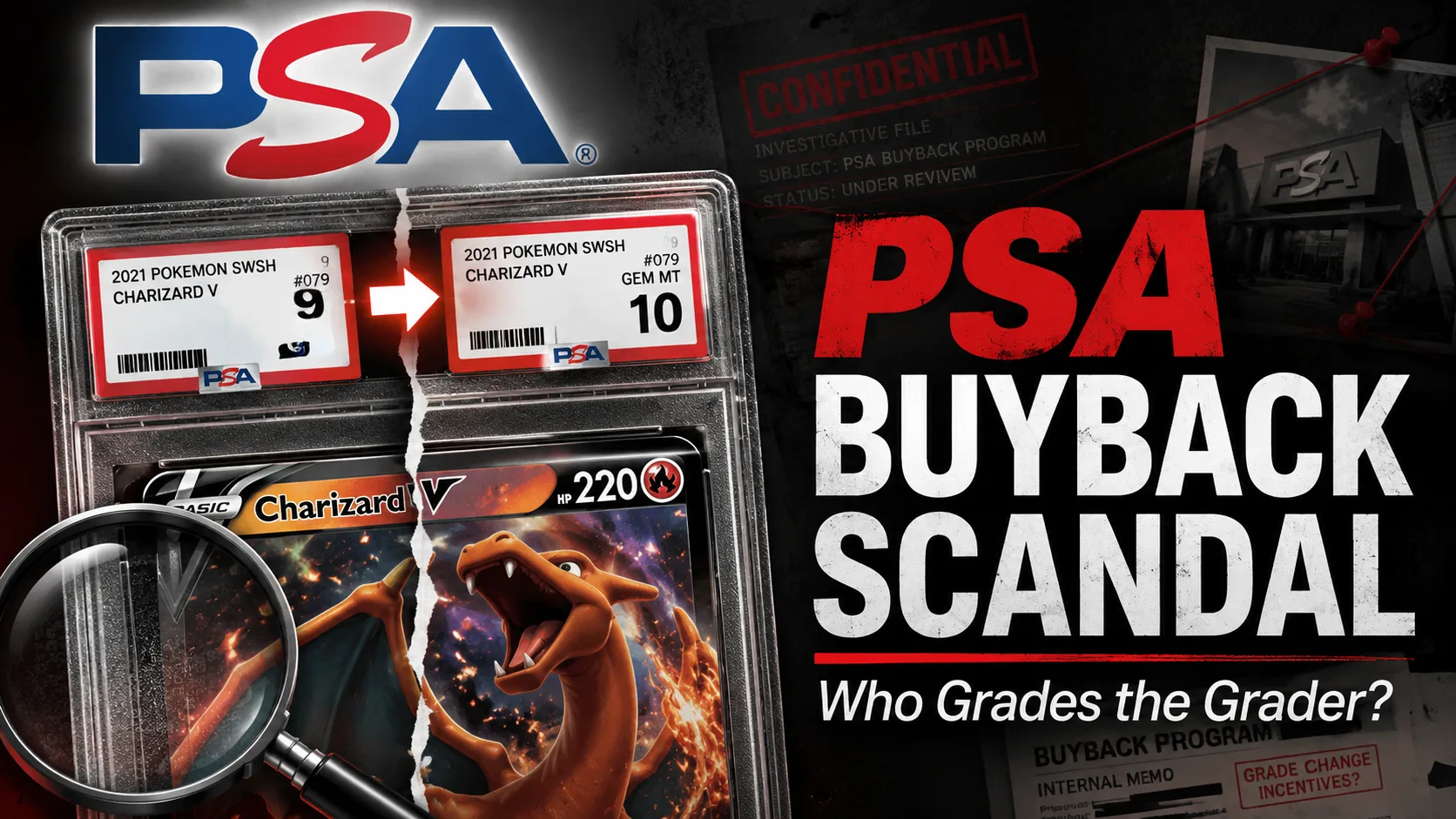
The PSA buyback scandal is the kind of hobby story that sounds almost too perfect for internet outrage: a big grading company, a mysterious grade change, a cash offer, and cards that reportedly moved from PSA 9 to PSA 10 after the original owner had accepted an offer.
If you collect graded cards, you already know why that matters. A PSA 9 and a PSA 10 are not just one number apart. In modern Pokémon, sports cards, and other liquid parts of the market, that difference can mean a small premium, a painful miss, or a very expensive “well, that aged badly.”
But this story needs precision. Based on the public record, this is not a proven fraud case. It does not prove that PSA intentionally undergraded cards. It does not prove that PSA itself bought the cards. It does not prove a secret machine where PSA 9s go in one side and profitable PSA 10s come out the other.
The stronger, more accurate version is this: the controversy exposed a serious trust problem inside a grading ecosystem where grading, vaulting, partner offers, market data, and resale tools are getting very close to each other.
Quick answer
The PSA buyback scandal refers to a controversy where cards reportedly graded as PSA 9s were connected to PSA-facilitated Partner Offers, and some of the same certification numbers later appeared as PSA 10s. The public record does not prove fraud, but it raises fair questions about transparency, conflicts of interest, and when a grade is truly final.
What actually happened?
The controversy started in hobby discussion and was later covered by Cardlines. The key claim was simple: a collector submitted modern cards to PSA, received PSA 9 grades on some of them, accepted cash offers through PSA’s offer system, and later saw several of the same certification numbers appear as PSA 10s.
That timing is the whole problem.
A grade changing is not automatically scandalous. Grading companies make mistakes. Labels can be corrected. Cards can be reviewed. Databases can show something that later needs fixing. Anyone who has dealt with grading long enough knows that “perfect system” is not exactly on the menu.
But when a grade appears to change after a sale decision, the mood changes quickly.
Imagine this: PSA tells you your card is a 9. An offer appears based on that reality. You accept. Then later, the same certification number appears as a 10. At that point, most collectors are not calmly saying, “Interesting operational ambiguity.”
They are asking the obvious question: who got the upside?
That question does not prove wrongdoing. But it is absolutely fair.
Why “buyback” is not quite the right word
The hobby calls this the PSA buyback scandal, so we are using that phrase too. It is what collectors search for, and it is now the common name of the controversy.
Still, the wording needs care.
PSA describes PSA Partner Offers as offers from buyers inside its trusted partner network, with PSA facilitating the sale. PSA’s own page says that once PSA confirms an accepted sale, the transaction is final and ownership transfers to a trusted buyer.
That means the sloppy version — “PSA bought PSA 9 cards and turned them into PSA 10s” — goes further than the public evidence supports.
The cleaner version is:
Cards connected to PSA-facilitated Partner Offers reportedly appeared later with higher PSA 10 grades.
Less dramatic? Yes. More accurate? Also yes. In a scandal article, accuracy is not decoration. It is armor.
Why collectors reacted so strongly
The reaction was not just about one collector’s batch. It hit a nerve because PSA is not just another company in the hobby. PSA labels help set prices. Auction titles shout “PSA 10” for a reason. Buyers pay premiums because they trust the number on the slab.
That trust is the product.
The plastic holder is just the packaging.
So when collectors see a situation where the number may have changed after the owner accepted an offer, they immediately start thinking about incentives. Who can request a review? Who sees the card after the offer? Who owns it at that moment? Does the original submitter ever get told if the card changes grade?
These are not wild conspiracy questions. They are basic questions about a high-value marketplace.
The modern card market has been moving toward convenience for years. Submit cards, grade them, vault them, track values, sell them, maybe never even hold them again. That is efficient. It is also a little strange when you stop and think about it.
A card can now move through an entire financial life inside one ecosystem.
That creates obvious benefits. It also creates obvious concerns.
The real issue is conflict of interest
The cleanest criticism of PSA here is not “they committed fraud.” That has not been proven.
The cleanest criticism is this: PSA needs stronger transparency around Partner Offers and post-grade changes.
Collectors should not have to rely on forum archaeology to understand what happened to a certification number. If a card changes from PSA 9 to PSA 10 after a sale, there should be a clear record of why that happened, when it happened, and under what process.
This is especially important because a grade is not just a collector opinion. It is a market signal.
A PSA 9 says one thing to buyers. A PSA 10 says something very different. Sometimes that difference has a comma in it.
For background on how card grading normally works, read our guide: How Are Trading Cards Graded?. For another example of why PSA trust matters, see How Forged PSA Labels Fueled a $2M Trading Card Scam.
The trust question now reaches beyond PSA’s own systems. Collectors, PSA’s parent company, also owns SGC and Beckett, and that consolidation is now being challenged in a federal proposed class action. We went through the complaint, the acquisition history and Collectors’ response in our report on the PSA, SGC and Beckett antitrust case.
Collector safety kit
If this scandal teaches anything practical, it is this: document your cards, protect your cards, and check values before accepting quick offers.
- Penny sleeves on Amazon
- Card savers for grading submissions on Amazon
- Toploaders on Amazon
- Magnifying loupes for card inspection on Amazon
Also useful: How to Store Trading Cards Long-Term and Essential Gear Every Trading Card Collector Needs.
This hobby has seen trust problems before
None of this happened in a vacuum. Collectibles markets have a long memory, even if collectors sometimes pretend they do not.
Bill Mastro and the T206 Wagner
The Bill Mastro case is one of the classic examples. Mastro, once a major figure in sports memorabilia, was sentenced to federal prison in a shill-bidding case. The U.S. Department of Justice said he placed fake bids to inflate auction prices and also sold altered memorabilia, including a T206 Honus Wagner card whose sides he had cut.
The damage was not just about one card. It was about confidence in the people who were supposed to protect the market.
PWCC and eBay
PWCC had its own major controversy when eBay restricted the company from selling on the platform in 2021 after alleging shill bidding connected to people associated with PWCC. PWCC denied wrongdoing, but the damage to collector confidence was real.
Wata, Heritage Auctions, and video games
The video game market had its own version with Wata and Heritage Auctions. Lawsuits alleged conflicts of interest and market manipulation. The companies denied wrongdoing. Different market, same uncomfortable theme: once grading and selling feel too close together, collectors start wondering whether the market is being measured or managed.
That is why the PSA buyback scandal landed so hard. It fits a pattern collectors already understand.
When insiders have too much influence, trust gets fragile.
What PSA should explain
PSA could calm a lot of this with plain-language answers.
Not corporate fog. Not “we take this seriously” followed by nothing useful. Actual answers.
Collectors need to know:
- When is a grade considered final?
- Can a card be reviewed after a Partner Offer appears?
- Can a card be reviewed after a Partner Offer is accepted?
- What happens if a sold card later changes grade?
- Does the original submitter get notified?
- Can Partner Offer buyers trigger reviews?
- Are grading operations separated from commercial offer activity?
- Is there a visible audit trail when a certification number changes grade?
That should not be controversial. If the walls exist, show the walls.
What collectors should do now
There is no need to panic-sell every PSA card like the slabs are cursed. PSA remains the dominant grading brand, and the market is not going to abandon PSA overnight because of one controversy.
But collectors should be less casual.
If you accept a PSA Partner Offer, screenshot everything: the grade reveal, certification number, offer amount, card images, submission page, and any confirmation screen. All of it.
That may sound excessive until a card changes status later and your only evidence is your memory and a bad mood.
Also, be careful with instant offers on cards that might have real PSA 10 upside. If you think a card is undergraded, do not rush just because a button makes selling easy. Convenience is wonderful until it quietly eats your margin.
Before accepting an offer, compare recent sales. Start with Card Ladder, search recent eBay sales, and check whether the PSA 10 premium is large enough to justify holding or reviewing the card.
The old rule still applies: buy the card, not just the label.
Maybe now we need a second rule: trust the slab, but document the process.
Check current market prices
Use these searches to compare PSA 9 vs PSA 10 values before accepting any quick offer. Do not treat asking prices as real value. Look for sold listings whenever possible.
- PSA 9 Pokémon sold listings on eBay
- PSA 10 Pokémon sold listings on eBay
- PSA 9 sports card sold listings on eBay
- PSA 10 sports card sold listings on eBay
Related Cards Mania guides: Rookie Cards Explained, How to Ship Trading Cards Safely, and Trading Card News: PSA Pulls the Plug on Cheap Grading.
So, was this really a scandal?
Yes, but not necessarily in the way some people online describe it.
This is not a proven case of fraud. It is not proof that PSA is secretly turning other people’s 9s into profitable 10s. Anyone saying that as fact is jumping further than the evidence allows.
But it is absolutely a scandal in the trust sense.
The grading market depends on confidence. Collectors need to believe that grades are independent, consistent, and not influenced by sale opportunities inside the same ecosystem. If that belief starts to crack, the whole premium around graded cards becomes harder to defend.
That is the real danger for PSA.
Not that every collector will believe the worst.
That collectors will start wondering how much of the process they actually understand.
Final thought
The PSA buyback scandal should not be treated as proof of a grand conspiracy.
It should be treated as a warning.
Modern card grading is no longer just about looking at corners, edges, centering, and surface. It is now tied to vaults, databases, partner offers, market tools, and resale systems. That makes the hobby faster and more liquid. It also means the companies running those systems need to be much more transparent.
Because when a card can be graded, offered, sold, reviewed, and upgraded inside the same broad ecosystem, collectors are right to ask one uncomfortable question:
Who is watching the people who grade the cards?
FAQ: PSA Buyback Scandal
What is the PSA buyback scandal?
The PSA buyback scandal refers to a controversy where cards reportedly graded as PSA 9s were connected to PSA-facilitated Partner Offers, and some of the same certification numbers later appeared as PSA 10s.
Did PSA commit proven fraud?
Based on the public information available, no proven fraud has been established. The stronger and safer conclusion is that the case exposed a serious transparency and conflict-of-interest problem.
Are PSA Partner Offers the same as PSA buying your cards?
Not exactly. PSA describes Partner Offers as offers from buyers in its trusted partner network, with PSA facilitating the sale.
Why does a PSA 9 to PSA 10 change matter?
Because the value difference between PSA 9 and PSA 10 can be large, especially in modern Pokémon and sports cards. A grade change after a sale decision can shift financial upside away from the original owner.
What should collectors do before accepting PSA Partner Offers?
Screenshot the grade reveal, certification number, offer amount, card images, and confirmation screens. Then compare recent PSA 9 and PSA 10 sold prices before accepting.
Sources and further reading
“datePublished”: “2026-06-25T09:00:00-04:00”,
“dateModified”: “2026-06-25T09:00:00-04:00”,
A weekly card rundown is coming
Market movers, set drops, and what is worth watching. Sign-ups open soon — the guides stay free either way.

Cards Mania Editorial Team
Cards Mania is an independent trading card media project covering sports cards, Pokémon, TCG, vintage cards, grading, collecting, card storage and hobby news. Articles are produced by the Cards Mania Editorial Team.
Related reads
Trading Card News: Magic God Packs, Brady SSPs, and a $7,700 Mario
CARDS MANIA / WEEKLY · OCTOBER 3-9, 2026 New pack formats, familiar faces and a smaller grading queue lead this week's trading…
Read more →
Card Grading Access: 78 of 250 Markets Documented
Cards Mania documents market-specific grading access in at least 78 of 250 markets under a strict primary-source evidence standard—and explains what that…
Read more →
Trading Card News: $8 Million Flagg, a Record-Chasing Pikachu, and Beckett Hits Pause Again
Cooper Flagg’s $8.04 million debut patch, an $8.4 million Art Academy Pikachu, Beckett grading delays, new card releases and Upper Deck Moments.
Read more →