
Why Hobby Boxes Sell Out Before Release
 Cards Mania Editorial Team
·
·
7 min read
Cards Mania Editorial Team
·
·
7 min read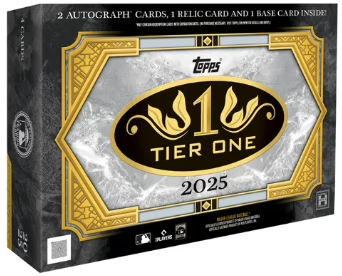
Updated August 16, 2026. Release times, pack odds, prices and channel availability can change without notice. Check the live product page before buying.
Some hobby boxes sell out before release because several clocks now run at once: distributor and shop allocations, direct manufacturer drops, breaker presales and secondary-market listings. Demand can be real while the public print run remains unknown. A quick sellout proves that available inventory met eager buyers at that moment. It does not prove permanent scarcity.
Five mechanics behind a fast sellout
| Mechanic | What collectors see | What it does not prove |
|---|---|---|
| First-wave allocation | A shop receives fewer cases than requested | That no later inventory, distributor stock or retail format exists |
| Direct drop | A manufacturer page sells through quickly | That the entire print run was offered on that page |
| Breaker presale | Teams, divisions or packs sell before product release | That sealed boxes disappeared from every other channel |
| Chase-card attention | One autograph, patch or bounty dominates social media | That average box value rose with the headline |
| Secondary relisting | Boxes appear above the original price immediately | That buyers are paying those asking prices |
Fanatics and Topps changed the channel mix
Fanatics acquired Topps’ physical and digital trading-card business in January 2022. Fanatics already held long-term rights involving MLB, MLBPA, NBA, NBPA and NFLPA, although start dates and the products available under each license were not identical. The acquisition gave one group important manufacturing, licensing, direct-commerce, live-commerce and marketplace capabilities.
That does not mean every box bypasses local stores. Fanatics’ own acquisition announcement said Topps would keep a commitment to hobby shops. In 2026, Topps buyback programs still directed collectors to participating shops and authorized online retailers. The accurate picture is a mixed channel system, not “manufacturer online or nothing.”
Channel control matters because different pools can open and close at different times. A product may have inventory on Topps, at a local shop, with a large online retailer and inside live breaks at different prices. “Sold out” needs a location and timestamp.
Live breaks move demand earlier
Platforms such as Whatnot and Fanatics Live let sellers presell teams, players, divisions or random spots before a release. That shifts part of the buying decision from release day to the days or weeks before it. The box is also entertainment inventory: a breaker can sell many small positions to viewers who would not buy a full box.
This can absorb meaningful product volume, but public gross-merchandise figures for a whole platform are not sealed-box print-run data. They include many categories and measure transaction value, not company revenue. The older claim that Whatnot had “one billion dollars in sales” mixed those concepts.
If you use live breaks, read the updated Cards Mania Whatnot buyer guide. A fast-moving room can make a weak spot price feel urgent.
A million-dollar card can move boxes, but not box math
The Paul Skenes one-of-one MLB Debut Patch Autograph sold through Fanatics Collect for $1.11 million including buyer’s premium in March 2025. The sale attracted attention well beyond ordinary collectors. It is fair to say that a headline hit can intensify interest in the product that contains it.
It is not fair to use one realized price as the expected value of another unopened box. Once a one-of-one has been pulled, it is no longer available in sealed inventory. Even before the pull, its probability was spread across the product run. Box value still depends on the full checklist, pack odds, parallel structure, autograph quality and current singles market.
Sellout is not the same as low print run
Collectors often use “scarce” to describe three different things:
- Launch scarcity: not enough boxes are available at the first public drop.
- Channel scarcity: one shop or platform is out while another still has stock.
- Production scarcity: the manufacturer made relatively few boxes in total.
Only the third statement describes the complete print run, and that figure is often unpublished. Serial-numbered cards and published pack odds can help estimate minimum production for a particular configuration, but estimates require assumptions about parallel insertion, formats and replacement inventory. Do not present them as audited totals.
How to evaluate a hobby-box presale
- Confirm the exact configuration. Match year, brand, sport, hobby or jumbo label, packs per box and cards per pack.
- Read the official odds. Look beyond the guaranteed line. Check the entire autograph, parallel and short-print structure.
- Price the average checklist. A box contains far more ordinary outcomes than headline hits.
- Compare channels. Check the manufacturer, established shops, local stores and current secondary listings at the same moment.
- Read cancellation and return rules. Presales can be final, delayed or subject to allocation changes. Topps’ current store policy says hobby-box sales are generally final except in limited circumstances.
- Separate asking and sold prices. A relisted box at twice MSRP is not a comp until someone buys it.
- Set a maximum before the timer starts. A sellout screen should not change the budget.
- Check whether the chase is still live. Publicly pulled one-of-ones cannot still be inside unopened boxes.
Where should you buy?
| Channel | Potential advantage | Watch for |
|---|---|---|
| Manufacturer site | Clear product identity and official launch | Fast checkout, quantity limits and final-sale terms |
| Local hobby shop | Known seller, advice and community | Limited allocation and local price premium |
| Established online retailer | Broad inventory and shipping infrastructure | Presale allocation language and delivery date |
| Live-break platform | Lower entry price for one team or player | Binding bids, break format, shipping and poor spot economics |
| Secondary marketplace | Availability after the official drop | Seller history, resealed product risk and unsold asking prices |
If you receive sealed product or expensive pulls by mail, use the Cards Mania safe shipping guide. If a pull looks like a grading candidate, the AI card grading comparison explains where computer vision helps and where it does not.
Evidence and further reading
- Fanatics acquisition of Topps
- TechCrunch on the Fanatics Live launch
- Sacra’s Whatnot market analysis
- Reuters on the Skenes $1.11 million sale
- One market forecast, useful only with its segment definitions
- Topps official pack-odds library
- Topps store and return policies
Compare current hobby-box listings
- eBay sealed hobby-box search
- TCGplayer for sealed trading card products
- Whatnot for live listings and breaks
- eBay hobby-box listings
Hobby-box sellout FAQ
Why do hobby boxes sell out before release?
Fast sellouts usually combine limited first-wave inventory, shop or breaker allocations, direct manufacturer drops, presales and demand for a small number of chase cards. The mix varies by product, and a sold-out page does not reveal the full print run.
Does sold out mean a hobby box is rare?
No. It may show launch scarcity or a shortage in one channel. Production scarcity requires evidence about the total number of boxes, which manufacturers often do not publish.
Are hobby-box presales always cheaper?
No. Some products rise after release, while others fall once more inventory appears or early breaks reveal weak average value. Compare the exact configuration, official odds, checklist and current sold prices before committing.
Do breakers cause hobby boxes to sell out?
Breakers can absorb meaningful volume and move demand into the presale window, but they are only one channel. Manufacturer allocation, shop demand, direct sales, print-run choices and secondary buyers also affect availability.
When is buying singles better than buying a box?
Singles are usually the clearer choice when you want one player or card, the box price is driven by a tiny chase, or the likely cards do not justify the entertainment cost. Buy a box only if the opening experience fits the budget even with an ordinary result.
Bottom line: buy the configuration and odds, not the countdown clock. A box can sell out quickly and still become cheaper later. The safest decision uses a fixed budget, a matched channel comparison and realistic expectations about the average box.
A weekly card rundown is coming
Market movers, set drops, and what is worth watching. Sign-ups open soon — the guides stay free either way.

Cards Mania Editorial Team
Cards Mania is an independent trading card media project covering sports cards, Pokémon, TCG, vintage cards, grading, collecting, card storage and hobby news. Articles are produced by the Cards Mania Editorial Team.
Related reads
What Is a Rookie Card? Meaning, Examples and Collector Value
A rookie card is generally one of an athlete’s first mainstream cards after reaching the top professional level, but licensing, set type…
Read more →
Black Lotus Card: Price, History, Rarity and Record Sales Explained
Black Lotus is Magic’s defining trophy card, led by the original Alpha, Beta and Unlimited printings. This guide covers print estimates, authenticity,…
Read more →
Digimon Trading Cards: The Complete Collector’s Guide (History, Value & Where to Buy)
Disclosure: This post contains affiliate links. If you purchase through them, we may earn a small commission at no extra cost to…
Read more →