
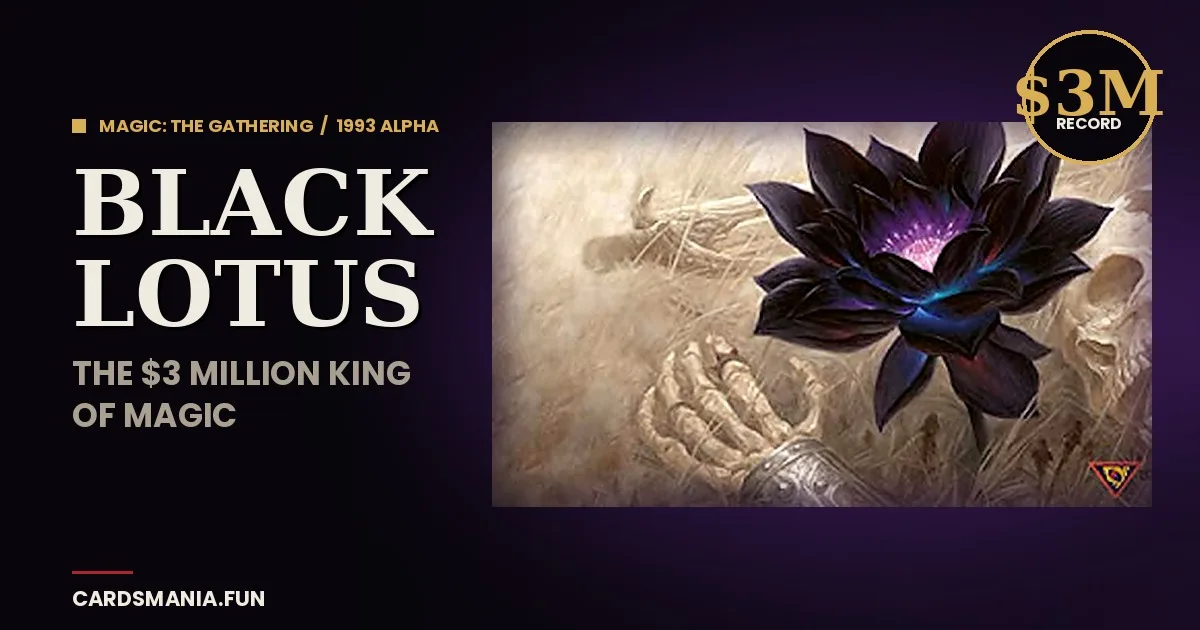
Quick answer: what is Black Lotus?
Black Lotus is one of the most iconic and valuable Magic: The Gathering cards ever printed. It originally appeared in the 1993 Alpha, Beta and Unlimited sets. Its value depends heavily on edition, condition, grading, authenticity and provenance.
- Original tournament-legal versions: Alpha, Beta and Unlimited.
- Most valuable version: Limited Edition Alpha, especially high-grade authenticated copies.
- Most expensive confirmed sale: $3,000,000 for a CGC Pristine 10 Alpha Black Lotus in April 2024.
- Why collectors chase it: tiny early supply, absurd gameplay power, Christopher Rush artwork and Reserved List protection.
- Current play status: restricted in Vintage, banned in Legacy and Commander.
Simple collector rule: Alpha is the trophy, Beta is the black-border alternative, and Unlimited is the most accessible original version. “Accessible” is doing Olympic-level stretching here, because even rough copies still cost serious money.
TL;DR — Black Lotus at a glance
- Record price: $3,000,000 paid in April 2024 for a CGC Pristine 10 Alpha Black Lotus, currently the highest confirmed price paid for any Magic: The Gathering card.
- Original 1993 printings: Alpha, Beta and Unlimited. The commonly cited collector estimate is roughly 22,800 to 22,900 original tournament-legal copies printed across all three.
- Why it stays expensive: tiny 1993 supply, iconic Christopher Rush artwork, extreme gameplay power, format bans or restrictions, and Wizards of the Coast’s Reserved List policy.
Three million dollars. For a single piece of cardboard from 1993. That actually happened in April 2024, and the wildest part? Nobody who collects Magic: The Gathering was even slightly surprised.
The card was an Alpha Black Lotus. The one card the entire hobby quietly measures itself against. Banned or restricted across major formats. Locked behind a list of cards Wizards has promised not to reprint in functional form. Printed during Magic’s first year, when nobody had any idea this game would become a global collecting economy.
So let’s get into it: what Black Lotus does, how many copies were printed, what the most expensive sale was, how Alpha differs from Beta and Unlimited, and what you need to know before even thinking about buying one. Yes, this is the part where your wallet starts breathing into a paper bag.

Black Lotus facts at a glance
- First set: Limited Edition Alpha, Magic: The Gathering, 1993
- Original tournament-legal versions: Alpha, Beta and Unlimited
- Artist: Christopher Rush (1965 to 2016)
- Estimated original print run: about 1,100 Alpha, about 3,200 to 3,300 Beta, and about 18,500 Unlimited copies
- Card type: Artifact, mana cost zero
- Effect: Sacrifice to add three mana of any one color
- Format status: restricted in Vintage, banned in Legacy and Commander
- Reserved List status: listed by Wizards of the Coast, meaning no functional reprint
- Record sale: $3,000,000 in April 2024 for a CGC Pristine 10 Alpha Black Lotus
What does Black Lotus do, and why did it break Magic?
Read the rules text and you will understand why the rest of the design team probably wishes they had a time machine.
Black Lotus costs zero mana. You play it for free. Then you sacrifice it to add three mana of any one color. That is the whole card. No paragraph of modern reminder text. No clever drawback. Just free acceleration with the subtlety of a brick through a tournament window.
It sounds small until you realize what it means. A Black Lotus on turn one can let a player cast spells several turns ahead of schedule. In old deck-building rules, players could run up to four copies, because in 1993 the developers honestly thought players would spend maybe thirty bucks total on the game. They were wrong by several orders of magnitude.
That is why Black Lotus is restricted in Vintage, meaning one copy per deck, and banned outright in Legacy and Commander. The card still appears in casual Old School Magic groups and collector showpieces, but most real copies live in display cases, graded slabs and safes with more security than a small bank branch.
How many Black Lotus cards exist?
No one knows the exact surviving number of Black Lotus cards. The better question is how many original tournament-legal copies were printed.
The commonly cited collector estimate is roughly 22,800 to 22,900 original Black Lotus cards across Alpha, Beta and Unlimited. That breaks down to about 1,100 Alpha copies, about 3,200 to 3,300 Beta copies, and about 18,500 Unlimited copies.
The surviving population is lower. Early Magic cards were played without sleeves, carried in rubber-banded stacks, traded by kids, spilled on, lost, bent, and generally treated like normal game pieces before anyone realized some of them would become five-, six- and seven-figure collectibles.
For collectors, the important distinction is this: printed does not mean surviving, and surviving does not mean collectible condition. A real Alpha Black Lotus in strong condition is a tiny corner of an already tiny market.
What is the most expensive Black Lotus sale?
The highest confirmed Black Lotus sale is $3,000,000, paid in April 2024 for a CGC Pristine 10 Alpha Black Lotus. The sale was handled privately through Pristine Collectibles and logged by Guinness World Records as the most expensive Magic: The Gathering card sold in a private sale.
That sale should not be treated as the normal price of every Black Lotus. It was an extreme trophy copy: Alpha, pristine grade, authenticated, record-level provenance and population-one CGC status at the time of the sale. In other words, not “grandma found one in the attic” pricing.
For more on how grading inflates value at this level, our card grading breakdown covers PSA, BGS and CGC and what each number actually means.
Black Lotus Alpha vs Beta vs Unlimited
Alpha, Beta and Unlimited are the three original tournament-legal Black Lotus printings. They use the same core card concept and Christopher Rush artwork, but collectors value them very differently.
| Version | Year | Border | Relative rarity | Collector note |
|---|---|---|---|---|
| Alpha | 1993 | Black border, noticeably rounded corners | Rarest original version | The trophy version. Highest demand, highest ceiling, record-sale territory in elite grades. |
| Beta | 1993 | Black border, sharper standard corners | Rarer than Unlimited, more available than Alpha | Often the smart black-border choice for collectors priced out of Alpha. |
| Unlimited | 1993 | White border | Most available original version | The entry point for original Black Lotus ownership, though still expensive. |
| Collector’s Edition / International Edition | 1993 | Gold border, square corners | Collector-only market | Not tournament legal. Valuable, but not valued like Alpha, Beta or Unlimited. |
| 30th Anniversary Edition | 2022 | Modern or retro frame, different card back | Commemorative reprint | Not tournament legal. Collectible, but not an original tournament-legal Black Lotus. |
If you are ever standing at a glass case eyeing one, look at the border first. White means Unlimited. Black with very rounded corners means Alpha, and probably a financial planner conversation. Black with sharper corners means Beta. We break down printing tells and version differences in our guide to trading card variations, parallels and SP value.
Black Lotus price in 2026: what should collectors expect?
Black Lotus prices move with condition, edition, grading company, eye appeal, signature provenance and whether the sale is public or private. There is no single “Black Lotus price.”
As a broad 2026 market snapshot, low-end original copies usually start in five figures, with Unlimited as the lowest original tournament-legal tier, Beta above that, and Alpha at the top. Current public marketplaces show Unlimited copies beginning around the low five-figure range, Beta copies often starting around the low-to-mid five figures, and Alpha copies starting far higher. Near Mint and professionally graded examples can move many multiples above those entry points.
That is why price guides should be treated as a starting point, not an appraisal. For a real purchase, compare recent sold listings, check grading population data, inspect provenance, and avoid using one record-breaking trophy sale as a value comp for a heavily played raw card.
👉 Check current Black Lotus listings and recent sales on eBay
Black Lotus price history
Black Lotus prices have climbed because the supply is fixed and the audience keeps expanding. The broad pattern looks like this:
- 1990s: early Magic collectors begin treating Black Lotus as the face of the Power Nine.
- 2013: an Alpha Black Lotus sale around $27,000 becomes a headline-grabbing number at the time.
- 2021: a PSA 10 Alpha Black Lotus with the case signed by Christopher Rush sells for $511,100.
- 2023: a PSA 10 Alpha Black Lotus sells through PWCC for $540,000.
- April 2024: a CGC Pristine 10 Alpha Black Lotus sells privately for $3,000,000.
The important price lesson is not that every Black Lotus is suddenly worth millions. It is that edition, grade and provenance control the price. A heavily played Unlimited copy and a pristine Alpha copy are both Black Lotus cards, but financially they live on different planets.
What is the Power Nine, and where does Black Lotus fit?
Black Lotus is not a solo act. It is the lead singer of a nine-card crew called the Power Nine, all from Magic’s first three core printings, all absurdly powerful, all banned or restricted basically everywhere. The full lineup:
- Black Lotus
- Ancestral Recall
- Time Walk
- Mox Pearl
- Mox Sapphire
- Mox Jet
- Mox Ruby
- Mox Emerald
- Timetwister
Every one of them was printed in Alpha, Beta and Unlimited. Every one of them sits on the Reserved List. Every one of them is worth serious money. Black Lotus just happens to be the one that breaks records, because it has the cleanest art, the simplest effect and the strongest myth around it.
For a deeper look at how the hobby grew up around cards like these, our complete history of trading cards walks through the moments that built today’s market.
Why does the Reserved List keep Black Lotus so expensive?
In 1996, Wizards of the Coast made what is probably the most consequential promise in the trading card industry. They put together a list of cards they would not reprint in functionally identical form. That list is called the Reserved List. Black Lotus is on it.
Why does that single policy matter so much? Because in most card games, the publisher can devalue a chase card overnight by reprinting it. With Reserved List MTG cards, that risk is limited by Wizards’ own policy. That artificial scarcity is a major reason a 1993 card can command five, six and sometimes seven figures.
The list is divisive inside the player base. Collectors tend to love it. Many players hate it, because it helps keep Vintage and Legacy staples behind a price wall most humans cannot climb. Wizards has reaffirmed the policy multiple times, and every reaffirmation reminds collectors that the original supply is fixed.
Why is Black Lotus banned or restricted?
Black Lotus is banned or restricted because it produces too much mana too early for no mana cost. In simple terms, it lets a player jump several turns ahead before the game has properly started.
In Vintage, Black Lotus is restricted, meaning a deck may use only one copy. In Legacy and Commander, it is banned. Commander also treats Power Nine cards as a barrier-to-entry problem: if the format appeared to require museum-grade cardboard just to sit down and play, casual tables would get weird fast.
That is also why modern Lotus-style cards get watched so closely. Fast mana is fun until the game ends before everyone has shuffled properly.
The Christopher Rush story
Christopher Rush was 28 when he painted Black Lotus for Magic’s first set. He had no idea he was about to create the most valuable piece of fantasy art in the trading card world. Nobody did.
Rush stayed close to the community for years. He signed cards for fans, attended events, and became one of the artists most closely associated with early Magic nostalgia. He died in 2016, at 50. From that day forward, every real Rush-signed Black Lotus became a finite resource. There will never be another newly signed copy.
That detail matters. Auctioneers and high-end sellers now flag Rush signatures and signature provenance because the premium is real. A signed card without reliable provenance, though, should be treated carefully. A signature can add value only when buyers trust it.

What are the modern alternatives to Black Lotus?
Wizards cannot print a tournament-legal functional Black Lotus reprint under its Reserved List policy. So instead, Magic has spent decades printing cards that echo the idea while staying somewhere closer to printable. A quick tour:
- Lotus Petal: Same family tree, but it adds one mana instead of three. It is far more reasonable, though still strong enough to matter in older formats.
- Jeweled Lotus: Released in Commander Legends in 2020. It added three mana, but only for casting your commander. Important update: it was banned in Commander in September 2024, so do not treat it as a current Commander staple.
- Blacker Lotus: A 1998 Unglued parody. It adds four mana, but you have to physically tear the card into pieces to use it. Magic at its most chaotic.
- 30th Anniversary Edition Black Lotus: A 2022 commemorative, non-tournament-legal version with a different card back. It is collectible, but it is not the same thing as an original Alpha, Beta or Unlimited Black Lotus.
For more on how Wizards keeps stretching the brand, see our pieces on the Sonic the Hedgehog Secret Lair drop and the Magic x Spider-Man avatar release.
How to identify a real Black Lotus
Black Lotus is one of the most counterfeited cards in the collectibles world. Fakes range from laughable printer-paper specials to dangerous high-end forgeries that need magnification, experience and comparison cards to detect.
Before buying, check the version, border, corner shape, printing pattern, card back and provenance. For any high-value copy, professional authentication is the sane route.
- Check the border: Alpha and Beta have black borders. Unlimited has a white border.
- Check the corners: Alpha corners are more rounded than Beta and Unlimited corners.
- Check the printing: real 1993 cards should show period-correct print patterns under magnification, not modern inkjet dots.
- Check the card back: the back, color tone and light behavior should match known authentic 1993 Magic cards.
- Check the seller story: vague provenance is not provenance. “Found in an old binder” is not an authentication method.
- Use grading for serious money: PSA, CGC or BGS authentication is strongly recommended before any major purchase.
Anything over $5,000 should be PSA, BGS or CGC graded before money changes hands. No exceptions, no romantic stories from the seller, no “I’d grade it but my dog ate the submission form.” For a real-world look at how forged grading slabs have actually been used in million-dollar scams, our writeup on forged PSA labels and the $2M card trade fraud is essential reading before any large purchase.
How should you store and protect a high-value Magic card?
Quick reality check. If you ever own a vintage MTG card worth four or five figures, day-one storage decisions help decide what it is worth in ten years. There are no shortcuts here.
- Penny sleeve plus semi-rigid: a fresh card sleeve and a Card Saver 1 style semi-rigid holder. Minimum standard for anything heading to a grading service.
- Magnetic one-touch holder: for raw cards on display, a UV-resistant Ultra Pro one-touch magnetic holder keeps the card flat, sealed and out of contact with finger oils.
- Graded slab storage: if the card is already graded, store the slab in a graded card storage box, out of direct sunlight, away from heat sources. If the value justifies it, use a serious safe.
- Climate control: stable temperature, 40 to 50 percent humidity. Garages and attics are death zones for vintage cards. Do not do it.
For a full breakdown of storage best practice, our trading card storage and shipping guide covers everything from penny sleeves up to vault-level setups.
Is Black Lotus actually a good investment in 2026?
Honest answer? Depends on which version, which grade, and who is asking. A few principles hold up across the available sales history:
Unlimited is the entry door, not the headline machine. The white-bordered Unlimited Black Lotus is usually the cheapest way to own an original tournament-legal copy. Buy it because you want a Black Lotus, not because you expect every Unlimited copy to behave like a pristine Alpha trophy.
Beta is the black-border middle ground. Beta sits between Unlimited and Alpha. It is rarer than Unlimited, more available than Alpha, and increasingly attractive to collectors who want black-border original Magic without paying the full Alpha premium.
Alpha is a trophy asset. A high-grade Alpha is not a normal card anymore. It competes with watches, comics, art and other hard-to-source collectibles. Liquidity exists at the top, but comps can be thin and private sales can distort public expectations.
Signed and artist-proof markets need extra care. Rush is gone, so authentic signed material is finite. That can create a premium, but only when authenticity and provenance are strong.
One thing applies to every grade: the trading card market is cyclical. Black Lotus is more resilient than most cards, but it is not immune to broader collectibles downturns. If you want an objective lens on card pricing, services like Card Ladder publish historical sales data the way stock charts do. Our TCGPlayer guide covers daily pricing for everything below the Reserved List trophy tier.
Could AI grading shake up the Black Lotus market?
Quick aside that matters if you are shopping at the top end. Grading companies are increasingly using technology-assisted authentication and imaging tools. For Reserved List cards like Black Lotus, that matters because high-end counterfeits are only getting better.
Machine vision can help check print patterns, ink behavior, edge wear and corner geometry against known authentic examples. It is not magic. It does not replace expertise. But it can make the authentication process harder to fool.
If you want to understand where that technology is heading, our breakdown of whether a robot can grade your cards better than you covers where AI grading is helping, where it is failing, and what to watch next.
Final word
Black Lotus is the perfect Magic card. Three lines of text. A painting that belongs on a fantasy novel cover. A print run so small it was already scarce by the mid-1990s. A company policy that protects it from functional reprint. Of course it costs $3 million at the top of the market. The surprise would be if it did not.
Whether you ever actually own one or just admire it through the glass at a card show, the card is worth understanding. It is the bedrock of MTG history. It is the loudest example of why supply caps matter in collectibles. And it is the reason the Reserved List remains one of the most important policy decisions Wizards of the Coast ever made.
Have you ever held a real Black Lotus in person? Would you actually crack a wallet-emptying deal on an Unlimited copy if it landed in front of you? Drop your take in the comments and let’s get into it. And if you want more deep dives in this lane, our piece on the full history of trading cards is the natural next stop.
Frequently asked questions about Black Lotus
Why is the Black Lotus card so expensive?
Black Lotus is expensive because several rare factors stack together: tiny early print runs, huge nostalgia, extreme gameplay power, Christopher Rush artwork, and Reserved List protection against functional reprints. It is also the most famous member of the Power Nine, which makes it the card many collectors use as the symbol of vintage Magic.
How much is a Black Lotus worth in 2026?
It depends on edition, condition, grade and provenance. Original tournament-legal copies usually start in the five-figure range, with Unlimited generally lowest, Beta higher, and Alpha highest. Elite graded Alpha copies can reach hundreds of thousands or more, with the current record at $3,000,000 for a CGC Pristine 10 Alpha Black Lotus sold in April 2024. Always check recent sold listings and professional price data before treating any number as current market value.
How many Black Lotus cards exist?
No one knows the exact surviving number. The commonly cited original print-run estimate is roughly 22,800 to 22,900 tournament-legal copies across Alpha, Beta and Unlimited. Many were lost, damaged or destroyed over the decades, so the surviving population in collectible condition is smaller.
How many Alpha Black Lotus cards exist?
Collectors commonly estimate that about 1,100 Alpha Black Lotus cards were printed. The number of surviving Alpha copies is lower and unknown. The number of high-grade authenticated Alpha copies is much smaller again.
Is Black Lotus banned in Magic: The Gathering?
Yes, in most major formats. Black Lotus is restricted in Vintage, meaning players may include only one copy. It is banned in Legacy and Commander.
Was Black Lotus ever reprinted?
Not in a tournament-legal functional form. Black Lotus appeared in non-tournament-legal collector products such as Collector’s Edition, International Edition and 30th Anniversary Edition, but those are not the same as Alpha, Beta or Unlimited tournament-legal originals.
How do I tell if a Black Lotus is real or fake?
Check the edition, border, corner radius, card back, printing pattern, light behavior and provenance. For any serious transaction, use professional authentication from PSA, CGC or BGS before money changes hands.
What is the difference between Alpha, Beta and Unlimited Black Lotus?
Alpha is the first and rarest version, with a black border and noticeably rounded corners. Beta is also black-bordered, but has sharper standard corners and a larger print run. Unlimited has a white border and is the most available original tournament-legal version.

Leave a Reply