
Would You Cut Up a Classic Spider-Man Comic for a 1/1 Card? Topps Did
 Cards Mania Editorial Team
·
·
14 min read
Cards Mania Editorial Team
·
·
14 min read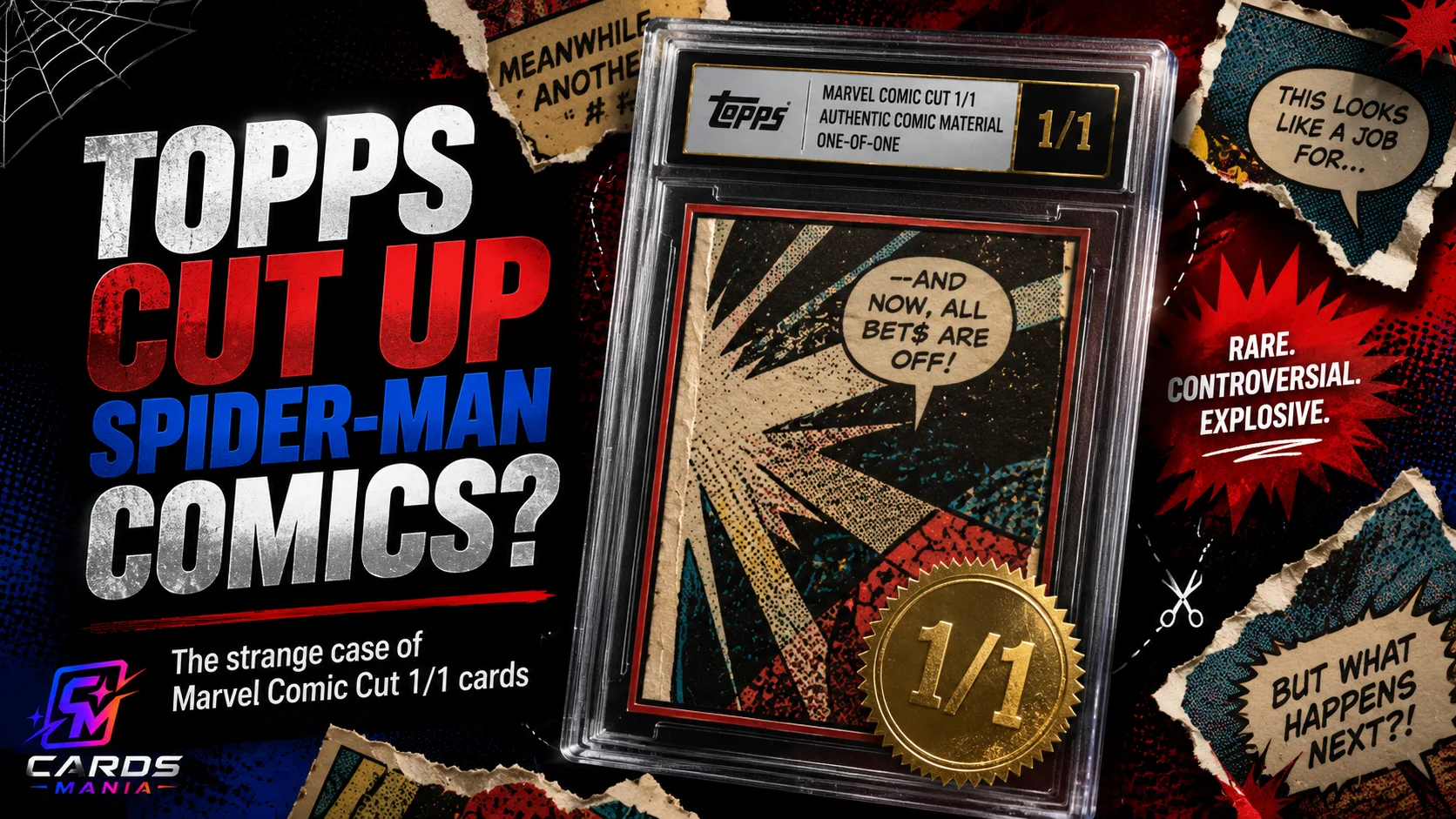
Research checked: August 27, 2026.
A comic collector sees a book that survived for decades and thinks it should stay that way. A card collector sees an authentic piece of Spider-Man comic history sealed inside a one-of-one trading card and starts wondering what the mortgage rate looks like.
Both reactions make sense.
That is what makes one of the strangest chase cards in 2026 Topps Mint Marvel much more interesting than another checklist entry.
The Hobby version of the product arrived on August 19, 2026, after collectors had already received an earlier look through a convention-exclusive San Diego Comic-Con release. Inside the set are Spider-Man Comic Cut relics tied to classic Marvel comic issues.
Topps names 15 specific source issues on its official checklist, including The Amazing Spider-Man #5, #16, #20, #100 and #101, alongside issues of Daredevil, Uncanny X-Men and Marvel Team-Up.
Topps also makes the scarcity claim unusually simple: the company describes the Spider-Man Comic Cuts as all 1-of-1s.
Quick answer: Yes, Topps really put pieces from Spider-Man comics into 2026 Mint Marvel trading cards. The official checklist identifies 15 issue-specific Comic Cuts, and Topps says every one is a 1/1. What the official Topps materials reviewed by Cards Mania do not disclose is the condition or completeness of the donor comics. That missing information is the difference between clever reuse of damaged material and the destruction of an intact collectible.
Topps Really Did Turn Comic Material Into 1/1 Spider-Man Cards
This is not a rumor created by a blurry breaker screenshot.
The official Topps Mint Marvel product page specifically promotes Spider-Man Comic Cut relics and states that they are all 1-of-1s.
The official 2026 Topps Mint Marvel checklist then identifies the comic associated with each card.
The official Topps odds sheet lists Spider-Man Comic Cuts at 1:67 in the Hobby SKU and 1:75 in the SDCC SKU.
Topps notes that its checklists and odds reflect the intended product configuration at the time of production, and that actual contents and odds may vary.
There is another important distinction. Topps identifies 15 source issues. It does not publicly state that exactly 15 complete comic books were cut apart, nor does it explain how many physical donor copies supplied the material.
Those are facts we simply do not have.
The 15 Comics Named on the Topps Checklist
This is where the story gets uncomfortable for comic collectors. Several of these are not random dollar-bin books. Some are important chapters in Spider-Man history.
| Topps card | Source issue | Why collectors care |
|---|---|---|
| CC-ASM5 | The Amazing Spider-Man #5 | A 1963 Stan Lee and Steve Ditko issue featuring an early Spider-Man battle with Doctor Doom. |
| CC-ASM16 | The Amazing Spider-Man #16 | A major early Spider-Man and Daredevil crossover from 1964. |
| CC-ASM20 | The Amazing Spider-Man #20 | First appearance of Mac Gargan as the Scorpion. |
| CC-DD16 | Daredevil #16 | A 1966 Spider-Man and Daredevil story featuring John Romita Sr. pencils. |
| CC-UXM35 | Uncanny X-Men #35 | A 1967 Spider-Man appearance alongside Marvel’s original-era X-Men. |
| CC-ASM100 | The Amazing Spider-Man #100 | The milestone 100th issue. Peter Parker’s attempt to remove his powers has a rather inconvenient side effect: four extra arms. |
| CC-ASM101 | The Amazing Spider-Man #101 | First appearance of Morbius the Living Vampire during the six-armed Spider-Man storyline. |
| CC-ASM134 | The Amazing Spider-Man #134 | First appearance of Tarantula, with Harry Osborn also learning Peter Parker’s secret. |
| CC-MTU27 | Marvel Team-Up #27 | A 1974 Spider-Man and Hulk confrontation. |
| CC-MTUA1 | Marvel Team-Up Annual #1 | One of the earliest appearances of the revived all-new, all-different X-Men. |
| CC-MTU43 | Marvel Team-Up #43 | Part of a storyline involving Spider-Man, Scarlet Witch, Doctor Doom and the Dark Rider. |
| CC-MTU53 | Marvel Team-Up #53 | A Bill Mantlo and John Byrne story involving Spider-Man, Hulk, Banshee and Woodgod. |
| CC-MTU54 | Marvel Team-Up #54 | Continuation of the Spider-Man, Hulk and Woodgod storyline. |
| CC-MTU150 | Marvel Team-Up #150 | Spider-Man joins the X-Men against Juggernaut in the final issue of the original series. |
| CC-ASM345 | The Amazing Spider-Man #345 | A key Venom-era issue in the chain of events that leads to Carnage. |
Source issues are taken directly from the official 2026 Topps Mint Marvel checklist. Historical notes were cross-checked against Marvel comic records and established comic reference sources.
The list stretches from Silver Age material all the way to Amazing Spider-Man #345 from 1991. That is why we prefer classic comics rather than pretending every source book fits neatly under one definition of “vintage.”
The Most Important Thing Topps Does Not Tell Us
Here is the question Cards Mania could not answer from the official Topps materials reviewed for this article:
What condition were the donor comics in before they were cut?
The Topps product page, checklist and odds sheet do not identify a comic grade, restoration status, completeness status, page quality or general condition of the donor copies. They do not tell us whether the books were high-grade, low-grade, incomplete, coverless, brittle, restored or already missing material.
That is not a minor technicality.
It is basically the entire collecting dilemma.
Imagine two copies of The Amazing Spider-Man #5.
One is complete, attractive and structurally sound. It survived from the early 1960s with its covers, story, advertisements and physical structure intact. Cutting that copy into fragments clearly reduces the surviving population of complete books.
The other is coverless, incomplete or severely damaged. It may have little appeal as a complete collectible, but surviving pages can still be historically interesting pieces of an old Marvel comic. Giving part of that material a new life inside a card is much easier to defend.
Those are completely different conservation stories.
Right now, the public information from Topps does not tell us which one applies.
Condition Can Change the Value by Thousands of Dollars
Recent completed comic auctions make the point much better than any theoretical price guide.
Take The Amazing Spider-Man #5.
Heritage Auctions recorded a coverless Poor copy at $79 in March 2026.
A CGC 4.0 copy reached $1,098 in July.
A CGC 9.2 copy reached $13,420 in April.
Same issue. Wildly different collectible.
| Comic | Condition | Heritage price realized | Heritage auction date |
|---|---|---|---|
| Amazing Spider-Man #5 | Coverless, Poor | $79.00 | Mar. 24, 2026 |
| Amazing Spider-Man #5 | CGC 4.0 | $1,098.00 | Jul. 21, 2026 |
| Amazing Spider-Man #5 | CGC 9.2 | $13,420.00 | Apr. 2, 2026 |
| Amazing Spider-Man #20 | Raw Good | $317.20 | Jul. 28, 2026 |
| Amazing Spider-Man #20 | CGC 8.0 | $2,074.00 | Aug. 4, 2026 |
| Amazing Spider-Man #101 | Raw VG | $189.10 | Aug. 4, 2026 |
| Amazing Spider-Man #101 | CGC 9.8 | $11,590.00 | Jul. 11, 2026 |
These are selected completed Heritage Auctions results, not estimates of the comics used by Topps and not predictions of future value. Heritage states that prices realized include the buyer’s premium where applicable. The dates shown follow Heritage’s issue-index auction records. Comic values can vary substantially according to grade, completeness, restoration, page quality, venue and timing.
This is why saying “Topps cut up a $13,000 comic” would be irresponsible.
There is no evidence that it did.
But it would be equally irresponsible to dismiss the issue by assuming Topps only used damaged reader copies.
We do not have evidence for that either.
Is It Destruction, Preservation or Just Collecting in a Different Form?
The comic collector’s argument
A complete comic is more than the sum of its panels. The cover, story pages, advertisements, letters pages, staples and physical sequence all belong to the object.
Once an intact surviving copy is divided into fragments, that specific comic no longer exists in its original form.
The card collector’s argument
The fragment is not necessarily thrown away or forgotten. It becomes a physical relic connected to a specific comic issue and protected inside a scarce trading card.
If the donor was already incomplete or badly damaged, the card might preserve material that otherwise had limited value as a complete collectible.
The argument becomes even stranger once the 1/1 stamp enters the equation.
The source issue may survive in hundreds or thousands of copies. The individual Topps card exists once.
Scarcity has effectively been created by taking material from an older collectible and placing it inside a new collectible with its own unique identity.
That does not automatically make the card more valuable than a complete comic. Markets do not work that neatly.
But it explains why a small comic fragment can attract collectors who would never pay the same amount for another ordinary copy of the source issue.
Topps Did Not Invent Comic Cut Cards
If this story makes you want to call the comic-book preservation police, there is an important twist.
The hobby has been doing this for about two decades.
CGC traces Marvel comic-cut trading cards back to 2006 Marvel: The Complete Avengers, which used oversized cards containing cuts from original comics.
Later examples appeared in products including 2011 Marvel Beginnings, 2020 Marvel Ages and 2021 X-Men Metal Universe.
Then came one of the most extreme examples.
For 2022 Spider-Man Metal Universe, Upper Deck produced only 15 comic-panel cards using original panels from a copy of Amazing Fantasy #15, the 1962 issue that introduced Spider-Man.
CGC subsequently certified examples from that run.
That means Topps did not invent the idea of turning pieces of historically significant comics into premium cards.
It did, however, bring the format directly into its new Mint Marvel identity.
And this was not Topps’s first attempt.
The debut 2025 Topps Mint Marvel release contained 200 unique Dr. Doom Comic Cut cards. Topps says each card incorporated an authentic comic panel and that every one was a true one-of-one.
That changes the context of the 2026 Spider-Man cards. Comic Cuts are not some random experiment hiding at the bottom of the checklist. They are becoming one of the defining premium features of Topps Mint Marvel.
That history also fits a much broader evolution in premium trading cards. Autographs, memorabilia, low serial numbers and unusual relic materials have steadily expanded the definition of what a trading card can be.
Our history of Upper Deck trading cards covers another major part of that transformation.
Topps Is Already Doing It in Another 2026 Marvel Set
Mint Marvel is not even the only current Topps product using Spider-Man comics this way.
2026 Topps Chrome Marvel Comics contains a 12-card Comic Excerpts Spider-Man subset.
Topps describes the cards as authentic comic-cut relics and identifies source books including:
- Web of Spider-Man #1
- Web of Spider-Man #32
- Amazing Spider-Man #48
- Amazing Spider-Man #55
- Amazing Spider-Man #258
- Amazing Spider-Man #299
- Amazing Spider-Man #329
- Amazing Spider-Man #375
Topps has already highlighted a one-of-one Amazing Spider-Man #329 Comic Excerpt among notable pulls from that release.
This is starting to look less like a novelty and more like a recognizable premium-card category.
The 1/1 Creates a Very Strange Kind of Value
A traditional comic collector values the object partly because it survived.
A Comic Cut collector may value the new card partly because the donor material has been transformed into something unique.
That is a fascinating reversal.
The finished card can combine several different forms of scarcity:
- the age or significance of the source comic;
- the specific piece of artwork or dialogue visible in the cut;
- the card design;
- the Spider-Man connection;
- and the 1/1 designation itself.
The exact panel could matter enormously.
A fragment showing Spider-Man, Doctor Doom, Morbius or a memorable speech balloon has very different eye appeal from a piece showing half a wall and someone’s elbow.
That sounds obvious, but it may become one of the biggest drivers of value among the 15 cards.
What Collectors Are Saying So Far
Because the Hobby release arrived only on August 19, direct discussion around the specific 2026 Mint Marvel Comic Cuts is still young.
There is no basis yet for pretending the comic world has launched some enormous organized rebellion against Topps.
What we can see is more interesting.
In an early discussion on the MarvelCards subreddit after a collector pulled a Mint comic-cut redemption, commenters immediately started debating the same questions that make these cards fascinating.
Why might a tiny one-of-one fragment be worth more than a complete copy of the comic?
Does the 1/1 label create meaningful scarcity?
How much does the actual panel matter?
One participant approached the subject from the comic-collecting side and questioned the economics of turning a comparatively inexpensive complete comic into a potentially much more expensive fragment card. Card collectors responded by pointing to uniqueness and the individual panel.
That discussion gets to the heart of the story.
The comic and the card are being valued under two different collecting systems.
What Topps Could Tell Collectors
There is a simple way to make products like this more interesting while reducing much of the preservation controversy.
Document the donor material.
Was the donor comic complete, incomplete, coverless, restored or heavily damaged?
Show collectors what the donor copy looked like before the relevant material became trading cards.
Identify the page or section of the comic that supplied the individual fragment.
A simple online provenance page or QR-linked database could permanently connect each 1/1 card to the material from which it came.
This would not satisfy everyone.
A preservation-minded collector may still object to cutting any complete Silver Age comic.
But transparency would let buyers distinguish between two very different scenarios: sacrificing a healthy collectible or finding a new use for material from a compromised one.
It would also make the card more interesting.
“Piece from Amazing Spider-Man #5″ is good.
“This fragment came from a documented incomplete donor copy, photographed before production and mapped to a specific page” is a much better story.
And collectors tend to remember stories.
Cards Mania Verdict
Would we cut apart a complete, collectible-grade copy of Amazing Spider-Man #5 simply to manufacture a new 1/1?
No.
The original comic is already a finite historical object. Creating new scarcity by destroying good existing scarcity is a difficult idea to love.
Would we use surviving pages from a coverless, incomplete or badly compromised donor copy?
That is much easier to defend.
In that scenario, the Comic Cut could function almost like adaptive reuse. A genuine surviving fragment is protected, given context and turned into something another collector wants to preserve.
The problem is simple.
From the official Topps information currently available, we do not know which scenario applies.
Until we do, the most interesting question about these 2026 Topps Mint Marvel cards is not:
What are the odds?
It is:
What had to stop being a comic so this card could exist?
Where to Find 2026 Topps Mint Marvel Cards
The product is still new, so secondary-market supply and prices can change quickly.
That matters even more with 1/1 Comic Cuts, where there may never be a directly comparable sale.
Browse 2026 Topps Mint Marvel on eBay
A five-figure eBay listing does not automatically make a card worth five figures. Asking prices tell us what a seller wants. Completed sales tell us what somebody actually paid.
For a one-of-one Comic Cut, the issue, visible panel, condition of the card, provenance, character content and actual buyer demand could all matter more than a generic “comp.”
Frequently Asked Questions
Are the 2026 Topps Mint Marvel Spider-Man Comic Cuts really 1/1?
Yes. Topps’s official product page describes the Spider-Man Comic Cut relics as all 1-of-1s. The official checklist identifies 15 issue-specific Comic Cut cards.
What are the odds of pulling a Spider-Man Comic Cut?
Topps’s published odds list Spider-Man Comic Cuts at 1:67 for the Hobby SKU and 1:75 for the SDCC SKU. Topps notes that its published odds represent the intended product configuration and actual contents and odds may vary.
Which comics did Topps use?
The official checklist includes comics from The Amazing Spider-Man, Daredevil, Uncanny X-Men, Marvel Team-Up and Marvel Team-Up Annual. The earliest listed source issue is Amazing Spider-Man #5, while the list extends through Amazing Spider-Man #345.
Did Topps cut up high-grade vintage comics?
We found no evidence in the official Topps materials reviewed for this article that establishes the condition or grade of the donor copies. Topps does not publicly identify them as high-grade, low-grade, incomplete, coverless, restored or damaged. Claims that pristine comics were sacrificed should therefore be treated as speculation unless additional evidence emerges.
Did Topps invent comic-cut trading cards?
No. CGC traces Marvel comic-cut cards back to the 2006 Marvel: The Complete Avengers set. Similar cards later appeared in other Marvel releases, and Upper Deck produced 15 panel cards using material from a copy of Amazing Fantasy #15 for 2022 Spider-Man Metal Universe.
Did Topps use Comic Cuts before 2026?
Yes. Topps says 2025 Mint Marvel contained 200 unique Dr. Doom Comic Cut cards. Each incorporated an authentic comic panel and was a true one-of-one.
Could a Comic Cut card be worth more than the complete comic?
Yes, but there is no universal rule. The comic and the card appeal to overlapping but different collector markets. The card may derive value from its 1/1 status, visual panel and demand among trading-card collectors, while a complete comic is valued according to factors including issue significance, condition and completeness.
Sources and Research Notes
Topps product information: 2026 Topps Mint Marvel official product page.
Official checklist: 2026 Topps Mint Marvel checklist.
Official odds: 2026 Topps Mint Marvel odds.
Release information: Beckett’s 2026 Topps Mint Marvel checklist and release guide.
2025 Dr. Doom Comic Cuts: Topps Ripped guide to 2025 Topps Mint Marvel.
Topps Mint Marvel history: Topps Mint Marvel product history.
Earlier comic-cut cards: CGC’s report on the Amazing Fantasy #15 Spider-Man Metal Universe comic-panel cards and the history of Marvel Comic Cuts.
2026 Chrome Marvel Comic Excerpts: Topps Ripped Comic Excerpts Spider-Man checklist and Topps’s report on notable 2026 Chrome Marvel pulls.
Comic market examples: Heritage Auctions results for Amazing Spider-Man #5, Amazing Spider-Man #20 and Amazing Spider-Man #101.
Collector discussion: early MarvelCards discussion of a 2026 Mint Marvel Comic Cut redemption. Reddit discussion is used only to illustrate collector reaction, not as a factual source for product specifications or market values.
More strange corners of the hobby: Browse the Cards Mania Vintage & Non-Sport Cards archive, read our history of Upper Deck trading cards, or discover Topps Hocus Focus, the self-developing cards that helped shape Topps’ early non-sport history.
A weekly card rundown is coming
Market movers, set drops, and what is worth watching. Sign-ups open soon — the guides stay free either way.

Cards Mania Editorial Team
Cards Mania is an independent trading card media project covering sports cards, Pokémon, TCG, vintage cards, grading, collecting, card storage and hobby news. Articles are produced by the Cards Mania Editorial Team.
Related reads
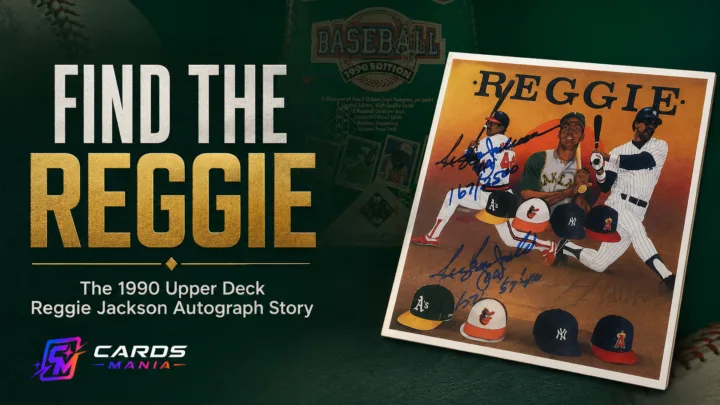
Find The Reggie: The 1990 Upper Deck Reggie Jackson Autograph Story
In 1990, Upper Deck hid 2,500 hand-numbered Reggie Jackson autographs inside High Series packs and told collectors to Find The Reggie. The…
Read more →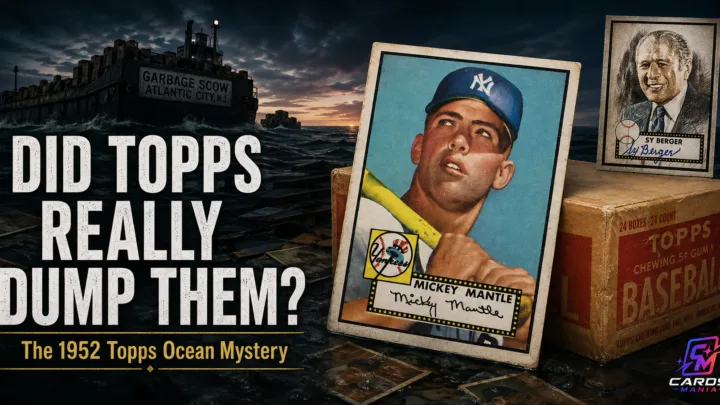
Did Topps Really Dump Millions of 1952 Baseball Cards Into the Ocean?
Sy Berger said Topps sent hundreds of cases of unwanted 1952 high-number baseball cards into the Atlantic, including cards from the series…
Read more →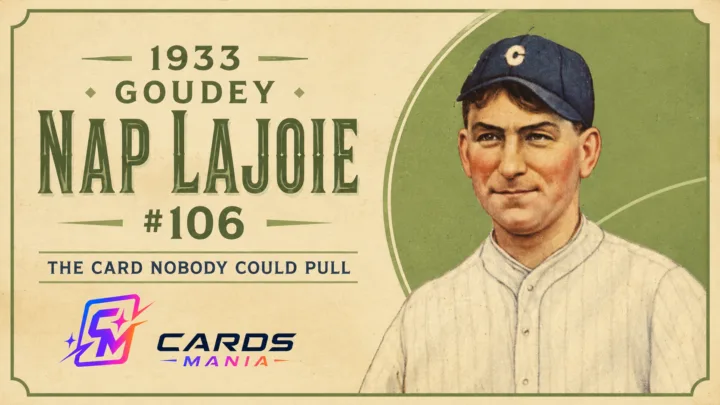
1933 Goudey Nap Lajoie #106: The Card Nobody Could Pull
Collectors could pull Babe Ruth and Lou Gehrig from 1933 Goudey packs, but card #106 was missing. Nap Lajoie #106 was printed…
Read more →