1961 Nu-Cards Horror Monsters: Ghost Gum, a Copyright Lawsuit and the Blue-Card Mystery
 Cards Mania Editorial Team
·
·
15 min read
Cards Mania Editorial Team
·
·
15 min read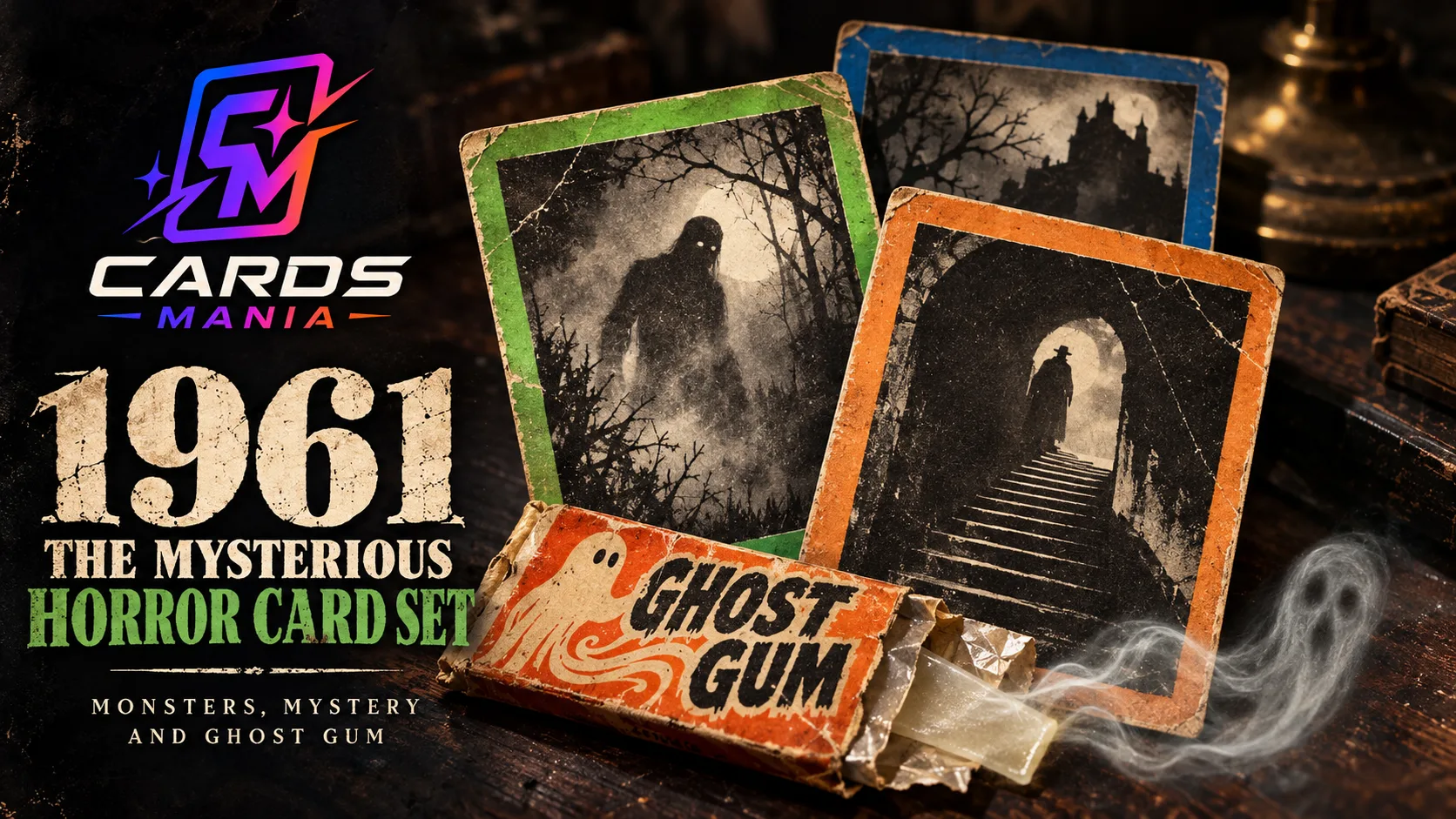
In 1961, Nu-Cards sold children monster cards without the piece of gum collectors expected to find in a five-cent pack. Instead, the wrapper promised something better: “Packed with GHOST GUM.”
You could not see it, taste it or chew it. That was the joke. The much stranger part is what sat around the joke: a 146-subject monster set made from movie imagery, perforated card panels, a mail-in poster offer, an elusive bonus-backed #102, a disputed blue-border issue and, as contemporary legal research shows, an actual copyright fight with Universal Pictures.
Early non-sport cards were not merely simpler versions of today’s hobby. Sometimes they were considerably weirder.
Quick answer: the hobby-standard 1961 Nu-Cards Horror Monsters release contains 146 unique numbered subjects, #1 through #146, split into a green-border first series (#1-66) and an orange-border second series (#67-146). PSA CardFacts currently says 147 cards, but PSA’s own Set Registry requires 146. The cleanest reconciliation is that some databases count the rare #102 bonus-back card as an additional collectible entry rather than a new numbered subject. Ghost Gum was a wrapper gag for gumless packs. Blue-border cards are real, but their origin remains disputed.
What exactly were 1961 Nu-Cards Horror Monsters?
The basic concept was enormous by early monster-card standards. Nu-Cards assembled black-and-white film imagery from famous studio monsters, science-fiction creatures and bargain-basement B-movie nightmares, then mixed serious photographic fronts with deliberately corny jokes on the backs. The result runs from King Kong, Dracula and the Creature from the Black Lagoon to The Alligator People, The Giant Behemoth, The Hideous Sun Demon and monsters whose films most people have forgotten.
Even the name is less tidy than modern databases make it look. PSA’s historical coverage commonly calls the issue Horror Monsters, while PSA CardFacts labels the set Horror Monster. The later orange-series packs are described as Movie Monsters. Cards Mania uses “1961 Nu-Cards Horror Monsters” because it is the established collector-facing name, not because every surviving package used identical wording.
The standard production cards measure 2-1/2 by 3-1/2 inches. Series One covers #1 through #66 and uses green borders. Series Two runs #67 through #146 and uses orange borders. The first-series backs were printed in red-orange and exist on white and gray stock; the second-series backs are green.
Series One
#1-66. Green border. White- or gray-stock backs. Some originated in perforated two-card panels.
Series Two
#67-146. Orange border. Green backs. Five-cent “Movie Monsters” packs are documented.
Disputed blue cards
Slightly smaller, typed-looking caption panels and altered address treatment. Origin unresolved.
If odd vintage card formats are your thing, Nu-Cards belongs in the same broad conversation as Topps Hocus Focus, another release that makes modern pack design look almost boring.
Series One: green borders, perforations and a grading trap
The green series is where the production story gets complicated. PSA’s historical research says the first cards were distributed as perforated two-card panels with white backs. Citing the Non-Sports Bible, PSA identifies 19 known panel pairings, representing 38 different card numbers. Those panels were placed in five-cent cello packs containing three two-card panels plus one single card.
Collectors were expected to separate the cards. That sounds harmless until you care about condition sixty-five years later. A perforation can wander into the image area, hand separation can leave rough edges, and the colored border makes edge wear obvious. PSA collectors interviewed for the company’s set history also noted that the backs of panel cards can be badly off-center even when the front looks respectable.
Later first-series singles with gray backs appeared in five-cent paper packs. This is the configuration that produced the set’s most memorable packaging gag.
Ghost Gum: turning “no gum” into marketing
The later green-series wrapper did not pretend there was ordinary gum inside. It advertised “Packed with GHOST GUM.” The rest of the gag explained, in effect, that the gum was invisible, tasteless and impossible to chew, while supposedly getting a dentist’s approval.
PACKED WITH
GHOST GUM
There was no ghost-shaped confection hiding under the cards. The point was that there was no gum at all. Nu-Cards turned the absence into a joke and printed the joke on the package.
That wording is specifically documented for later first-series Horror Monsters wrappers. PSA also documents the second-series “Movie Monsters” packs as gumless, but the surviving evidence reviewed for this article does not justify claiming that every Nu-Cards monster wrapper used the exact same Ghost Gum copy.
Collector takeaway: the wrapper is not just packaging debris. It is part of the story of the set, and surviving wrappers, panel packs and boxes can be far scarcer than ordinary orange-series singles.
Series Two: orange borders and eighty more monsters
Cards #67 through #146 switched to orange borders and green backs. PSA describes these as more readily available than the first series and documents five-cent packs carrying the “Movie Monsters” wording. The cards still used photographic monster imagery and “Horrible Jokes,” but the back artwork became more polished.
A four-card promotional or dealer-sample panel is also documented for the orange series. PSA quotes specialist Kurt Kuersteiner describing sales copy for “80 different cards” and urging dealers to order so children could keep collecting the monsters. That wording neatly matches the eighty numbers in Series Two.
It is tempting to turn every surviving package or dealer piece into a neat chronological sequence. The evidence is not that cooperative. We can document panel distribution, later gray-back singles, gumless packs and a dealer sample. We cannot reconstruct every production run, vending route or package transition with factory-record precision.
#102 The Electronic Monster and the wrapper-redemption game
Card #102 is titled The Electronic Monster in the PSA Set Registry. A normal example carries the standard second-series back. A much scarcer version replaces that with a redemption message stating that the card is “WORTH 100 WRAPPERS.”
PSA also reports 50-, 25- and 10-wrapper bonus backs. That wording matters: reports are not the same as independent confirmation. The 100-wrapper version is directly documented by PSA. The lower denominations are repeated in PSA’s historical coverage, but during this research Cards Mania did not locate equally strong primary scans or auction descriptions establishing each denomination separately.
The redemption rules were strange enough to fit the product. PSA reports that collectors could obtain a poster showing the complete first green series by sending the appropriate bonus card, or $1 plus five wrappers, or 50 wrappers. The poster reproduced the green-series fronts on ordinary poster paper with a blank reverse. We found no authoritative dimensions for the poster and are not going to invent them.
It is reasonable to think redemption removed some bonus cards from collector hands. It is not reasonable to claim Nu-Cards destroyed every submitted #102. No source located for this article proves what happened to redeemed cards after they reached the company.
For a broader explanation of why back variations, production formats and other small changes matter, see the Cards Mania guide to trading-card variations and short prints.
So is it a 146-card set or a 147-card set?
There are 146 unique numbered subjects. The numbering runs #1 through #146. Trading Card Database lists 146 cards. PSA’s Set Registry also requires exactly 146 items for a complete set.
Then PSA CardFacts says the set “consists of 147 cards.” That looks contradictory until you compare how high-end sets are actually cataloged. In May 2026, Heritage sold a complete 146-card set and listed an extra #102 bonus card outside the numbered run. Heritage’s grading inventory separately identifies #102 and “#102 Bonus.”
Best reconciliation: 146 is the correct count for unique numbered fronts and for a complete numbered set. The 147 figure appears to be checklist accounting that treats a #102 bonus-back variation as an additional collectible entry. PSA has not published a CardFacts methodology note explicitly saying that, so it should be described as the most coherent explanation, not as a newly discovered card #147.
The copyright lawsuit most checklists barely mention
This is where the story stops being hobby rumor.
A 1962 article in the Bulletin of the Copyright Society of the U.S.A. discusses an unreported federal case, Universal Pictures Co., Inc. v. Nu-Cards, Inc., Civil Action No. 61-C-144 in the Eastern District of New York. The author, attorney John F. Whicher, described Nu-Cards as a small trading-card manufacturer and wrote that nearly a third of the series reproduced Universal publicity stills without authorization.
According to Whicher’s contemporary account, Universal had been discussing an exclusive trading-card license with a chewing-gum company. When the prospective licensee discovered Nu-Cards was already using Universal monster stills, interest in the deal cooled. Universal sued. It obtained a temporary restraining order, then won its motion for a preliminary injunction. The parties later settled, with a permanent injunction and a damages judgment entered against Nu-Cards by consent.
That does not prove every movie image in the 146-card issue was unlicensed. The set pulls from multiple films and rights holders. It does establish that the Universal portion of the rights question was not merely collector speculation.
An unresolved date wrinkle: Whicher’s 1962 article says Nu-Cards “put out, in 1960” the horror series, while the hobby-standard catalog date is 1961 and the lawsuit carried a 1961 civil-action number. Without Nu-Cards production records, Cards Mania keeps the established 1961 date and treats the 1960 wording as a chronology clue, not a reason to rewrite the catalog.
Corporate documentation on Nu-Cards itself remains thin. PSA records an 80-card 1961 Dinosaur set, an 80-card 1961 Baseball Scoops issue and an 80-card 1961 football set, alongside Horror Monsters. We did not find reliable documentation identifying founders, executives or a formal corporate end date, so those blanks stay blank.
The blue-border mystery: prototype, bootleg or something in between?
Blue-border Horror Monsters cards exist. That is the easy part. Explaining what they are is harder.
PSA describes them as slightly smaller than the standard green and orange cards. They use a picture with a white caption panel below it, with lettering that looks typed rather than professionally typeset. Examples using subjects from both major series have surfaced. Their backs resemble the standard issues, but the Nu-Cards address line appears to have been obscured.
For years, hobby lore treated these as prototypes. The rough design and extreme scarcity certainly make that story feel plausible. But specialist Kurt Kuersteiner has argued that they are later unauthorized copies, often called bootlegs by collectors. His strongest point is the obscured address: if these cards were preliminary designs created before the final Nu-Cards production version, why would a finished Nu-Cards address already be present only to be covered up?
Kuersteiner has also pointed to printing characteristics that he believes look like copied production cards rather than pre-production originals. Those are arguments, not a court finding or a surviving printer’s ledger.
Cards Mania verdict: call them blue-border cards of disputed origin. “Prototype” is unproven. “Bootleg” is a specialist theory with meaningful physical clues behind it. “Counterfeit” is too strong unless a specific card can be shown to have been made to deceive buyers as an original production card.
PSA’s own CardFacts profile acknowledges the blue-bordered variety and repeats the competing prototype-versus-bootleg camps. It does not resolve the provenance question. That uncertainty is part of the appeal, but it should not vanish just because a seller needs a shorter listing title.
Why monsters were suddenly everywhere
Nu-Cards did not invent America’s late-1950s monster obsession. It arrived at exactly the right moment.
Screen Gems’ 1957 Shock! television package put dozens of older Universal horror films back in front of mass audiences. Local stations built late-night programming around them, often using horror hosts. Famous Monsters of Filmland followed in 1958 and became a hit with young readers. Meanwhile, drive-ins and neighborhood theaters were full of giant insects, atomic mutations, aliens, Japanese monsters and low-budget creatures that could be turned into toys, masks, magazines and cards.
Topps had already tested the monster-card audience with the 66-card 1959 You’ll Die Laughing set. Those cards used Jack Davis illustrations, humorous captions and jokes on the backs. Nu-Cards kept the comic relief but replaced the drawings with film photography. Specialist collectors have long suggested the Topps release influenced Nu-Cards, but influence is not the same thing as documented copying.
It is also safer to call Horror Monsters one of the earliest major American monster-card sets built around movie photography than to shout “first ever.” Vintage card history is full of regional, promotional and poorly documented issues that punish absolute claims.
A year later, Topps would take non-sport horror in a completely different direction with painted alien carnage. If this era interests you, our Mars Attacks history is the natural next stop. For an even stranger example of provocative non-sport subject matter, see the story of the 1987 Terrorist Attack cards.
Cards and variants collectors care about
| Card or item | Why collectors notice it |
|---|---|
| #21 Abbott and Costello Meet Frankenstein | A recognizable crossover film and a long-standing hobby favorite in the tougher green series. |
| #24 Dracula / #62 Horror of Dracula | Two very different vampire-era touchpoints inside the same first series. |
| #26 Creature from the Black Lagoon | One of the most recognizable Universal monster subjects in the run. |
| #3 and #8 King Kong | Major monster imagery plus the added condition challenge of Series One. |
| #101 The Blob | A cult-film subject in the orange series with strong name recognition. |
| #102 The Electronic Monster bonus back | The confirmed 100-wrapper redemption version is one of the set’s signature rarities. |
| Intact green-series panels | They preserve the original perforated format instead of the hand-separated singles most collectors encounter. |
| Blue-border cards | Scarce, visually different and still carrying an unresolved provenance argument. |
| Wrappers, dealer material and redemption poster | They explain how the product was sold and promoted, often making them historically more interesting than another common single. |
What are 1961 Horror Monsters cards worth in 2026?
There is no honest single number. The gap between a raw orange-series common, a chipped green card, a high-grade PSA single, an intact panel, a blue-border rarity and an elite registry set is enormous.
The cleanest current evidence comes from completed major-auction sales, especially for top-end material:
| Date | Completed sale | Price | Context |
|---|---|---|---|
| May 15, 2026 | Heritage complete 146-card PSA set, plus extra #102 Bonus | $15,250 | Advertised as #1 Current Finest at the time. Ten PSA 10s, 59 PSA 9s, 50 PSA 8s and lower grades. Heritage listed a 22% buyer’s premium for the lot. |
| May 15, 2026 | Heritage collection of 12 PSA-graded two-card panels | $1,586 | Useful evidence that intact perforated panels carry their own collector market. |
| July 10, 2026 | Heritage complete graded set, GPA 7.934 | $8,845 | Advertised as #2 Current Finest at the time, with 26 PSA 9s and 50 PSA 8s. |
Those are exceptional graded collections, not price guides for ordinary raw sets. Auction premiums, grading mix, registry competition and the presence of scarce variations all matter. A spectacular sale proves what a spectacular example achieved on a particular date. It does not turn every attic stack into a five-figure set.
1961 Nu-Cards Horror Monsters
Broad search for singles, lots and memorabilia.
Complete sets
Compare raw and graded set listings carefully.
Green-border Series One
Search the tougher first series.
Orange-border Series Two
Compare the more available second-series material.
Blue-border cards
Scarce disputed-origin examples. Read descriptions skeptically.
#102 The Electronic Monster
Check standard and claimed bonus-back examples separately.
Wrappers and Ghost Gum packaging
Packaging can be much scarcer than common singles.
Perforated panels
Look for intact Series One pairs rather than separated cards.
Why high-grade green cards are so difficult
Vintage condition problems are built into the product. The green border shows chipping immediately. Perforated panels invited children to tear cards apart by hand. Panel printing can leave the reverse badly off-center. Add ordinary sixty-five-year storage issues, surface wear, print registration and corner damage, and a clean first-series card starts to look less ordinary.
Orange-series cards have their own chipping problems, but PSA collectors consistently report greater high-grade availability than the green series. That does not tell us the original print run. It tells us what survives, what gets submitted and what PSA has seen.
Population-report warning: “PSA has graded X copies” does not mean “only X copies exist.” Raw cards, cards graded elsewhere, unsubmitted cards and resubmissions all complicate the number. Use population data as one market signal, not a census of surviving cardboard.
If you are considering grading, our guide to how trading cards are graded explains what graders actually evaluate. For long-term protection, see how to store trading cards long-term. If you are mailing an expensive vintage card or panel, the Cards Mania shipping-supplies guide covers safer packing materials.
Horror Monsters myths: what do we actually know?
| Claim | Status | What the evidence supports |
|---|---|---|
| There are 147 numbered cards. | Contradicted | The numbered run is #1-146. The 147 figure appears to count an extra #102 bonus-back entry. |
| Ghost Gum was actual invisible gum. | Contradicted | It was wrapper humor built around the fact that gum was not included. |
| Blue-border cards are definitely prototypes. | Unverified | That is long-standing hobby lore, but physical clues support a competing unauthorized-copy theory. |
| Blue-border cards are definitely bootlegs. | Supported theory, not proven | Kuersteiner’s address and printing arguments are meaningful, but definitive production records have not surfaced. |
| Nu-Cards had no licensing problem. | Contradicted for Universal material | A contemporary legal article documents Universal’s copyright case, preliminary injunction and consent settlement with damages. |
| Every image in the set was unlicensed. | Unverified and too broad | The Universal dispute covered a substantial group of stills. It does not establish the rights status of every image from every studio. |
| All redeemed #102 bonus cards were destroyed. | Hobby lore / unverified | No source located for this article establishes what Nu-Cards did with submitted bonus cards. |
Why this set still matters
The Ghost Gum wrapper is funny. The blue cards are mysterious. The #102 redemption chase is exactly the sort of odd mechanism collectors love. But the lasting appeal is bigger than any one gimmick.
Horror Monsters captures a moment when old Universal creatures were returning on television, new B-movie monsters were multiplying, monster magazines were finding young readers and card companies were learning that kids would collect far more than baseball players. Nu-Cards threw classic horror, drive-in science fiction, jokes, movie publicity photography and unconventional distribution into one sprawling set.
Then the history became messier. Universal sued. Bonus backs disappeared into a mail-in program. Children tore panels apart. Blue-border cards surfaced without a clean origin story. Sixty-five years later, collectors are still arguing about what some of this cardboard actually is.
That is why the set works as a Halloween story without being trapped in October. The monsters are the hook. The real subject is how strange the early non-sport hobby could be.
Sources and further reading
- PSA: The 1961 Nu-Cards Horror Monsters Series, A Monstrous Challenge
- PSA Set Registry: 1961 Nu-Cards Horror Monsters historical overview
- PSA CardFacts: 1961 Nu-Cards Horror Monster
- PSA Set Registry: 1961 Nu-Cards Horror Monsters
- Trading Card Database: 1961 Nu-Cards Horror Monster checklist
- John F. Whicher, “The Case of the Horror Monsters: Art as Law, Art as Fact,” Bulletin of the Copyright Society of the U.S.A.
- Heritage Auctions: May 2026 complete set sale
- Heritage Auctions: May 2026 graded panel collection sale
- Heritage Auctions: July 2026 complete set sale
- PSA CardFacts: 1959 Topps You’ll Die Laughing
- MonsterCards / MonsterWax: Kurt Kuersteiner’s specialist research on Nu-Cards Horror Monsters
A weekly card rundown is coming
Market movers, set drops, and what is worth watching. Sign-ups open soon — the guides stay free either way.

Cards Mania Editorial Team
Cards Mania is an independent trading card media project covering sports cards, Pokémon, TCG, vintage cards, grading, collecting, card storage and hobby news. Articles are produced by the Cards Mania Editorial Team.
Related reads
Prerelease Raichu: The Pokémon Card Nobody Could Prove Existed
For decades, collectors argued over whether Prerelease Raichu even existed. Then CGC used provenance, specialized imaging and XRF testing to authenticate two…
Read more →
This Football Set Promised 240 Players. It Stopped at 36.
National Chicle printed “one of 240 football players” on its 1935 cards, yet the numbered checklist stops at 36. Here is what…
Read more →
Would You Cut Up a Classic Spider-Man Comic for a 1/1 Card? Topps Did
Topps turned pieces from 15 classic Spider-Man comic issues into 1/1 Comic Cut cards for 2026 Mint Marvel. We traced the source…
Read more →