
Prerelease Raichu: The Pokémon Card Nobody Could Prove Existed
 Cards Mania Editorial Team
·
·
14 min read
Cards Mania Editorial Team
·
·
14 min read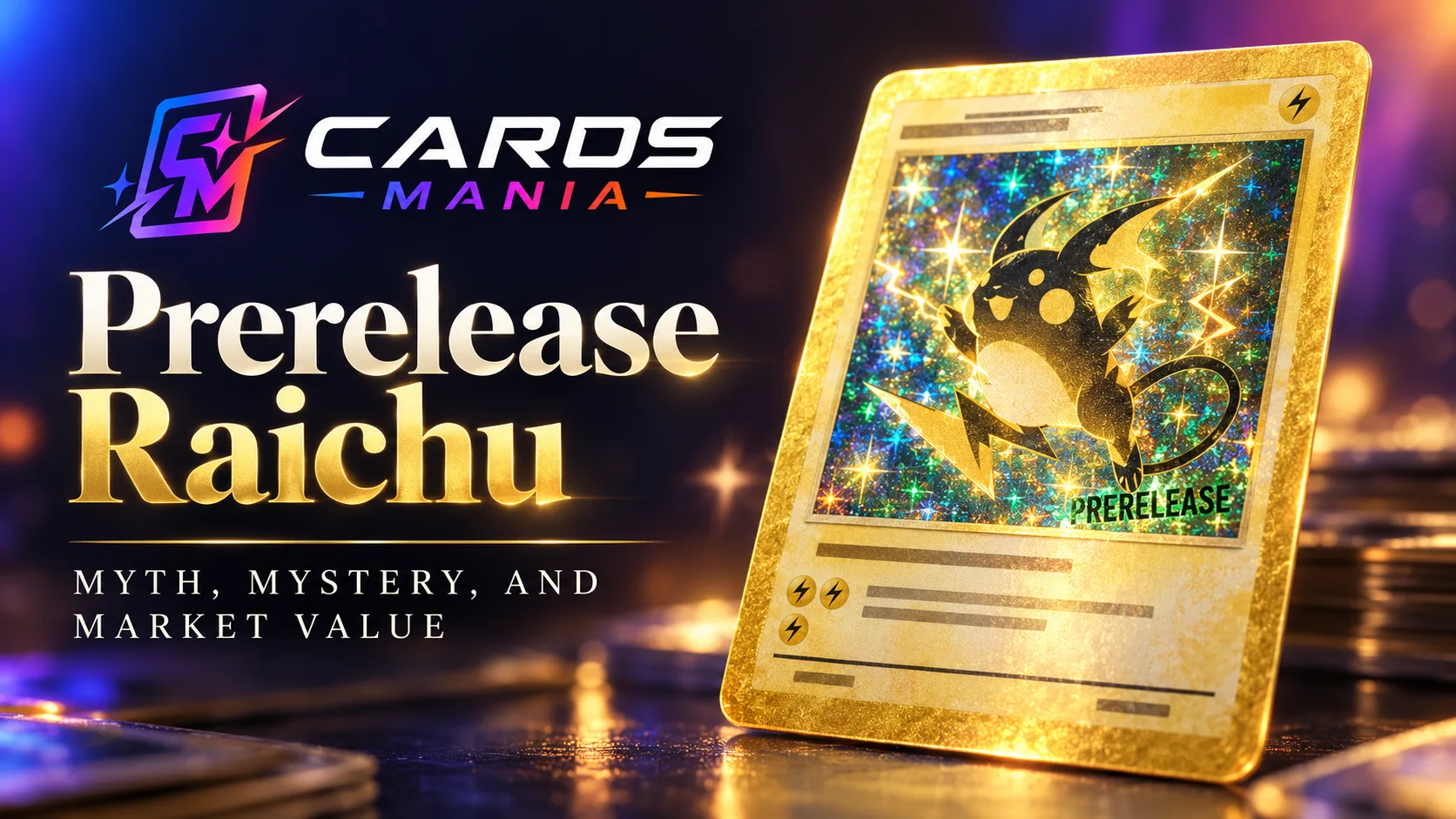
Disclosure: This post may contain affiliate links. If you buy through them, Cards Mania may earn a small commission at no extra cost to you. We only point you toward stuff we would actually spend our own money on. Read our full affiliate disclosure.
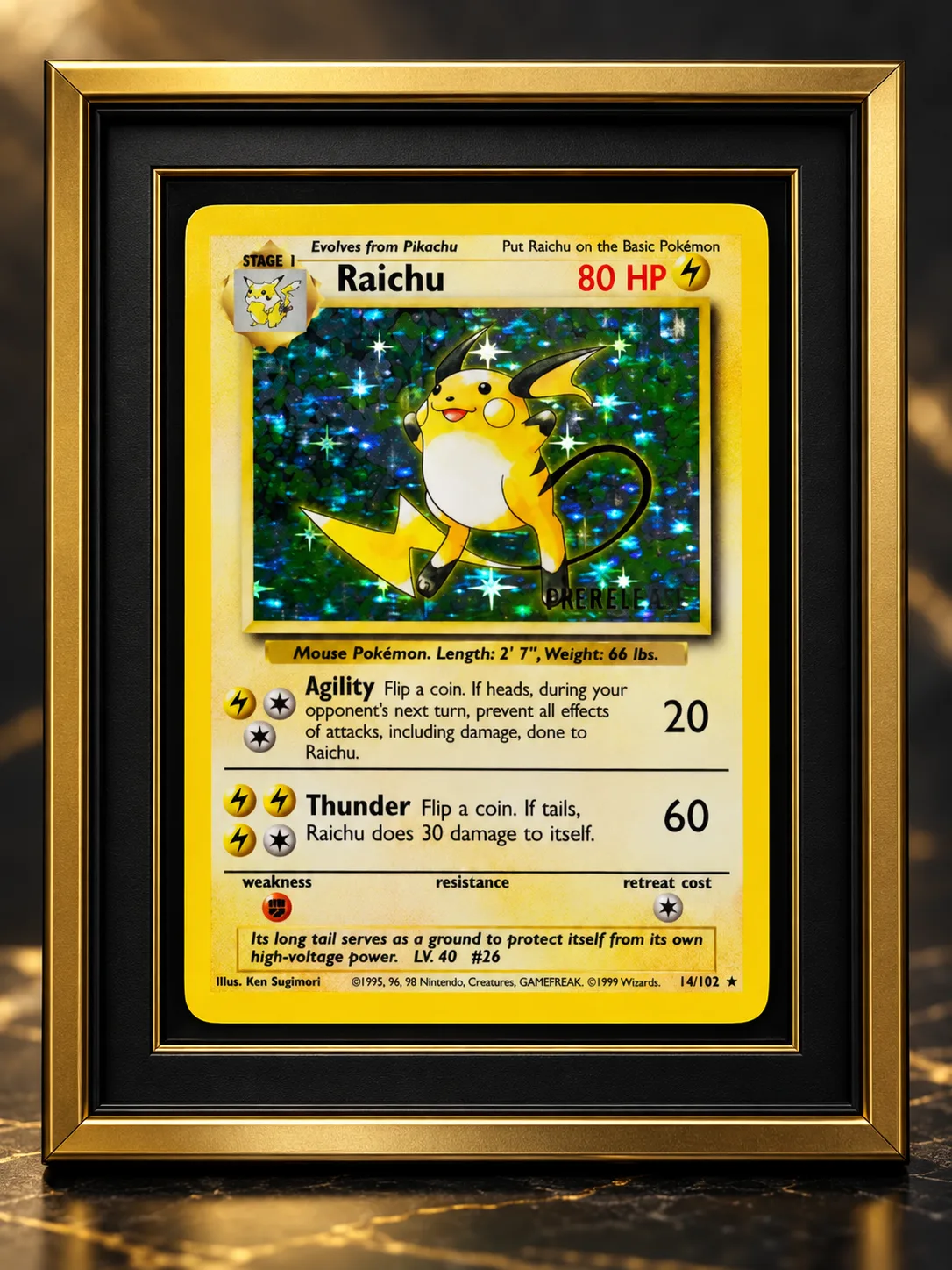
For years, Prerelease Raichu had an unusual problem for a supposedly legendary Pokémon card: collectors could not agree whether it was real. The story said that a tiny number of 1999 Base Set Raichu cards accidentally received the green PRERELEASE foil stamp intended for Jungle Clefable. One Wizards of the Coast manager was remembered as saying that only 11 existed. Then, in 2006, a photograph finally appeared online.
It was posted on April 1.
That did not help.
Today the central mystery is settled. Genuine Prerelease Raichu cards exist. CGC authenticated two in 2023 after provenance research, specialized imaging, 42x magnification and X-ray fluorescence testing. PSA later authenticated additional examples. What remains unresolved is almost as interesting: nobody has produced a manufacturing record proving that exactly 11 were made, and the public grading record still cannot tell us with certainty how many physical copies survive.
Prerelease Raichu at a glance
What Is Prerelease Raichu?
Prerelease Raichu is an ordinary-looking English Base Set Raichu with one extraordinary addition: the same green foil PRERELEASE stamp associated with the legitimate Jungle Prerelease Clefable. It was never a normal retail issue and it was not one of the recognized Wizards-era prerelease promos collectors received through organized play.
That distinction matters. Calling it a “promo” makes the card sound planned. The best-supported explanation is the opposite: a production anomaly created while Wizards of the Coast was preparing stamped Clefable cards. CGC’s 2023 investigation concluded that the examined Raichu stamps were genuine and applied by the same manufacturing method as authentic Prerelease Clefable stamps. That makes production error or accidental hot-stamp more defensible descriptions than prototype or official promotional card.
If you want the broader context for the era, Cards Mania’s Pokémon cards history guide separates the 1996 Japanese TCG launch from the 1999 English Base Set. Our error cards and misprints guide explains why genuine production mistakes can become collectible categories of their own.
Curious what the normal cards look like in today’s market? Compare Base Set Raichu cards on eBay or Prerelease Clefable examples. Those searches are for context, not evidence that an authentic Prerelease Raichu is casually sitting in a marketplace listing.
The Clefable Stamp That Started Everything
The key to the mystery is Clefable. Jungle Clefable was one of the legitimate early Wizards-era cards distributed with a green PRERELEASE foil stamp. CGC’s reconstruction says these stamps were applied while the cards were still on uncut sheets, before cutting. Consultants told CGC that the sheets could be hot-stamped in one operation using multiple foil dies.
Here is the detail that gets flattened in retellings. The evidence does not require somebody to have dropped loose Raichu cards into a pile of Clefables. CGC published an uncut-sheet image it believes is relevant to the error. Clefable and Raichu sit near each other in the upper-left area, while the remaining cards appear destined for Base Set theme decks. CGC’s working hypothesis is that a stamping-machine operator loaded two dies instead of one during what may have been a test run. One die hit Clefable as intended; another also hit Raichu. The mistake was then noticed.
That explanation fits the physical evidence and the sheet layout, but it is still a reconstruction. There is no surviving WotC production log saying exactly who loaded the dies, when it happened or how many Raichu cards came through the machine. The right language is that CGC’s investigation supports this mechanism strongly, not that every step is documented beyond doubt.
Where Did the “Only 11 Exist” Story Come From?
The famous number is not something modern graders invented. CGC traced an early account to a PokeGym contributor known as Edo, describing the International Tropical Mega Battle at the Hilton Hawaiian Village in Honolulu on August 24-27, 1999. In that account, Wizards manager Andrew Finch showed a special misprint to a Media Factory employee and was quoted saying, “Only 11 exist.”
That is important historical evidence, but it does not convert 11 into a certified print run. The account documents what Finch was remembered as saying. It does not come with a manufacturing sheet count, destruction record or internal memo, and CGC explicitly says it cannot prove that only 11 were created.
CGC also found a Pojo error-card page, last updated May 2, 2002, as the earliest Prerelease Raichu reference its graders could still locate online in original form. That helps show the story was circulating long before the 2006 photograph, but it should not be mistaken for proof of the manufacturing quantity.
The 1999 Tropical Mega Battle Sighting
The Tropical Mega Battle story is one reason the legend refused to die. According to the account preserved by CGC, an example was shown publicly in Hawaii in 1999, close to the period when the card would have been created. That is much stronger than a rumor invented years later.
It is still a recollection rather than a surviving 1999 photograph of the card on the table. That difference matters. The event, location and dates are established; the account attributes the showing and the “11” statement to Finch. We can reasonably treat the story as an early eyewitness account, but not as the same kind of evidence as CGC’s later physical examination.
Then Somebody Photographed It on the Worst Possible Day
By 2006, former WotC Customer Service Manager Mike Boozer had become central to the story. He owned a Prerelease Raichu and was known among PokeGym regulars for showing a binder of unusual material after events, sometimes pointing to the card while joking that it did not exist.
When a buyer wanted a copy in early 2006, PokeGym’s Michael “PokePop” Martin helped connect the parties. The sale was completed in late March. In a 2024 Johto Times interview, Martin explained that he deliberately announced it on April 1 for a bit of mischief, timed around PokeGym’s anniversary. Predictably, many collectors assumed the photograph was an April Fool’s joke. Martin says he clarified the next day that it was real, and some people still did not believe him.
Years later, that joke became forensic evidence. The original image link disappeared, but CGC recovered the photograph through the Wayback Machine. The graders compared details in the archived photo with the card submitted in 2023. The positions of holo stars and a scratch below the Raichu artwork matched. In other words, the 2023 slab could be tied to the physical card photographed online in 2006.
One of the best pieces of evidence for a card’s existence had arrived on the single calendar date most likely to make collectors dismiss it. Pokémon history occasionally writes its own punchlines.
The Two Cards CGC Could Trace Back to Wizards Employees
Card #1: Mike Boozer → Will Gore → David Persin
CGC graded the Boozer-linked card CGC 5.5. After the 2006 disclosure, a PokeGym member named Will Gore bought it. CGC says Gore submitted the card to another grading service, which declined to authenticate and grade it. CGC did not identify that company, so there is no good reason to guess.
Gore later sold the card at his cost to collector David Persin in May 2009. PokeBeach reported, based on price information Persin supplied, that the 2009 transaction was $10,500. That is a reported private transaction, not an auction result.
Card #2: The Binder Nobody Realized Mattered
The second CGC card has an even stranger paper trail. On November 6, 2018, former WotC employee Jennifer M. brought an old binder to her job at The Pokémon Company International. A coworker noticed the Prerelease Raichu. Jennifer reportedly had not understood its significance.
There was also a Post-it note on the back of the sleeve from “Freddi,” a former WotC coworker who had given Jennifer the card as a memento. CGC obtained signed letters from Jennifer and two coworkers supporting the story. The card had effectively spent close to two decades hiding in plain sight before eventually being sold to Persin. CGC graded it 8. PokeBeach reported Persin paid $20,000 in 2018.
These stories are why provenance mattered so much. A convincing green stamp could theoretically be faked. A card linked back through named former WotC employees, archived photographs and witness statements is much harder to explain away.
How CGC Actually Authenticated Prerelease Raichu
CGC did not simply look at the cards, recognize the story and declare victory. It compared the suspicious feature, the green stamp, against genuine Prerelease Clefable examples using several methods.
- Provenance research: ownership chains, WotC employee connections, archived web material and signed statements.
- Infrared side lighting: used to compare stamp dimensions, foil response and possible alterations.
- 42x magnification with specialized coaxial lighting: used to inspect microscopic surface texture.
- Heat-and-pressure signatures: CGC found the same rippled texture expected from hot foil die application.
- X-ray fluorescence, or XRF: used to compare the elemental composition of the stamp material without destroying the cards.
Under magnification, CGC found the Raichu stamps shared the same surface characteristics as the Clefable stamp. The company argued that different dies, temperatures or pressure settings would be expected to leave different textures. Matching characteristics therefore supported a common manufacturing process and equipment.
This is also a useful case study in the difference between grading and authentication. A numerical grade tells you about condition. The historically important part here was establishing that the unusual stamp itself belonged to the process claimed.
What the XRF Test Proved, and What It Did Not
XRF sounds wonderfully CSI, but it is not a time machine. The technique uses X-rays to excite atoms in a material and measures the characteristic secondary X-rays they emit. Museums and conservation labs use XRF because it can identify elemental composition non-destructively.
CGC compared two Raichu stamps with two genuine Prerelease Clefable stamps. The four samples showed closely tracking amounts of calcium, titanium, iron, copper and zinc in the substrate and foil. CGC said the small differences were within tolerance and the overall compositional patterns aligned closely.
Combined with the matching dimensions, foil response and microscopic texture, that is strong evidence that the Raichu stamps were made using the same kind of process and materials as genuine Clefable stamps. It is one reason CGC was comfortable certifying the two cards as genuine.
But XRF cannot tell us that exactly 11 cards were stamped. It cannot identify the operator, provide a production timestamp, name the people who received cards or prove the Tropical Mega Battle distribution story. Scientific testing strengthened the authentication of the objects. It did not magically fill every hole in the historical record.
So How Many Prerelease Raichu Cards Are Known in 2026?
This is where older articles are now out of date. In 2023, the headline answer was two authenticated examples, both CGC. By October 5, 2026, PSA records show two PSA 6 examples, while current population tracking shows another example graded PSA 5. The two CGC cards authenticated in 2023 were graded 5.5 and 8.
You can see the two-copy PSA 6 population on PSA’s certification record.
That gives us five public grading records across the two companies. It does not, by itself, prove there are five different physical cards, because a card can be cracked from one holder and submitted to another grader. Public crossover history is not complete.
The safest statement is therefore more conservative: at least four distinct physical Prerelease Raichu cards are publicly documented, while current grading records show five slabs or records across PSA and CGC. The 2026 PSA 5 was compared by specialist collectors against previously known examples using holo pattern and wear and was treated as a newly surfaced card. The two PSA 6 certification numbers are also different. Without a complete chain for every resubmission, claiming “five known surviving cards” as settled fact would outrun the evidence.
From Hobby Ghost Story to a $699,625 Raichu
The market has moved almost as fast as the authentication story. The first PSA 6 became a major auction benchmark in September 2025. Heritage’s own press release says it realized $555,000 including buyer’s premium on September 19, 2025. PSA’s sales-history page displays $550,000 for the same Heritage result, so there is a small metadata discrepancy. Heritage’s primary release is the better source for the all-in figure.
On August 10, 2026, another PSA 6 sold through Goldin for $640,500. PSA’s sales-history record confirms the price and identifies a different certification number from the 2025 Heritage card.
Then the record moved again. In early October 2026, Alt announced that the PSA 5 Prerelease Raichu sold for $699,625, calling it the world’s most valuable Raichu card. Alt’s public announcement gives the final sale price but does not separately state the hammer and premium components, so we are not going to invent them.
| Date | Card / grade | Venue | Reported result | Price note |
|---|---|---|---|---|
| Sept. 19, 2025 | Prerelease Raichu, PSA 6 | Heritage | $555,000 | Heritage says buyer’s premium included; PSA database displays $550,000 |
| Aug. 10, 2026 | Prerelease Raichu, PSA 6 | Goldin | $640,500 | Contemporary auction reporting states the result included 22% buyer’s premium |
| Early Oct. 2026 | Prerelease Raichu, PSA 5 | Alt | $699,625 | Alt-announced final sale price; its public announcement does not separately break out the premium |
Those prices should not be used as “the value of a Raichu.” This is a tiny, irregular market for historically important anomalies with provenance, authentication and very little liquidity. A normal Base Set Raichu is a completely different collectible. Even within Prerelease Raichu, a future result could move sharply in either direction because there are so few comparable transactions.
For ordinary collecting and price research, you can browse WotC-era Raichu listings on eBay, Pokémon error-card listings, or compare regular Pokémon singles through TCGplayer. Active listings are asking prices, not completed-sale evidence.
Prerelease Raichu Myths: What Do We Actually Know?
| Claim | Status | What the evidence supports |
|---|---|---|
| Prerelease Raichu is real. | Confirmed | CGC authenticated two in 2023 with provenance, imaging and XRF; PSA has since authenticated additional examples. |
| Exactly 11 were made. | Unverified | The number traces to Andrew Finch’s quoted 1999 statement in an eyewitness account. CGC says it cannot prove 11 were created. |
| The stamp was intended for Clefable. | Strongly supported | The authentic comparison card is Jungle Prerelease Clefable, and CGC’s sheet/process reconstruction supports an accidental extra stamp on Raichu. |
| The cards were stamped after cutting. | Misleading | CGC’s consultants said this prerelease hot-stamping was performed on uncut sheets before cutting. |
| The 2006 photo was an April Fool’s fake. | False | The timing was a joke; the card was not. CGC matched the archived 2006 image to its 2023 submission. |
| All copies went to WotC employees. | Plausible, not proven | The two CGC examples trace to former WotC employees, but that does not document the destination of every card produced. |
| A grading company once refused one. | Confirmed for one card | CGC says Will Gore submitted Card #1 to another service that declined to authenticate it. CGC did not name the company. |
| More could still be in old binders. | Possible | Jennifer M.’s card sat unnoticed for nearly two decades. That proves forgotten examples are possible, not that more definitely exist. |
Could Another One Still Be Sitting in a Binder?
Nothing in the evidence rules it out. In fact, Jennifer’s story is the reason the idea cannot be laughed away. An authentic example apparently survived for years as a keepsake in an old binder before a coworker recognized it.
But “possible” is not “probable,” and it certainly is not permission to treat every green-stamped Raichu as a lottery ticket. The card’s fame also created an obvious incentive for counterfeits. A green stamp alone proves very little. Provenance, physical stamp characteristics and specialist authentication matter.
If somebody genuinely believes they have one, the sensible first move is not to clean it, press it, polish it or start comparing DIY foil stamps. Photograph it carefully, preserve every scrap of provenance and talk directly to a grading company that has already authenticated the variety. Our grading-company comparison and Grading Finder explain the broader submission landscape, while our storage and shipping guide covers safe handling before a valuable card goes anywhere.
Why Prerelease Raichu Matters
The price is spectacular, but the better story is what happened to the evidence.
Prerelease Raichu spent years in an awkward zone between insider knowledge and collector folklore. There were employee stories, a remembered 1999 sighting, old web references and eventually a photograph that appeared on April Fool’s Day. None of those alone gave the wider hobby the level of proof it wanted.
Then physical cards with credible Wizards provenance met modern forensic examination. CGC could compare stamp dimensions, microscopic texture, foil response and elemental composition against known genuine Clefables. It could also reconnect one card to the vanished 2006 photograph and another to a former employee’s binder and witness statements.
That settled the big question: Prerelease Raichu exists.
It did not settle the fun questions. We still do not know exactly how many were stamped, whether Finch’s 11 was a precise count or an early estimate, how many left Wizards offices, how many survive, or whether another former employee has one sitting behind a stack of old league material.
After more than 25 years, the hobby finally has evidence strong enough to kill the “it never existed” argument. The mystery, inconveniently and wonderfully, survived anyway.
Research note: Population and market information checked October 5, 2026. Grading populations and auction records can change. Completed public sales are separated from private transaction reports and active listings throughout this article.
A weekly card rundown is coming
Market movers, set drops, and what is worth watching. Sign-ups open soon — the guides stay free either way.

Cards Mania Editorial Team
Cards Mania is an independent trading card media project covering sports cards, Pokémon, TCG, vintage cards, grading, collecting, card storage and hobby news. Articles are produced by the Cards Mania Editorial Team.
Related reads
1961 Nu-Cards Horror Monsters: Ghost Gum, a Copyright Lawsuit and the Blue-Card Mystery
In 1961, Nu-Cards combined movie monsters, perforated panels, invisible Ghost Gum, a strange wrapper-redemption program and mysterious blue-border cards. The deeper research…
Read more →
This Football Set Promised 240 Players. It Stopped at 36.
National Chicle printed “one of 240 football players” on its 1935 cards, yet the numbered checklist stops at 36. Here is what…
Read more →
Would You Cut Up a Classic Spider-Man Comic for a 1/1 Card? Topps Did
Topps turned pieces from 15 classic Spider-Man comic issues into 1/1 Comic Cut cards for 2026 Mint Marvel. We traced the source…
Read more →