
Best Trading Card Shipping Supplies and Packing Guide
 Cards Mania Editorial Team
·
·
9 min read
Cards Mania Editorial Team
·
·
9 min read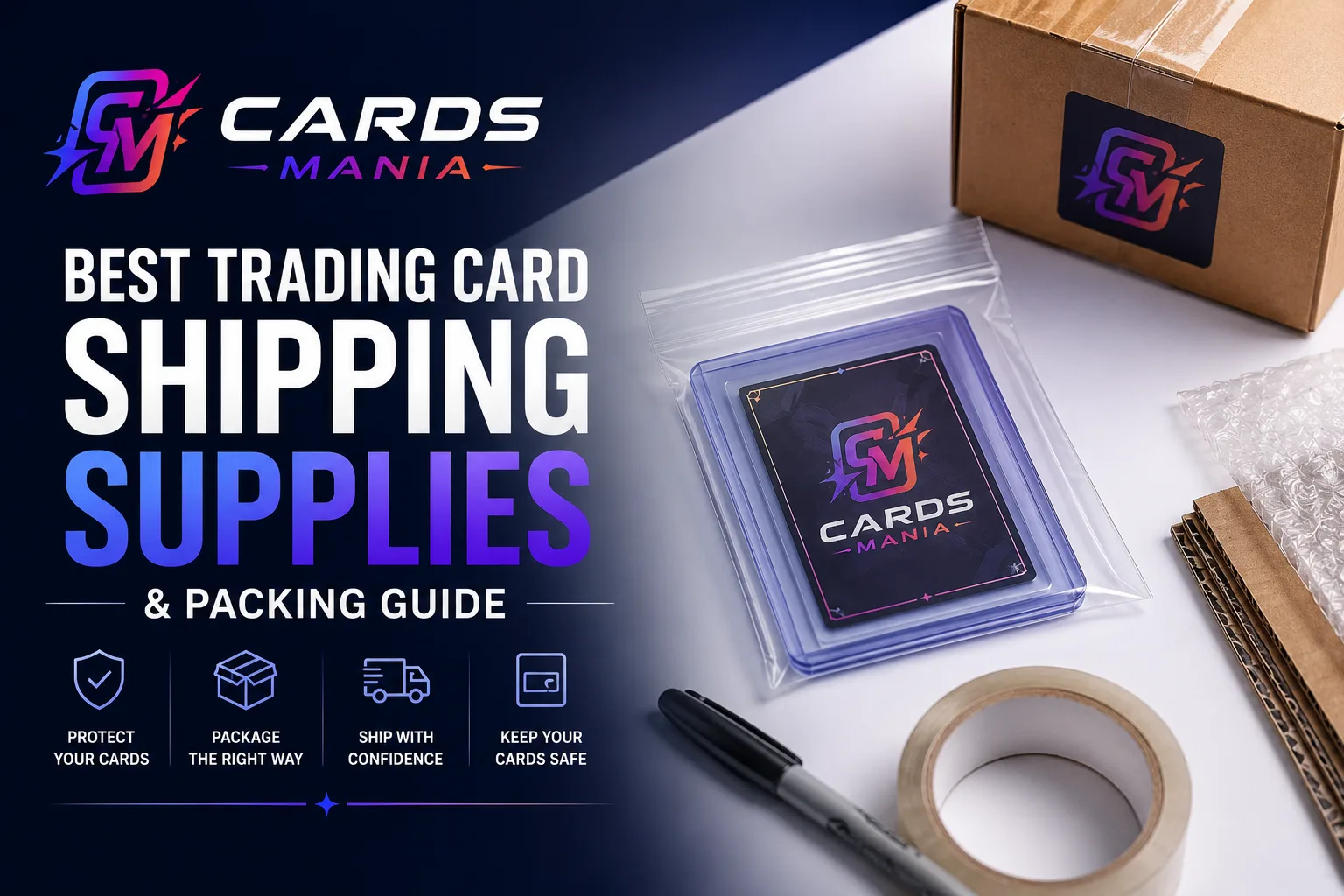
Updated August 25, 2026. Carrier rules and grading-company instructions can change, so check the linked policy pages before mailing an expensive card.
The best trading card shipping supplies are not the most expensive ones. They are the ones that stop four predictable problems: surface scratches, movement inside the holder, bending and moisture. For most raw cards, that means a clean penny sleeve, the right rigid or semi-rigid holder, a resealable outer bag and packaging that matches the mail service.
This is the shipping-supplies guide: it focuses on what each material does, which items are worth keeping at your packing station, and how the kit changes for raw cards, slabs, eBay Standard Envelope and grading submissions. For the full packing sequence from card to sealed parcel, use our step-by-step guide to shipping trading cards safely. If you are building a broader collector setup, our essential trading card supplies guide covers storage, protection, grading and handling gear beyond shipping.
- Clean penny sleeves
- Toploaders for buyer shipments, plus semi-rigid holders for grading submissions
- Team bags or another resealable outer sleeve
- Corrugated cardboard cut slightly larger than the card holder
- Painter’s tape for removable tabs, and packing tape for the outside of a box
- Rigid envelopes, bubble mailers and small boxes for different shipment types
- A scale and ruler so the finished package matches the label
If you also need long-term storage advice, start with the Cards Mania storage and shipping guide. This article focuses on the supplies and decisions that matter at the packing table.
Which trading card shipping supplies should you use?
| Shipment | Inside protection | Outer packaging | Important limit |
|---|---|---|---|
| Low-value raw card sold on eBay | Penny sleeve, toploader or approved card envelope, team bag | eBay standard envelope if eligible | Up to 3 oz, under 0.25 inch thick, no more than two cards in toploaders and no graded cards |
| Raw card in a tracked parcel | Penny sleeve, toploader, team bag, cardboard support | Bubble mailer or small rigid mailer | Measure the finished parcel and buy the correct postage |
| Graded slab or higher-value card | Sleeve or slab bag, bubble wrap, immobilized bundle | Strong corrugated box with void fill | Coverage is not automatic beyond the carrier’s included amount |
| Cards sent to PSA | Clear penny sleeve and correct semi-rigid holder | New box with bubble wrap | PSA says no toploaders, tape, pull tabs or sticky notes in standard submission holders |
The trading card shipping supplies that do the real work
1. Penny sleeves
A penny sleeve is the first layer, not the full package. It keeps the card surface away from hard plastic and grit. Use a fresh, clear sleeve that fits without forcing the corners. If the opening feels tight, stop and use a larger sleeve rather than pushing on the card.
You can compare standard penny sleeves and soft card sleeves. Avoid reusing a cloudy sleeve for a valuable card. A tiny piece of trapped debris can mark the surface.
2. Toploaders and semi-rigid holders
A standard toploader is a practical choice for mailing a raw card to a buyer. Match the holder thickness to the card. Forcing a thick relic or patch card into a standard holder can damage an edge or corner.
A one-touch magnetic holder is useful for display, but it is not automatically the safest shipping holder. If you mail one, make sure the card fits the recess, place the holder in a protective bag and stop it from opening or moving inside the parcel.
Grading submissions are different. PSA’s current shipping guide asks for a clear penny sleeve and a standard semi-rigid holder measuring 3 5/16 by 4 7/8 inches. It specifically says not to use toploaders, tape, pull tabs or sticky notes. Follow the grading company’s live instructions rather than copying the way you package a buyer order.
3. Team bags and resealable outer sleeves
A team bag keeps a sleeved card and holder together and helps keep dust, loose adhesive and minor moisture away from the holder. It also avoids putting tape across the toploader opening. Fold the flap smoothly and keep adhesive away from the card sleeve.
4. Cardboard support
Cut two clean pieces of corrugated cardboard slightly larger than the holder. Sandwich the protected card between them and secure the bundle without squeezing it. The goal is to resist bending, not to clamp the card. Painter’s tape is handy for a removable tab on this inner bundle. Packing tape belongs on the outside seams of a box.
5. Bubble mailers, rigid mailers and boxes
A bubble mailer cushions a protected raw card, but the bubbles do not replace a rigid holder. For a slab, several cards or a higher-value order, use a sturdy shipping box. Fill empty space so the contents do not rattle when the sealed box is gently moved.
How the shipping supplies work together
If you are packing cards specifically for grading, the submission route matters too. Our Trading Card Grading Finder helps you compare grading options by country, card type, service, published fees and turnaround times before you send anything out.
The supplies form a simple protection chain: sleeve → holder → outer bag → bend protection → mailer or box. The exact holder and outer package depend on the card and the shipping service. A low-value raw card may qualify for eBay Standard Envelope, while slabs, thick cards and higher-value orders usually need a tracked parcel or box.
This article is intentionally focused on choosing the right materials. The separate step-by-step packing guide covers the full buyer-shipment procedure, including photos, taping, movement control, weighing and documentation.
eBay Standard Envelope rules for trading cards
eBay standard envelope can be a sensible low-cost option, but it is not a miniature parcel service. According to eBay’s current policy, the envelope must weigh no more than 3 oz, stay under 0.25 inch thick, have uniform thickness and remain flexible enough for letter processing. It cannot contain clasps, strings or buttons.
For trading cards, eBay currently allows up to 24 raw cards in one envelope, no more than two cards in toploaders, and no graded cards. A single order carries up to $20 in shipping protection, while eligible combined orders can have up to $50. Check the live page before shipping because rates and limits can change.
Tracked parcels, insurance and signatures
USPS Ground Advantage includes tracking and, under current USPS guidance, $100 of included insurance for eligible merchandise. Additional coverage is generally available for purchase, subject to USPS rules and claim requirements. Coverage is not the same as a guaranteed payout. Keep proof of value, proof of mailing and photos of the packaging in case a claim is needed.
Do not treat a signature as automatic insurance or insurance as automatic proof of delivery to the intended person. They solve different problems. For an expensive shipment, compare the declared value, carrier coverage, signature options and the marketplace’s seller-protection rules before buying the label.
Labels such as Do Not Bend or Fragile can communicate handling intent, but they do not replace correct packaging or change carrier liability.
How to pack graded cards and high-value shipments
- Place the slab in a fitted bag so the case does not get scratched.
- Wrap it in bubble wrap without putting tape directly on the slab or bag.
- Use a strong box, not a plain paper envelope.
- Fill every void so the slab cannot strike the box walls.
- Use packing tape across the box seams and keep every barcode flat and visible.
- Record the card, serial or certification number, packing process and sealed parcel.
- Buy coverage and a delivery service that fit the actual value and marketplace requirements.
If the package will sit unattended after delivery, use the practical steps in the Cards Mania guide to prevent trading card package theft. If you are unsure what a grade does and does not prove, read the card grading basics guide.
Sending cards to PSA is a separate workflow
PSA’s current instructions call for clear penny sleeves, semi-rigid holders, cardboard dividers, two or three rubber bands, bubble wrap, a new shipping box and packing tape. Cards should be in the same order as the submission form. The bands should hold the stack without bending it, and empty box space should be filled so the bundle cannot move.
PSA also tells submitters to use packing or security tape on the box and to avoid painter’s tape, thin clear tape or reused tape on its seams. That does not conflict with using a small painter’s-tape pull tab inside an ordinary buyer shipment. The jobs are different. Follow the receiving company’s latest guide for submissions.
Common packing mistakes
- Putting tape over a toploader opening. The buyer can catch the card while cutting or peeling it.
- Using a holder that is too tight. Thick cards need a holder made for their point size.
- Assuming a bubble mailer prevents bending. Add a holder and, when appropriate, cardboard support.
- Leaving space inside a box. Movement creates repeated impacts during transit.
- Guessing the finished weight or thickness. Measure after every protective layer is in place.
- Calling every shipment insured. Eligibility, included limits, documentation and exclusions matter.
- Using one method for buyers and graders. PSA’s receiving rules are not the same as an eBay buyer shipment.
Compare current trading card shipping supplies
Trading card shipping supplies FAQ
What supplies do I need to ship one trading card?
For a typical raw card, use a clean penny sleeve, a correctly sized toploader, a team bag and outer packaging that matches the mail service. Add cardboard support for a parcel shipment when it improves bend resistance without creating an ineligible envelope.
Can I ship a card in a plain white envelope?
Only if the finished envelope meets the chosen service’s size, thickness, flexibility, weight and content rules. For eBay standard envelope, current trading-card limits include no more than 3 oz, less than 0.25 inch thickness, up to 24 raw cards and no more than two cards in toploaders. Graded cards are not eligible.
Should I tape the top of a toploader?
Do not put ordinary tape across the opening where it can contact the sleeve or card. A resealable team bag is cleaner. If you use a removable painter’s-tape tab on an inner bundle, keep the adhesive away from the card and holder opening.
Are bubble mailers safe for trading cards?
A bubble mailer provides cushioning but not enough bend protection by itself. Sleeve the card, use a suitable holder, close it in a team bag and add support when needed. Use a box for slabs, multiple cards or higher-value orders when the mailer cannot keep the contents secure.
Should I use a toploader when sending cards to PSA?
No. PSA’s current standard card-submission guide asks for clear penny sleeves and semi-rigid holders, and says not to use toploaders, tape, pull tabs or sticky notes. Always check the live grading-company instructions before shipping.
Bottom line: build the package around the card, the recipient and the mail service. A sleeve protects the surface, a holder controls bending, an outer bag keeps the bundle together, and the mailer or box handles the trip. Measure the finished package and keep evidence for valuable shipments.
A weekly card rundown is coming
Market movers, set drops, and what is worth watching. Sign-ups open soon — the guides stay free either way.

Cards Mania Editorial Team
Cards Mania is an independent trading card media project covering sports cards, Pokémon, TCG, vintage cards, grading, collecting, card storage and hobby news. Articles are produced by the Cards Mania Editorial Team.
Related reads

MTG The Hobbit 2026: Complete Collector & Player Guide
Magic: The Gathering | The Hobbit released August 14, 2026. This updated guide covers HOB and HOC legality, products, mechanics, Dwarvish cards…
Read more →
Palworld Card Game Guide: Cards and Rules
Palworld OFFICIAL CARD GAME launched worldwide on July 30, 2026. This updated guide covers Dawn of Palpagos, rules, rarities, errata, events and…
Read more →
What Is a Rookie Card? Meaning, Examples and Collector Value
A rookie card is generally one of an athlete’s first mainstream cards after reaching the top professional level, but licensing, set type…
Read more →