
1948 Topps Hocus Focus: The Self-Developing Cards That Started It All
 Cards Mania Editorial Team
·
·
6 min read
Cards Mania Editorial Team
·
·
6 min read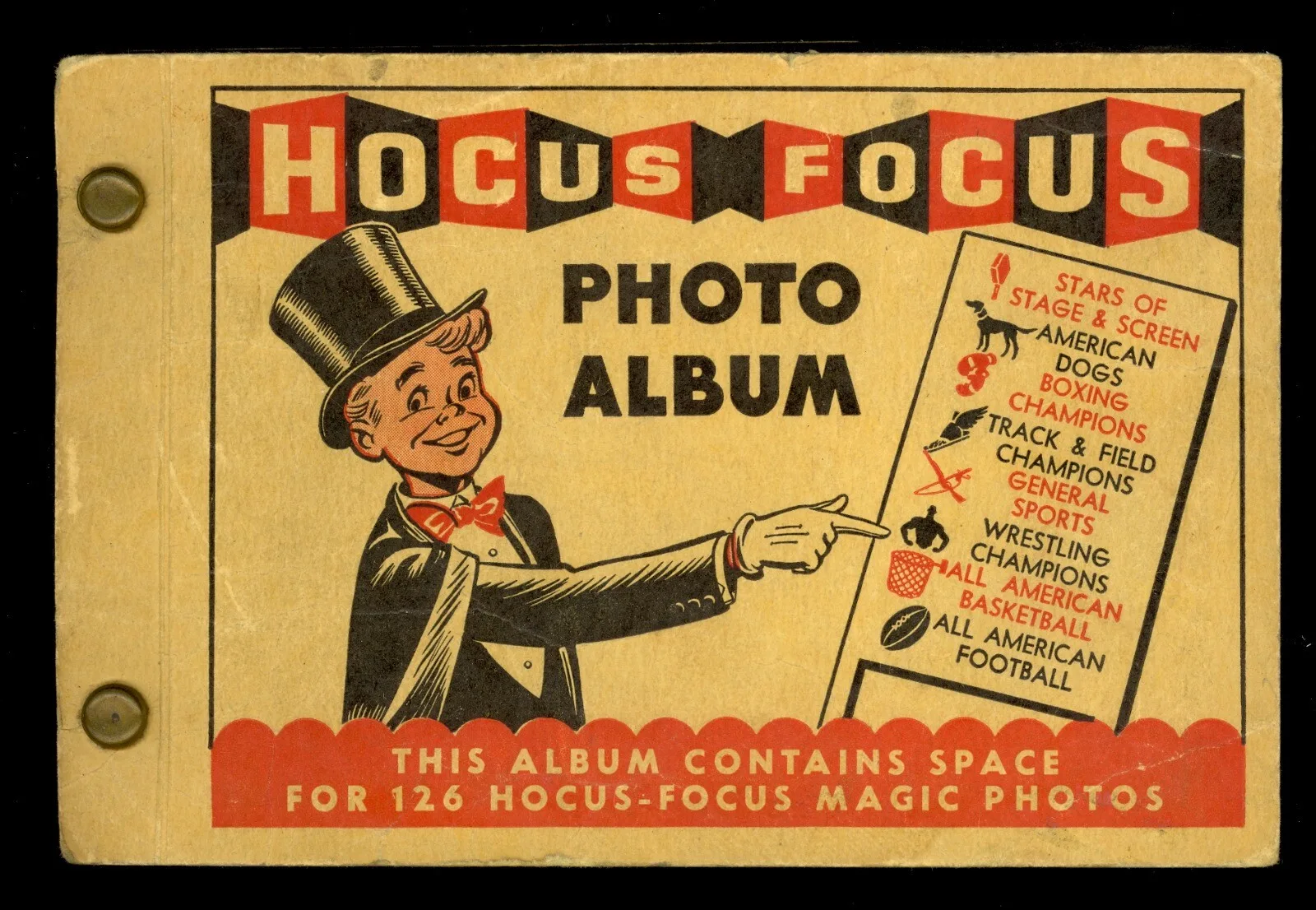
Before Topps became the name every collector knows, they pulled off one of the most creative tricks in trading card history. In 1948, they released a set of cards with completely blank fronts, and that was exactly the point. Welcome to the strange and wonderful world of the 1948 Topps Hocus Focus Magic Photo cards.
This is the first entry in an ongoing series here at CardsMania where we spotlight the weird, the rare, and the genuinely surprising corners of trading card history. And few stories are as good as this one.
Blank Cards With a Twist
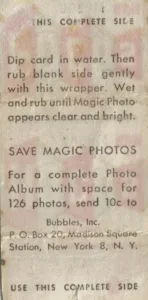
Imagine cracking open a pack of gum cards and finding nothing. Just a tiny white rectangle, barely larger than a postage stamp. No image, no player name, no color whatsoever. A kid in 1948 might have felt cheated. But then they read the instructions on the wrapper: wet the card and hold it up to sunlight. Slowly, a sepia-tone photograph would appear, like magic developing right in their hands.
The process worked like early photographic paper: water activated a light-sensitive coating on the card face, and natural sunlight did the developing. Most kids used spit and sunshine. Some packs may also have included a chemical activator in the wrapper to help the process along, though the exact contents varied. Either way, the results were never guaranteed. Cards developed at different speeds and with different clarity, which is a big part of why condition varies so dramatically across surviving examples. A well-developed image with clean contrast commands a real premium. A faded or muddy result is worth far less, regardless of who is on the card.
Topps’ First-Ever Baseball Cards
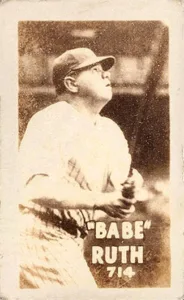
Here is the fact that surprises most collectors: the 1948 Topps Magic Photos set contains Topps’ first-ever baseball cards. Most people point to 1952 as where Topps began, given the legendary Mickey Mantle card in that set. Others correctly note that the 1951 Topps Red Backs and Blue Backs came before it. But the actual starting point predates both. The 1948 Magic Photos baseball subset, labeled Series K, includes 19 cards featuring Hall of Famers like Babe Ruth, Ty Cobb, Honus Wagner, Christy Mathewson, and Lou Boudreau, making this the first time Topps ever put a baseball player on a card.
The 1951 Red and Blue Backs were Topps’ first dedicated baseball card sets, designed as a card game and sold with candy. But the baseball images in the 1948 Magic Photos set got there three years earlier, buried inside a multi-sport novelty release that history largely forgot.
The Full Set and Checklist
The complete 1948 to 1949 Hocus Focus release spans 252 cards across two series, each containing 126 subjects. Topps used a letter-coded system to organize them into 19 different subsets covering both sport and non-sport subjects. Boxing champions, basketball stars, football players, wrestlers, track and field athletes, movie stars, aviation pioneers, famous landmarks, military leaders, American inventors, and even dogs all made the checklist. The series ran from A through T, skipping I entirely to avoid confusion with the number 1.
The cards are tiny by modern standards: approximately 7/8 inch wide by 1 7/16 inches tall. Barely bigger than a US postage stamp. That size is one reason some collectors overlook them. Another is condition sensitivity. A card that was poorly developed in 1948 is still poorly developed today, and there is no fixing it.
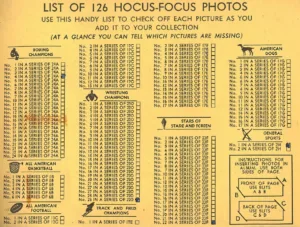
Topps also produced a dedicated storage album with a full printed checklist for the first 126-card series. A separate checklist was produced for the 1949 second series. Finding the album in any shape is a challenge on its own. Finding it intact with the checklist is a genuine score.
What Are They Worth?
Most Hocus Focus cards sit at the affordable end of the vintage market, especially the non-sport subjects. Many can be found in the single digits to low double digits. The baseball Hall of Famers are a different story. Cards for Babe Ruth, Ty Cobb, and Lou Gehrig regularly sell for $200 and up in decent condition, with well-developed examples pushing considerably higher. Cards for boxing legends like Joe Louis, Jack Johnson, and Jesse Owens in the track and field subset can command prices on par with many of the baseball names.
PSA population numbers for this set are extremely low, meaning graded copies are genuinely scarce. If you find a well-developed example with clean surfaces, grading it before selling could be well worth the cost.
If you pick up any of these cards, protecting them properly matters. Because of their unusual size, standard toploaders are oversized, but a penny sleeve fits fine as basic protection while you decide on long-term storage.
Topps Revisited the Format in 1955 and 1956
The concept was strong enough that Topps came back to it. In 1955, they released two separate Hocus Focus sets: a smaller format sold in penny packs and a larger format sold in nickel packs, both featuring baseball players alongside other subjects. Research by hobby historians has established that both versions were issued in 1955, even though the larger format was long attributed to 1956. A final version with 18 baseball subjects, in the larger size, followed in 1956.
The original post on this blog listed the return dates as “1955 and 1957,” which was incorrect. The correct years are 1955 and 1956. The 1955 baseball subset in the small format is considered by specialists to be among the most difficult of any Topps-issued set to complete, with some cards only confirmed in the last decade.
Can You Still Develop an Undeveloped Card?
This is one of the most fun questions in the hobby. In theory, yes, if a blank card was stored dry and away from light for 75-plus years, the photographic coating may still respond to moisture and sunlight. In practice, the chemicals degrade over time, and results are unpredictable at best. The possibility alone makes finding a blank 1948 Hocus Focus card quietly thrilling. Attempt development at your own risk, but document everything first.
As for chewing the original gum that came with these, please do not.
Where to Find Them
These cards do not flood the market, but they surface regularly on eBay, often mixed into general vintage lots rather than listed specifically under baseball cards. Searching for “Topps Magic Photos” or “Hocus Focus 1948” gets the best results. Non-sport subjects are the most affordable entry point into the set, and they let you appreciate the format without paying Hall of Famer prices.
Browse Hocus Focus listings on eBay
Do you own one of these cards? Or maybe even the original album? Drop a comment below and let us know what you have.
A weekly card rundown is coming
Market movers, set drops, and what is worth watching. Sign-ups open soon — the guides stay free either way.

Cards Mania Editorial Team
Cards Mania is an independent trading card media project covering sports cards, Pokémon, TCG, vintage cards, grading, collecting, card storage and hobby news. Articles are produced by the Cards Mania Editorial Team.
Related reads
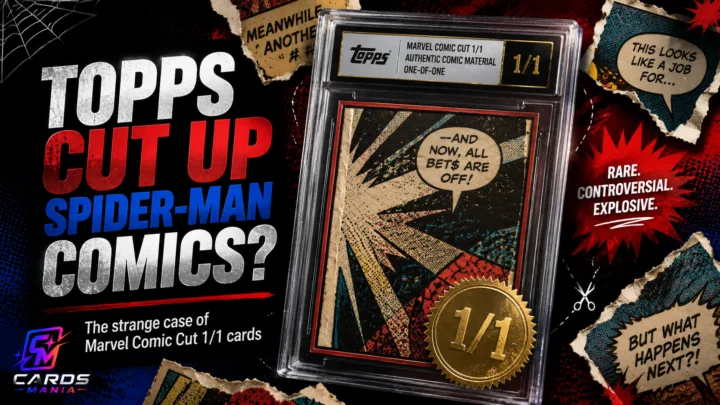
Would You Cut Up a Classic Spider-Man Comic for a 1/1 Card? Topps Did
Topps turned pieces from 15 classic Spider-Man comic issues into 1/1 Comic Cut cards for 2026 Mint Marvel. We traced the source…
Read more →
2026 Topps Chrome x Jennie: Checklist, Odds, Autos & Relics
Topps Chrome x Jennie brings K-pop photocard culture into the traditional trading card hobby with Refractors, numbered parallels, on-card autographs and concert-worn…
Read more →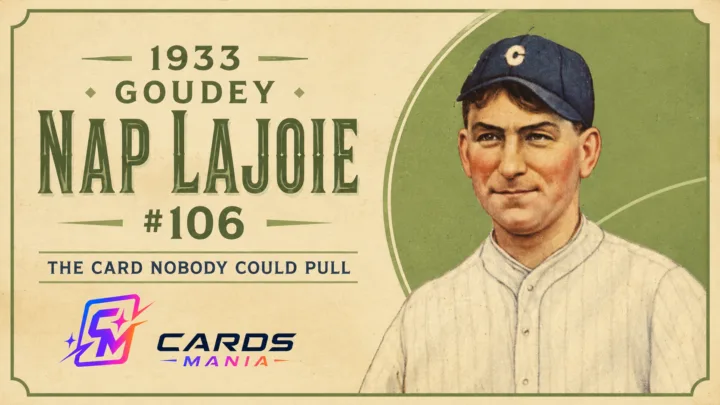
1933 Goudey Nap Lajoie #106: The Card Nobody Could Pull
Collectors could pull Babe Ruth and Lou Gehrig from 1933 Goudey packs, but card #106 was missing. Nap Lajoie #106 was printed…
Read more →