
1987 Terrorist Attack Trading Cards: The Real Story Behind the Fake Candy Company
 Cards Mania Editorial Team
·
·
8 min read
Cards Mania Editorial Team
·
·
8 min read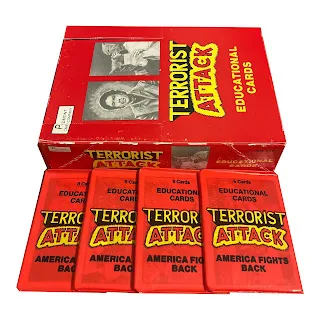
Some trading card sets are remembered for their stars. Others for their misprints. And then there is the 1987 Terrorist Attack set, which is remembered for being one of the strangest, sneakiest, and most quietly subversive non-sport releases of the Reagan era. The set claimed to come from a candy company that did not really exist, was illustrated in the bloody style of a horror comic, and tried to ride the cultural wake of Mars Attacks. And almost everything you have read about it online is slightly wrong.
The Quick Answer
The 1987 Terrorist Attack set is a 35-card non-sport release credited to the “Piedmont Candy Company” of Detroit. Piedmont Candy was a cover name. The real creator was Charles Mandel of Sports Design Products in Hazel Park, Michigan, who used the fake company to keep his real address off the wrappers. The cards were not banned, were not pulled from shelves in days, and full sets typically sell for around 15 to 25 dollars on the secondary market today. Sealed packs and complete display boxes are where the real money sits. The full checklist is documented on the Trading Card Database set page.
Who Actually Made the 1987 Terrorist Attack Cards
The cards list “Piedmont Candy Co.” of Detroit as the manufacturer. There is no record of a Detroit candy company by that name producing trading cards. The man behind the set was Charles Mandel, president of Sports Design Products in Hazel Park, Michigan, a Detroit suburb.
In a 1987 interview Mandel openly described himself as a “rabid American right-winger” and reportedly said he did not particularly care whether the cards turned a profit. He told reporters he sent free sets to President Ronald Reagan, Secretary of State George Shultz, and National Security Council member Oliver North. The cover company name was a deliberate move to keep his real address off the cards, partly out of caution about the subject matter.
Mandel reportedly mailed free sets to Reagan, Shultz, and Oliver North. He told reporters he did not particularly care if the cards turned a profit. The whole project, in his telling, was less about commerce and more about message.
It is one of the more unusual origin stories in non-sport cards. Most controversial sets came from corporate boardrooms taking a bet on edgy content. Terrorist Attack came from one ideologically driven collector with a printing budget.
What Is Actually On the Cards
The 35-card factory set profiles known terrorists, terrorist groups, terror tactics, and hypothetical future attack scenarios. Cards cover figures including Muammar Gaddafi alongside training camp profiles, hijacking incidents, and speculative attacks on American landmarks. The artwork is illustrated rather than photographic, in a comic-style execution. The original cards do not credit an artist, though the work has occasionally been attributed to illustrator Doug West in later collector commentary.
The packaging is its own oddity. The cards were sold in plain white boxes with no company branding visible. Each box held 36 wax packs. Each pack contained 8 cards. There was no bubble gum inside, despite the supposed candy company connection. The wrappers carry a 1986 copyright, but the actual release reached collectors in mid-1987.
The Hitler, Mussolini, and Manson Problem
The set’s working definition of “terrorist” was, to put it kindly, loose. Adolf Hitler and Benito Mussolini both made the cut, despite running uniformed state militaries rather than clandestine terror cells. Charles Manson appears too, despite being a cult leader and convicted murderer rather than a terrorist by any standard definition. Critics at the time read this as Mandel quietly slipping dictator and serial-killer imagery into a set that nostalgia-driven Horrors of War card fans would buy regardless of the label on the box. Mandel reportedly hinted at a planned follow-up set covering historical “maniacal leaders” including Caligula, Vlad the Impaler, and Herod. That set never made it to print.
The Eerie Pre-9/11 Predictions
One of the strangest things about Terrorist Attack is how prescient some of its scenarios turned out to be. Cards in the set warned of nuclear attacks, poison gas releases, and car bombings against targets including New York City, the Statue of Liberty, and domestic nuclear power plants. This was 14 years before September 11, 2001, at a time when the mainstream view of organized terrorism reaching American soil was, as one writer put it, treated as Chicken Little territory.
Was the Set Really Banned and Pulled?
This is where most internet retellings of the Terrorist Attack story go off the rails. The widespread claim is that public outrage forced the cards off shelves within weeks. Primary sources do not support that narrative.
Kurt Kuersteiner’s detailed 2006 history of the set in The Wrapper magazine notes that any backlash was, in his words, “more of a tempest in a teapot.” By 1987 the trading card hobby had already absorbed plenty of edgy content, and Terrorist Attack arrived as a minor curiosity rather than a national scandal. The headline-bait reaction never really happened.
The set sold through normal hobby channels. Underground comic legend Gary Arlington of the San Francisco Comic Book Company reportedly sold 72 packs on the first day they hit his shop. They quietly faded out of print like most independent non-sport sets do, not because activists forced them off shelves, but because the print run sold through and Mandel never reprinted them.

What Are 1987 Terrorist Attack Cards Worth Today
Reality is much less dramatic than the “hundreds of dollars” claim that gets repeated across collector blogs.
- Singles: Loose individual cards in nice condition typically sell for around 2 to 5 dollars each on eBay.
- Complete 35-card sets: Widely reported to trade in the 15 to 25 dollar range for ungraded sets in clean condition.
- Sealed wax packs: Single sealed packs run higher because they are vintage and the set was never reprinted. Pricing varies by listing.
- Full sealed display boxes (36 packs): The genuine prize. Sealed boxes appear infrequently on eBay and command the strongest prices in the set.
If you want to check live market data and grab a piece of one of the most peculiar non-sport sets of the 80s, current listings are easiest to browse on eBay.
Browse 1987 Terrorist Attack listings on eBay here.
Why Collectors Hunt This Set Now
The Terrorist Attack set sits in an unusual collecting category. It is too obscure for the mainstream non-sport crowd that built its hobby around Mars Attacks and Wacky Packages. It is too political for collectors who want pure nostalgia. And it is too independent for completionists who chase only Topps and Donruss-grade releases.
What it does have is a story. The fake candy company. The right-wing collector behind it all. The free cards posted to the White House. The Hitler card that probably should not be in a terrorism set. The pre-9/11 attack scenarios that read very differently in the 21st century. For a certain kind of collector, that combination is irresistible. The set has slowly built a quiet cult following among people who collect oddities, fringe Americana, and Cold War cultural artifacts.
If you do pick up loose cards or a sealed pack, do not store them naked in a shoebox. Vintage non-sport cardboard is fragile and these prints have been kicking around for nearly four decades. A stack of penny sleeves and toploaders plus an acid-free storage box is the bare minimum for protecting any 80s find before it deteriorates further.
Should Cards Like This Even Exist?
The Terrorist Attack debate quietly continues every time the set surfaces in a collector forum. Should card companies turn real-world violence into hobby product? Does the educational framing change the calculation? When Topps released its Enduring Freedom set after 9/11, the same arguments came back almost word for word. The Terrorist Attack cards are a useful case study because they show that the line keeps getting redrawn, set by set, era by era.
If the broader history of non-sport oddities interests you, books like Mars Attacks: 50th Anniversary Collection dig into the cult set that Mandel was so clearly trying to ride the wake of. They are a useful companion read for understanding why Terrorist Attack landed the way it did in 1987.
FAQ: 1987 Terrorist Attack Trading Cards
Who really made the 1987 Terrorist Attack cards?
Charles Mandel of Sports Design Products in Hazel Park, Michigan. The “Piedmont Candy Co.” name printed on the wrappers was a cover identity.
How many cards are in the set?
35 cards in the complete factory set.
Were the cards banned?
No. Despite popular retellings claiming the set was pulled from shelves, contemporary sources show no organized ban. The set simply sold through its limited print run and was never reissued.
How much are 1987 Terrorist Attack cards worth?
Loose singles typically sell for 2 to 5 dollars. Complete ungraded sets sell for around 15 to 25 dollars. Sealed packs and unopened display boxes command higher prices, with sealed boxes the most sought-after format in the set.
What was the inspiration for the set?
The title is widely understood as a deliberate riff on the 1962 Topps Mars Attacks set. Mandel appears to have hoped some of that cult notoriety would carry over.
Are 1987 Terrorist Attack cards rare?
Single cards and complete sets are not particularly hard to find on the secondary market. Sealed packs and especially sealed display boxes are genuinely scarce because the set was a single print run from a small independent publisher.
Got One in Your Collection?
If you owned a pack of these as a kid, picked one up at a card show, or stumbled on a sealed box in a relative’s basement, drop a comment below. The story of the 1987 Terrorist Attack set is still half-folklore, half-documented hobby history, and reader memories help fill in the gaps.
A weekly card rundown is coming
Market movers, set drops, and what is worth watching. Sign-ups open soon — the guides stay free either way.

Cards Mania Editorial Team
Cards Mania is an independent trading card media project covering sports cards, Pokémon, TCG, vintage cards, grading, collecting, card storage and hobby news. Articles are produced by the Cards Mania Editorial Team.
Related reads
Trading Card News: Magic God Packs, Brady SSPs, and a $7,700 Mario
CARDS MANIA / WEEKLY · OCTOBER 3-9, 2026 New pack formats, familiar faces and a smaller grading queue lead this week's trading…
Read more →
Card Grading Access: 78 of 250 Markets Documented
Cards Mania documents market-specific grading access in at least 78 of 250 markets under a strict primary-source evidence standard—and explains what that…
Read more →
Trading Card News: $8 Million Flagg, a Record-Chasing Pikachu, and Beckett Hits Pause Again
Cooper Flagg’s $8.04 million debut patch, an $8.4 million Art Academy Pikachu, Beckett grading delays, new card releases and Upper Deck Moments.
Read more →