Error Cards and Misprints: Value, Types and Fakes
 Cards Mania Editorial Team
·
·
8 min read
Cards Mania Editorial Team
·
·
8 min read
Updated August 16, 2026. Population counts and sale prices change. Every value in this guide is tied to a date, grade and exact card variety.
Error cards and misprints can be fascinating, valuable or completely ordinary. The difference is not how strange a listing looks. It is whether the feature happened during production, can be matched to a documented variety, survives authentication and has real collector demand.
You can browse current error-card and misprint listings, but search results mix certified errors, ordinary defects, custom cards and wishful descriptions. Use the checks below before treating any asking price as evidence.
Error, variation, miscut or alteration?
| Term | What it means | Typical evidence | Value outlook |
|---|---|---|---|
| Printing error | A factory problem such as a missing color, registration shift, obstruction, wrong back or ink defect | Repeat examples, known sheet position, matching print characteristics or grading-company recognition | Can carry a premium when dramatic, scarce and authenticated |
| Miscut | The sheet was cut outside its intended card boundaries | Factory-consistent edges and corners, adjacent-card content or registration marks, expert review | Demand varies sharply by game, severity and eye appeal |
| Variation | A repeatable difference between printings, sometimes created intentionally | Catalog listing, population-report label, set research or manufacturer history | Scarce, recognized versions can command a premium |
| Post-factory alteration | Someone erased ink, added a stamp, trimmed an edge or otherwise changed the card later | Tool marks, wrong ink or foil response, inconsistent corners, failed authentication | Usually damages value and must not be sold as a factory error |
Six famous cards, correctly classified
1989 Fleer Bill Ripken #616
The original card shows an obscenity written on the knob of Ripken’s bat. Fleer issued several censor versions, commonly cataloged as the uncensored FF error, black box, black scribble, white scribble and whiteout. Label wording can differ, so compare the exact front and certification description before buying.
The uncensored card is famous, but it is not uniformly rare. PSA’s database showed 3,066 PSA 10 examples on the certification page checked in August 2026. PSA recorded July 27, 2026 sales of $1,300 and $1,290 for PSA 10 examples. Lower grades sell for much less. Compare the exact Billy Ripken version and grade, not the headline alone.
Broad trading card searches are useful for discovery, but sold records and exact labels are the better comparison tools.
1990 Topps Frank Thomas #414 No Name on Front
The NNOF card is not simply a normal Thomas rookie with the name erased. Authentic copies are missing other black ink as well, including much of the Topps logo and parts of the lower border. That makes a front-only marketplace photo inadequate.
PSA’s CardFacts record showed a PSA 3 sale for $6,622 on September 23, 2025, while a PSA 8 sold for $12,197 on August 26, 2024. Those are historical examples, not promises about the next sale. Use the current NNOF marketplace only after reading the Cards Mania Frank Thomas NNOF authentication and value guide.
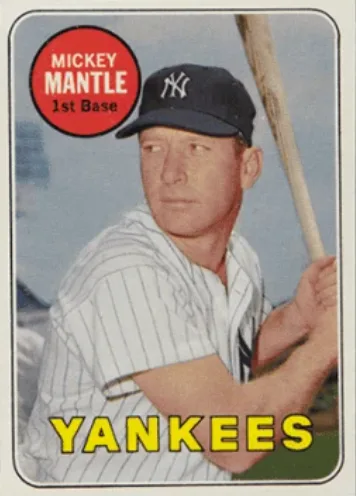
1969 Topps Mickey Mantle #500 white letters
Mantle’s last Topps card exists with his last name printed in white or yellow. The white-letter card belongs to a wider group of scarce white-letter variations in the #440 to #511 range, not a Mantle-only accident. PSA describes the white version as limited and recognizes it as a distinct variety. Check the exact Mickey Mantle white-letter listing, grade and label before comparing prices.
Base Set Pikachu with red cheeks
English Base Set Pikachu with red cheeks is better treated as a print variation than a random factory misprint. Wizards of the Coast changed the original Japanese yellow-cheek artwork to red for early English production, then later printings returned to yellow. Edition, shadow treatment, card number, language and condition all affect the comparison.
The full history of Pokémon cards explains why release and print context matters. Current red-cheek Pikachu listings should be filtered to the exact English version you are researching.
Base Set Prerelease Raichu
Prerelease Raichu is a genuine stamp error, but casual claims deserve extreme caution. In November 2023, CGC authenticated two examples using provenance, specialized imaging, magnification and X-ray fluorescence comparison with genuine Prerelease Clefable stamps. Both traced back to former Wizards of the Coast employees.
CGC said it could not prove the long-repeated claim that only 11 were made. It could prove that at least two genuine examples existed. That is the honest boundary. An unauthenticated card with a green stamp is not equivalent to either certified example, and no public asking price proves value. Treat Prerelease Raichu listings as leads that require elite provenance and authentication.
1994 Summer Magic Hurricane
Hurricane is a green Magic card, but the recalled Summer Magic printing put it in a blue frame. Wizards of the Coast has described the run, internally called Edgar, as a replacement printing that was scrapped because the cards still had problems. Most boxes were destroyed, although a small number escaped into the market.
This is a true, documented color-frame error from an unreleased print run. Even so, a buyer should verify the full Summer Magic characteristics rather than relying on a blue frame alone. Compare Blue Hurricane listings only with authenticated or strongly proven examples.
What makes an error card valuable?
- Recognition: the hobby or a major grading service identifies the feature consistently.
- Factory origin: evidence shows the feature happened during production, not after release.
- Scarcity: the exact variety is meaningfully harder to find, supported by populations or specialist research.
- Visibility: collectors can see and understand the difference without an elaborate story.
- Subject demand: a major player, character or historically important set usually has a larger buyer pool.
- Condition and eye appeal: an error does not erase ordinary condition problems.
- Provenance: for extreme rarities, documented ownership can be essential to authenticity.
A small print dot, ordinary off-centering or common production line rarely creates a large premium. The market pays for documented differences and collector demand, not every flaw.
How to evaluate a claimed error before buying
- Name the exact feature. Ask whether it is a missing ink layer, wrong back, miscut, stamp error, corrected variation or something else.
- Request clear images. Get front, back, edges, corners and close-ups of the feature under neutral light.
- Look for another documented example. Compare print pattern, cut, color, stamp position and surrounding design.
- Check the grading label and certification. Confirm that the service recognizes the same variety. A valid certification number does not authenticate a different physical card.
- Use population reports carefully. Services may begin labeling a variety years after earlier copies were graded, so counts can be incomplete.
- Compare realized sales. Match the card, variation, grade, date and marketplace. Ignore unsold asking prices.
- Escalate unusual claims. A one-of-a-kind stamp or dramatic miscut should receive expert review before a high-value purchase.
Marketplace browsing still has a role. Search current trading-card listings, save exact searches and study sold examples. Just keep discovery separate from proof.
Check current error-card and misprint listings
Error cards and misprints FAQ
What is the difference between an error card and a variation?
An error comes from a production mistake such as missing ink, a wrong back, a bad cut or an accidental stamp. A variation is a repeatable difference between printings and may result from a deliberate correction or design change. Catalogs and grading labels sometimes use the terms differently, so identify the exact feature.
Are all misprint cards valuable?
No. Value depends on factory origin, recognition, scarcity, visibility, subject demand, condition and provenance. Small print dots, ordinary off-centering and common defects often add little or no premium.
How can I tell if a miscut card is real?
Check factory-consistent edges and corners, adjacent-card content or registration marks, and documented examples from the same product. Extreme claims should be authenticated because cards cut from uncut sheets after production can imitate factory miscuts.
Is red-cheek Pikachu an error card?
It is more accurately described as an early English print variation. Wizards of the Coast changed the original Japanese yellow cheeks to red, then later English printings used yellow again. Edition, shadow treatment and language still need to be matched.
Is Prerelease Raichu real?
Yes, at least two examples are proven. CGC authenticated two in 2023 using former Wizards of the Coast provenance and forensic comparison with genuine Prerelease Clefable stamps. CGC did not prove the often-repeated claim that only 11 were made.
Bottom line: buy the evidence, not the story. A documented error with clear factory characteristics, recognized labeling and matched sales can be a serious collectible. A strange-looking card with no provenance may be ordinary damage or an alteration.
A weekly card rundown is coming
Market movers, set drops, and what is worth watching. Sign-ups open soon — the guides stay free either way.

Cards Mania Editorial Team
Cards Mania is an independent trading card media project covering sports cards, Pokémon, TCG, vintage cards, grading, collecting, card storage and hobby news. Articles are produced by the Cards Mania Editorial Team.
Related reads
Would You Cut Up a Classic Spider-Man Comic for a 1/1 Card? Topps Did
Topps turned pieces from 15 classic Spider-Man comic issues into 1/1 Comic Cut cards for 2026 Mint Marvel. We traced the source…
Read more →
Black Lotus Card: Price, History, Rarity and Record Sales Explained
Black Lotus is Magic’s defining trophy card, led by the original Alpha, Beta and Unlimited printings. This guide covers print estimates, authenticity,…
Read more →
1987 Terrorist Attack Trading Cards: The Real Story Behind the Fake Candy Company
The 35-card 1987 Terrorist Attack set used the fictional Piedmont Candy Company name, but creator Charles Mandel was behind it. Contemporary sources…
Read more →