
1954 Topps World on Wheels: The Collector’s Guide to This Wildly Underrated Set
 Cards Mania Editorial Team
·
·
15 min read
Cards Mania Editorial Team
·
·
15 min read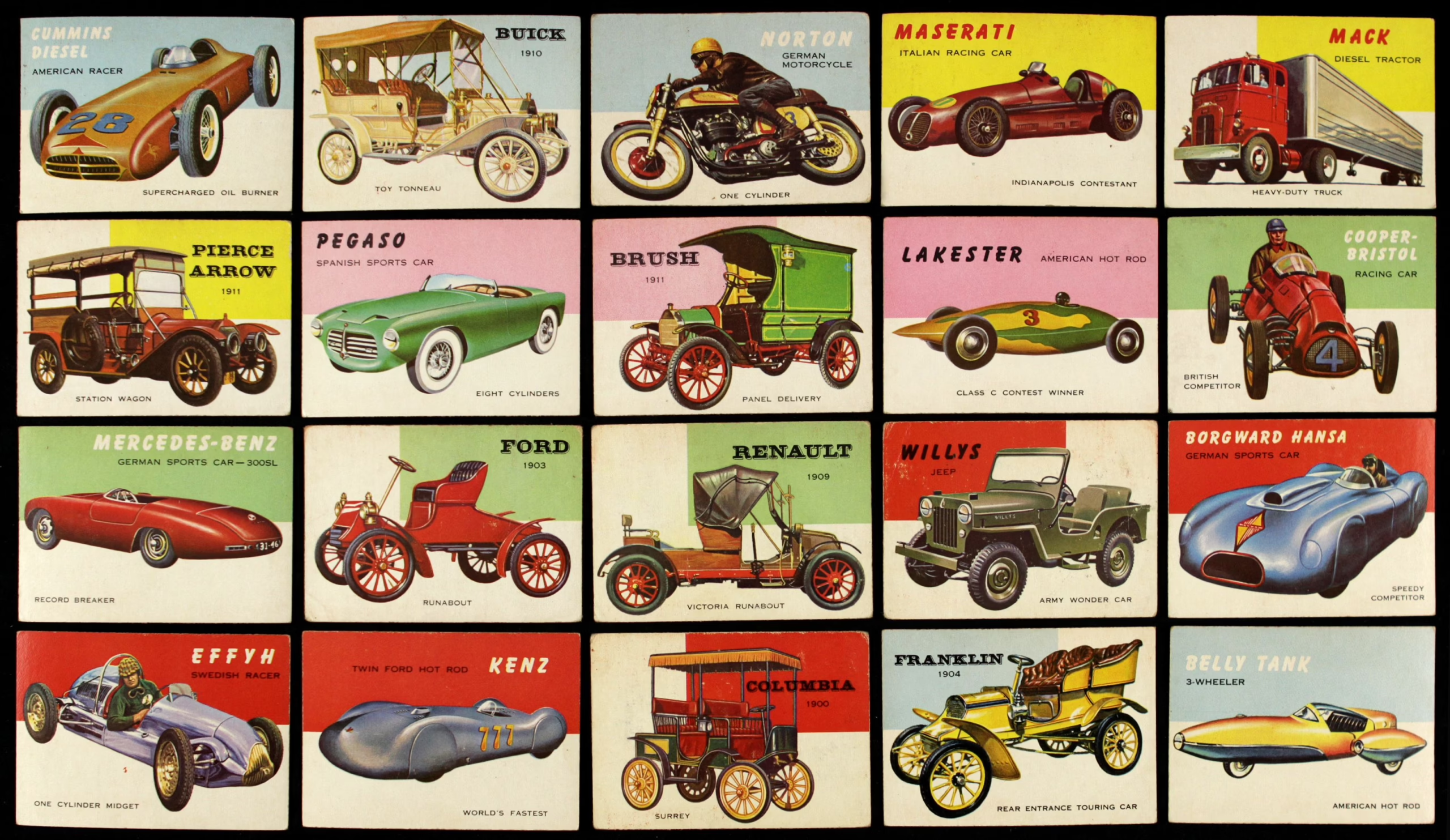
Let’s get one thing out of the way immediately. Nobody actually knows when this set came out.
The wrappers say 1954. A contest insert inside a 5-cent box has an expiration date of December 20, 1953. The last 20 cards in the set feature 1955 car models. Hobby historians have been arguing about it for decades, and the official position right now is basically “somewhere between late 1953 and late 1954, probably.” For a set called 1954 Topps World on Wheels, that is a genuinely spectacular level of confusion about a foundational fact.
Welcome to one of the most interesting non-sport sets Topps ever produced.
The World on Wheels set (American Card Catalog reference R714-24, if you want to feel official) is a 180-card journey through automotive history spanning from 1896 all the way to brand-new 1955 models. Cars, trucks, fire engines, military vehicles, experimental dream cars, motorcycles, and at least one vehicle that looks like someone bolted two cars together and called it innovation. All illustrated in vivid color on cards slightly larger than modern standard size, sold with Wheels Bubble Gum for one or five cents a pack.
It is not especially expensive to collect. It is not aggressively hunted by the mainstream hobby. It is, however, genuinely fascinating cardboard with a history full of odd facts, unsolved puzzles, and at least one completely unforgettable car that nobody wanted to buy at the time and everyone wants to talk about now.
What Is the 1954 Topps World on Wheels Set?
Short answer: 180 cards, landscape format, highly detailed color illustrations, printed by Topps Chewing Gum out of Brooklyn, New York.
Longer answer: it is one of Topps’ transportation-themed non-sport releases from the early 1950s, a period when the company was experimenting aggressively with subjects beyond baseball. The set covers vehicles from 1896 to 1955, including American passenger cars, European sports cars, fire trucks, Army tanks, concept cars, racing machines, a scooter or two, and a concrete mixer. Card #1, for example, is a Diamond T Concrete Mixer. Card #27 is a Mercedes-Benz 300SL. The set does not discriminate. If it has wheels, it’s in.
Each card measures 2-5/8 by 3-3/4 inches, which is slightly oversized by today’s standards. The front carries a colorized illustration of the vehicle with the make, model, and year printed clearly. The back lists the card number, a descriptive paragraph about the car, and a small “World on Wheels” historical vignette, a little drawing with a short anecdote that changes from card to card. They are charming, educational, and a genuinely good read if you enjoy knowing that the 1896 De Dion Bouton Tricycle had one cylinder and made about one and a half horsepower.
The set is also sometimes called the “Wheels” set, because that is literally what it says on the wrappers. “World on Wheels” is the name printed on the backs of the cards themselves, and that is the name that stuck with collectors. Topps apparently couldn’t decide either.
The Two Mysteries Every World on Wheels Collector Should Know
Serious researchers have identified two genuine unsolved puzzles in the history of this set. They are not mysteries in the dramatic sense, but for people who care about vintage cardboard, they are the kind of thing that keeps you up at night.
Mystery One: When was it actually released?
The set was originally produced as 160 cards. That part is agreed upon. The first wrapper indicates vehicles from 1896 to 1954, and a contest insert from a 5-cent box has an expiration date of December 20, 1953, which is the strongest evidence that the original 160-card set hit store shelves in late 1953. But 1954 car models appear throughout those first 160 cards, which makes sense because automakers unveiled new model years in the fall. So the set launched in late 1953 featuring cars marketed as 1954 models, exactly the way a 2026 car can be sitting on a showroom floor in 2025.
Then there are the final 20 cards, numbers 161 to 180, which feature 1955 models including the Chrysler 300 and the Cadillac Eldorado Brougham Show Car. These were clearly added later, probably in late 1954, to keep the set current. And just to finish things off, The Card Collectors Bulletin of August 1956 stated that Topps added 20 cards to “Wheels” in 1956, which researchers believe is simply a typo and should read 1955. Probably. Nobody knows for certain.
The result is a set that was collected across at least two years, possibly three, with wrappers that advertise different date ranges depending on which version you find.
Mystery Two: Why do some backs come in red and some in blue?
Cards 161 to 170 are found with red backs only. Cards 171 to 180 are found with both red and blue backs, and the blue-back cards do not show the T.C.G. copyright notice. Nobody has ever fully explained why the two colors exist or what the distinction means in terms of production run or distribution. The blue-back variants of cards 171 to 180 are the rarer version, and they carry a premium on the market. But the reason for their existence? Still officially unknown.
For collector purposes: if you find a card from the final ten in the set with a blue back, you have the scarcer version. Whether that matters to you depends on how deep you want to go into this particular rabbit hole.
The Set Structure: A Story in Three Acts
Think of the World on Wheels set in three parts, because that is essentially what it is.
Cards 1 to 160 form the original release. These are the relatively common cards, though “relatively common” for a 70-year-old non-sport set still means patience is required. You will find a Diamond T Concrete Mixer, a 1903 Ford Runabout, a 1911 Stanley Steamer, an M24 General Chaffee tank, a Willys Jeep, a Maserati, an Alfa Romeo, a Ferrari, and about 150 other vehicles that range from legendary to completely forgotten. Several vintage fire trucks. A fair number of Army vehicles. The occasional motorcycle. Card #160, the Haynes-Apperson Touring Car of 1905, commands a significant price premium over cards 1 to 159, because it is the last card of the original run and was positioned at the end of printing sheets where it took the most damage from handling.
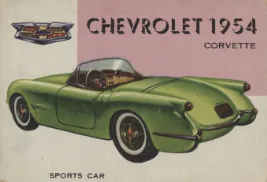
Cards 161 to 170 are the first wave of high numbers, added to the set sometime in 1954. These all carry red backs and include a 1954 Chevrolet Corvette (#161), a 1954 Ford Thunderbird (#169, spelled “Thunderbiord” on the card due to a typo nobody caught), a 1954 Buick Skylark (#170), and a 1954 Packard Caribbean (#163). These are significantly harder to find than the first 160 cards. The Corvette and Thunderbird, in particular, are the most desirable single cards in the set.
Cards 171 to 180 are the rarest of all, featuring 1955 models and Motorama dream cars. These come in both red-back and blue-back versions. The blue backs are harder to find. This final run includes the Pontiac Strato-Star Dream Car (#171), the Chevrolet Biscayne Dream Car (#172), the Buick Wildcat III Dream Car (#173), the Chrysler 300 (#176), the Cadillac Eldorado Brougham Show Car (#177), and the Ford Crown Victoria (#180). An almost complete raw set of 163 cards, missing most of the high numbers, was listed for a break-up value of $1,654 when sold separately, which gives you a sense of how quickly the high-number cards inflate the total cost of completing the set.
The Wildest Card in the Set: Card #135, the Reeves Octoauto
Every great trading card set has that one card. The card that makes people stop, look again, and say “wait, that was a real thing?”
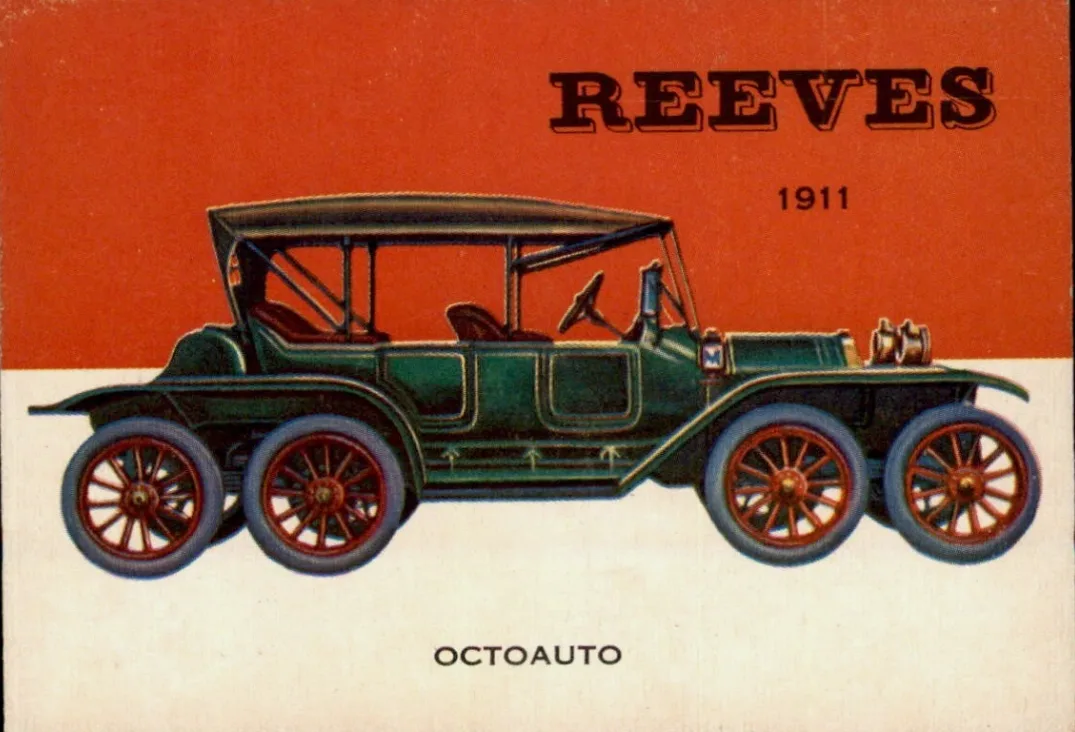
Card #135 is the Reeves Octoauto, and it is the most spectacular automotive failure ever to be immortalized on cardboard.
Here is the story. In 1911, an inventor from Columbus, Indiana named Milton Reeves had a problem. American roads were terrible. Car suspensions were primitive. Passengers were being rattled to pieces on every journey. Milton Reeves looked at this problem, looked at trains (which used four-wheel “bogies” at each end of each car to absorb shocks), and concluded that the solution was obvious. He modified a 1910 Overland by adding four wheels and creating two sets of four in front and back, creating a vehicle over 20 feet long.
He called it the Octoauto. It had eight wheels, four axles, seating for four passengers, a 40-horsepower engine, and a price tag of $3,200 at a time when a Ford Model T cost $690.
Milton Reeves took the Octoauto on a barnstorming tour of the Midwest. He visited the inaugural Indianapolis 500, where crowds found the vehicle’s $3,200 sticker less compelling than the race cars themselves. He advertised it as “the only easy riding car in the world.” A well-known writer of the era named Elbert Hubbard wrote two full pages of enthusiastic prose praising the Octoauto’s engineering logic. None were ever sold.
Undeterred, Reeves removed two of the front wheels, renamed it the Sextoauto, and tried again in 1912 on a brand new Stutz chassis. The Sextoauto’s price was even higher, and sales were few. None of either vehicle is known to survive today.
So what we have is this: a card featuring a car of which zero examples exist anywhere on earth, built by a man who invented over a hundred other things and died in 1925 having never sold a single one of his wheeled masterpieces. The card itself costs about a dollar in decent raw shape. The history behind it is worth considerably more than that.
The Octoauto card is the single best reason to collect the World on Wheels set. Not for its value. For its story.
Other Cards Worth Talking About
The Octoauto gets the spotlight, but the rest of the set earns it too. Here are some other cards that deserve attention.
Card #14: The Gatso “Cyclops”
The Gatso Cyclops was a Dutch racing car built by Maurice Gatsonides, a rally driver obsessed with measuring his own cornering speed. The single centrally mounted headlight earned it the nickname. Gatsonides later invented a device to clock vehicles precisely through corners. You almost certainly know his invention by a different name: the Gatso speed camera, now a fixture on roads across Britain and Europe and the source of considerable bad language on the morning commute. A man built a racing car, put it on a trading card, and accidentally gave the world its most unpopular contribution to road safety. Remarkable.
Card #50: The Astra-Coupe Dream Car
One of several experimental dream cars scattered through the set, the Astra-Coupe was a two-place concept with a futuristic enclosed canopy design, the kind of body style that belongs in a 1950s science fiction serial. These dream car cards capture something specific about postwar American optimism: the genuine belief that by 1965 we would all be piloting personal aircraft shaped like Jell-O molds. Almost none of these concepts made it to production, which makes the card feel like a small window into a future that never happened.
Card #74: The 1953 Cadillac El Dorado Convertible
The car that defined postwar American luxury. The 1953 Eldorado was produced in very limited numbers and cost $7,750, which was more than twice the price of a standard Cadillac. Having it appear on a trading card sold for a penny is one of the great ironies of the hobby.
Cards 161 and 169: The Corvette and the Thunderbird
The 1954 Chevrolet Corvette (#161) and the 1954 Ford Thunderbird (#169) are the two most coveted cards in the set for obvious reasons. Both are high numbers, meaning they are genuinely hard to find. Both feature two of the most iconic American cars ever built. And card #169 has a typo, “Thunderbiord,” that was apparently never corrected. Collectors can’t agree on whether the typo makes the card more desirable or just funnier. Probably both.
(Card #135 is the Octoauto. It was covered earlier. Go back and read it again if you skipped it. Seriously.)
Cards 171 to 173: The Motorama Dream Cars
The Pontiac Strato-Star, Chevrolet Biscayne, and Buick Wildcat III were all General Motors Motorama show cars, concepts that toured the country as visions of what American cars might become. They are extraordinary to look at, they are the hardest non-blue-back cards in the set to find in high grade, and they appear on cardboard that most collectors have never heard of. That last part is their problem and your opportunity.
What Does the World on Wheels Set Cost to Collect?
This is where it gets interesting, because the answer is “wildly different depending on how far you want to take it.”
Cards from the first 160, in decent raw condition, generally run from a dollar to a few dollars each. Some of the more obscure industrial vehicles and early motoring oddities cost even less, because demand is thin and supply is thin too, which is vintage non-sport collecting in a nutshell. Finding a complete run of numbers 1 to 160 in nice shape takes patience, but it should not break the bank for most collectors even on a tighter budget.
The high numbers are where the budget goes. Cards 161 to 170 (red backs) start to climb toward $20 to $50 each in decent raw shape for the popular models. Cards 171 to 180 in red backs are harder. Blue backs of 171 to 180 are the toughest pull in the whole set and command meaningful premiums when they surface.
PSA-graded examples of any high number in PSA 7 or above are relatively rare. PSA population numbers for this entire set are small compared to any vintage sports set of the same era. That means genuine high-grade examples carry legitimate collector weight.
For the budget-conscious: building a nice raw set of cards 1 to 160 is entirely doable and extremely rewarding. That is a complete story of automotive history from 1896 to 1954 on 160 cards, for a total cost that most collectors could manage over a few months of patient hunting.
How to Collect World on Wheels: Practical Notes
Storage
The cards measure 2-5/8 by 3-3/4 inches, which is slightly larger than modern standard (2-1/2 by 3-1/2 inches). Standard penny sleeves will not fit without forcing the card, which is a bad idea. Look for vintage card sleeves or slightly oversized toploaders. This is not a reason to avoid the set, just something to sort out before your first order arrives.
These oversized toploaders on Amazon work well for cards in the 2-5/8 by 3-3/4 inch range. Pick up a pack of slightly larger penny sleeves alongside them and your vintage cards will be properly protected without bending a single corner.
Grading
For the main 160-card run, grading rarely makes financial sense given the low per-card values. For the high numbers, particularly the blue-back variants and the Corvette and Thunderbird cards, PSA grading can be worthwhile if the card is in strong condition. The tiny population numbers mean even a PSA 6 on a high-number World on Wheels card is a meaningful piece. If you are new to grading vintage non-sport cards, a general card grading and collecting reference on Amazon covers condition standards clearly and is worth having on the shelf.
Where to find them
eBay is the primary source. Search “1954 Topps World on Wheels,” “Topps Wheels 1953,” and “R714-24” (the American Card Catalog reference number) for the broadest results. Specialist non-sport dealers carry singles regularly. Card shows occasionally surface box lots of vintage non-sport cards where World on Wheels singles turn up mixed in with other 1950s Topps sets.
Organizing a growing collection
Once you have a run of cards building up, a proper binder system beats a shoebox every time. Collector binder pages sized for slightly oversized vintage cards are available on Amazon and make browsing your set far more satisfying than rooting through a box, especially once the high numbers start arriving.
The fan additions
One last piece of trivia worth knowing: a collector named Bob Lemke created ten unofficial fan continuation cards, numbered 181 to 190, that continue the original set’s style with red or blue backs consistent with cards 171 to 180. These are not original Topps cards and are not considered part of the set by the collecting community. But they exist, and occasionally show up in lots without being identified as fan creations. Worth knowing so you are not confused when you encounter them.
World on Wheels: The Questions Collectors Actually Ask
- How many cards are in the 1954 Topps World on Wheels set?
- 180 cards total, numbered 1 to 180. The original series was 160 cards; 20 more were added later featuring 1954 and 1955 models.
- What are the rarest World on Wheels cards?
- Cards 171 to 180 are the rarest. The blue-back variants of cards 171 to 180 are rarer than the red-back versions. Card #160 (Haynes-Apperson Touring Car 1905) commands a premium as the last card of the original printing run.
- What are the key cards in the set?
- Card #161 (1954 Chevrolet Corvette), card #169 (1954 Ford Thunderbird, note the “Thunderbiord” typo), card #177 (1955 Cadillac Eldorado Brougham Show Car), card #135 (1911 Reeves Octoauto), and cards 171 to 173 (GM Motorama dream cars).
- Is the set from 1953 or 1954?
- Most likely released in late 1953, with the high-number series (cards 161 to 180) added in 1954 to 1955. The exact dates are genuinely disputed among researchers.
- What is the difference between red back and blue back World on Wheels cards?
- Cards 1 to 170 have red backs only. Cards 171 to 180 exist with both red backs and blue backs. The blue-back versions are rarer and do not carry the T.C.G. copyright notice. The reason for the two versions has never been definitively explained.
- What is the American Card Catalog reference for this set?
- R714-24.
Should You Collect the 1954 Topps World on Wheels Set?
Yes, honestly. Here is why.
It is one of the most visually appealing vintage non-sport sets ever made. The color illustrations hold up beautifully. The subject matter covers 60 years of automotive history in a way that makes every card feel like a small discovery. The first 160 cards are accessible and affordable. The high numbers give you something to chase if you want a longer-term goal. And the whole thing sits in a corner of the hobby where competition is light and prices reflect that.
There is also the matter of what the set represents historically. These cards were printed before most of the people reading this were born. They were sold for a penny with bubble gum. A kid in Brooklyn in 1953 could pull a card featuring the brand-new 1954 Corvette, one of the most significant American cars ever built, for one cent. That is genuinely remarkable.
And somewhere in the middle of that set, card number 135, there is an eight-wheeled car that nobody bought and nobody preserved, illustrated in vivid color on 70-year-old cardboard because someone at Topps thought it deserved to be remembered.
They were right.
Already collecting World on Wheels? Have a high-number or blue back? Tell us about it in the comments. And if you’re just getting started with vintage car cards, check out our full guide to Cards on Wheels: The Full History of Muscle Car, Corvette and Harley-Davidson Trading Cards for more sets worth chasing.
This post contains affiliate links. If you purchase through them, CardsMania.fun may earn a small commission at no extra cost to you. We only recommend products we genuinely believe in.A weekly card rundown is coming
Market movers, set drops, and what is worth watching. Sign-ups open soon — the guides stay free either way.

Cards Mania Editorial Team
Cards Mania is an independent trading card media project covering sports cards, Pokémon, TCG, vintage cards, grading, collecting, card storage and hobby news. Articles are produced by the Cards Mania Editorial Team.
Related reads

MTG The Hobbit 2026: Complete Collector & Player Guide
Magic: The Gathering | The Hobbit released August 14, 2026. This updated guide covers HOB and HOC legality, products, mechanics, Dwarvish cards…
Read more →
Palworld Card Game Guide: Cards and Rules
Palworld OFFICIAL CARD GAME launched worldwide on July 30, 2026. This updated guide covers Dawn of Palpagos, rules, rarities, errata, events and…
Read more →
What Is a Rookie Card? Meaning, Examples and Collector Value
A rookie card is generally one of an athlete’s first mainstream cards after reaching the top professional level, but licensing, set type…
Read more →