
Pokémon Cards History and Value: 1996 to 2026
 Cards Mania Editorial Team
·
·
6 min read
Cards Mania Editorial Team
·
·
6 min read
Updated: August 16, 2026
Pokémon cards began in Japan in October 1996, eight months after Pokémon Red and Green arrived on Game Boy. The familiar 102-card English Base Set came later, in 1999. Keeping those two launches separate is the first step toward understanding early Pokémon cards and their value.

From Game Freak to Pokémon Red and Green
Satoshi Tajiri founded Game Freak and led the idea that became Pocket Monsters. The concept drew on collecting, discovery, and trading creatures between Game Boy systems. Ken Sugimori shaped the visual identity of the original Pokémon, while Nintendo and Shigeru Miyamoto helped the project reach the market.
Game Freak had already developed titles including Pulseman and Mario & Wario. They show the studio’s work before Pokémon, but they should not be presented as games created by Tajiri alone.
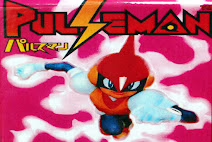
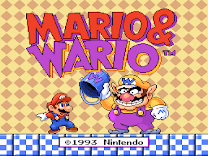
Pokémon Red and Green launched in Japan in February 1996. Trading through the Game Boy Link Cable made collecting a social activity, since no single version offered every Pokémon.
The Japanese TCG and English Base Set are different milestones
| Date | Milestone | Why it matters |
|---|---|---|
| February 1996 | Pokémon Red and Green launch in Japan. | The games establish catching, battling, and trading as the franchise’s core loop. |
| October 1996 | The Pokémon Trading Card Game launches in Japan. | This is the beginning of the physical Pokémon TCG, not the English Base Set. |
| 1999 | Wizards of the Coast releases the 102-card English Base Set in the United States. | This set contains the English 1st Edition, Shadowless, and Unlimited print distinctions collectors compare today. |
| 2004 | The Pokémon World Championships begin. | Organized play becomes a lasting international pillar, with the 2020 and 2021 events canceled during the pandemic. |
| October 2024 | Pokémon TCG Pocket launches. | The card game expands into a new digital collecting format alongside the physical TCG. |
The Pokémon Company reported more than 75 billion cards produced, 16 languages, and sales in more than 90 countries and regions as of March 2025. That scale explains the game’s reach. It does not make every card scarce.
How to tell 1999 English Base Set printings apart
| Printing | Identification | Market context |
|---|---|---|
| 1st Edition | Circular Edition 1 stamp at the lower left of the artwork box, thin HP font, and no artwork-box drop shadow. | The earliest English print run and usually the most sought after when card and condition match. |
| Shadowless | No Edition 1 stamp, but still no drop shadow and the thinner early HP font. | A distinct early printing, generally valued between 1st Edition and Unlimited. |
| Unlimited | No Edition 1 stamp, with a drop shadow along the right side of the artwork box and thicker HP font. | Printed in greater quantity and often the most accessible Base Set route. |
Why condition and grading change price
Professional grading can make a card easier to compare and sell because the holder identifies the card, assigns a grade, and provides a certification number. It does not create condition that was not already there, and it does not guarantee a profit.
Price gaps between grades vary. A low-population trophy card may show an enormous premium at the top grade, while a common modern card may not recover the grading fee. Compare recent sales for the same set, language, printing, card number, grading company, and grade.
- Inspect centering, corners, edges, surface, print lines, dents, and scratching before submitting.
- Check the current population report, but remember populations change.
- Verify a slab’s certificate and confirm the physical card and holder match the record.
- Calculate grading fees, shipping, insurance, selling fees, and likely net proceeds.
The $16.492 million Pikachu Illustrator record
On February 16, 2026, a PSA Gem Mint 10 Pikachu Illustrator sold through Goldin Auctions for $16,492,000, including buyer’s premium. Guinness World Records recognizes it as the most expensive trading card sold at auction. The card was originally awarded through a Japanese illustration contest and the sold copy is the only PSA 10.
That result is a trophy-market event. It should not be used as a multiplier for Base Set cards, modern chase cards, or sealed products. Record sales happen through auction houses and private deals, and every result needs its exact card, grade, provenance, fees, and transaction type.
Seven checks before valuing a Pokémon card
- Identify the language and set. Japanese 1996 cards and English 1999 Base Set cards are different products.
- Match the collector number. Character name alone is never enough.
- Confirm the printing. Check 1st Edition, Shadowless, Unlimited, promo, reverse holo, and other variants carefully.
- Judge actual condition. A clean photo does not prove a grade.
- Use completed sales. Active listings show seller expectations, not market-clearing prices.
- Separate raw and graded comps. Match grading company and grade for slabs.
- Allow for liquidity. A rare card can still take time to sell at a defensible price.
Where collectors research and buy
Different platforms answer different questions. TCGplayer is useful for raw singles and recent-sales market context. eBay provides broad active and completed listing coverage. Whatnot offers live sales, but confirmed bids are binding and card Buyer Protection deadlines are short. Major auction houses handle some high-end material, but no venue removes the need for identification and due diligence.
Read our updated Whatnot buyer guide and TCGplayer buyer and seller guide before using those platforms.
Compare vintage Pokémon listings
Browse graded Pokémon cards
Check sealed Pokémon products
Explore Pokémon shows on Whatnot
Compare live Pokémon listings
Browse Pokémon on TCGplayer
Check raw Pokémon singles
View more Whatnot Pokémon streams
Compare TCGplayer Pokémon prices
More Cards Mania reading: What is Whatnot? | How TCGplayer works | TCG articles
Quick answers
When did Pokémon cards first launch?
The Pokémon Trading Card Game launched in Japan in October 1996. The 102-card English Base Set was released in the United States in 1999.
How many cards are in the 1999 English Base Set?
The English Base Set contains 102 cards. Its early printings include 1st Edition, Shadowless, and Unlimited versions.
What is the most expensive Pokémon card sold at auction?
A PSA 10 Pikachu Illustrator sold through Goldin Auctions for $16,492,000 on February 16, 2026. Guinness recognizes it as the auction record for any trading card.
Does grading always increase a Pokémon card’s value?
No. Grading identifies and evaluates a card, but the price effect depends on the card, grade, population, demand, fees, and recent comparable sales.
Are all Base Set cards rare?
No. Set, printing, card, and condition matter. Unlimited Base Set cards are generally more available than comparable 1st Edition or Shadowless cards.
Shop and compare
Browse Pokémon streams on Whatnot
Check vintage 1st Edition Pokémon listings on eBay
Sources
The Pokémon Company history | Pokémon in figures | PSA 1999 Base Set guide | PSA Pokémon print guide | Guinness auction record
A weekly card rundown is coming
Market movers, set drops, and what is worth watching. Sign-ups open soon — the guides stay free either way.

Cards Mania Editorial Team
Cards Mania is an independent trading card media project covering sports cards, Pokémon, TCG, vintage cards, grading, collecting, card storage and hobby news. Articles are produced by the Cards Mania Editorial Team.
Related reads
Pokémon 30th Anniversary Cards 2026: Release Calendar
Pokémon TCG: 30th Celebration launches worldwide on September 16, 2026. Here is the updated calendar of ETBs, promos, regional releases and later…
Read more →
Digimon Trading Cards: The Complete Collector’s Guide (History, Value & Where to Buy)
Disclosure: This post contains affiliate links. If you purchase through them, we may earn a small commission at no extra cost to…
Read more →
Best One Piece TCG Cards and Sets to Watch in 2026
Disclosure: This post contains affiliate links. If you buy through them, Cards Mania may earn a small commission at no extra cost…
Read more →