
Upper Deck Trading Cards: The Rise, the Fall, and What’s Left
 Cards Mania Editorial Team
·
·
17 min read
Cards Mania Editorial Team
·
·
17 min read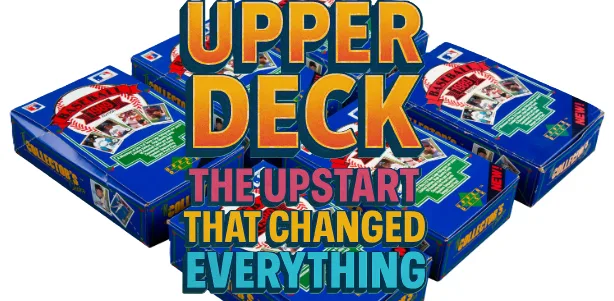
Disclosure:
This post may contain affiliate links. If you buy through them, Cards Mania may earn a small commission at no extra cost to you. We only point you toward stuff we would actually spend our own money on. Read our full affiliate disclosure
Disclosure: This post contains affiliate links. If you buy through them, we may earn a small commission at no extra cost to you. We only recommend things we genuinely believe collectors will find useful.
In February 1989, a pack of Upper Deck trading cards cost a dollar. That does not sound like much today. But at the time, when Topps was selling packs for 45 cents and collectors were already grumbling, one dollar was a provocation. It was Upper Deck saying, out loud, that everything that came before was not good enough.They were right. And for a while, it worked spectacularly. Upper Deck helped grow the sports card market from roughly $50 million in 1980 to a $1.5 billion industry by 1992. Then, over the following two decades, the company managed to burn through almost every major sports license it held, get caught counterfeiting the very cards it had built its reputation fighting against, and watch its international division collapse into bankruptcy.This is the full story of Upper Deck: the rise, the fall, and where the company stands today.Before Upper Deck Trading Cards, the Hobby Was a Mess
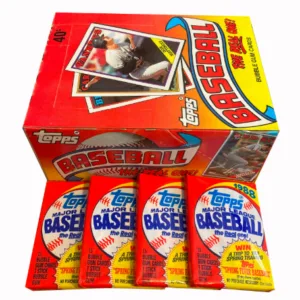 To understand what Upper Deck actually did, you need to remember what cards looked like in 1988. The big three, Topps, Donruss, and Fleer, had run the hobby for years with a formula that barely changed. Thin cardstock. Muddy photography. Wax wrappers that bled color onto the top card in the pack. A stick of stale gum that nobody wanted. The cards felt disposable because they mostly were.Counterfeiting was a growing problem too. With card values climbing in the early 1980s as Fleer and Donruss broke Topps’s long-standing monopoly, fakes started appearing. Dealers were getting burned. Collectors did not know what to trust.The man who crystallized the solution was Paul Sumner, a VP at a printing company who had studied holograms in college and used them in his company’s brochures. He knew a hologram stamped on a card would be a near-impossible-to-fake authentication mark. He joined forces with three others: Bill Hemrick, a trading card shop owner who first spotted the opportunity; Richard McWilliam, a certified public accountant who brought the financial structure; and DeWayne Buice, a Major League Baseball pitcher who brought credibility and connections inside the sport. Together they started building something new.What they built was 1989 Upper Deck Baseball: 800 cards across two series, printed on thick white cardstock with high-gloss UV coating on both sides, full-bleed photography that actually looked like it belonged in a magazine, foil wrappers that could not be steamed open and resealed, and a hologram on the back of every card. No gum. No apologies for the price.The hobby had never seen anything like it. Dealers called it lunacy. Then they sold out of it within days.
Card No. 1: The Kid
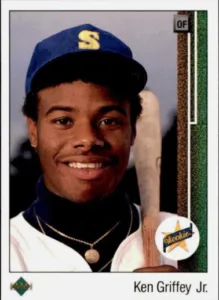 Every great debut needs a headline act. Upper Deck’s was Ken Griffey Jr., card number one in the set, chosen by Tom Geideman, an 18-year-old Upper Deck staffer who was a Mariners fan and had a hunch about the kid nobody else had fully committed to yet.Griffey had not played a single major league game when the set was designed. Topps left him out of their main 1989 set entirely. Donruss and Fleer included him, but their cards did not carry the same weight. Upper Deck put him first, front and center, on premium stock with a photograph so clean it felt different from anything else in a collector’s binder.When Griffey debuted in April 1989 and immediately looked like the best player in baseball, Upper Deck cards became the only cards serious collectors wanted. A raw copy of the Griffey rookie in nice shape recently sold for around $100, while top-grade PSA 10 examples have sold for well into four and five figures at auction. For a card produced in the millions, that kind of demand is remarkable. It speaks to how many people want one specifically because of what it represents, not just what it is worth.The 1989 Upper Deck set also included rookies of Randy Johnson, Craig Biggio, and Gary Sheffield. It was one of the deepest debut sets in hobby history, and it came with a look that forced every competitor to raise their game.If you are thinking about submitting your own Griffey or any other Upper Deck card for grading, you will want proper penny sleeves and semi-rigid holders before you ship. A damaged submission is a wasted submission:Shop penny sleeves and grading prep supplies on Amazon
The Golden Years: 1990 to 1997
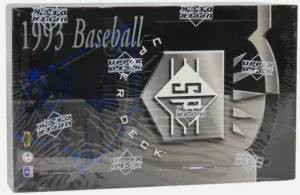 Upper Deck trading cards had changed what collectors expected, and the company spent the early 1990s pushing that formula even further.In 1990, Upper Deck introduced the first randomly inserted autographed cards in packs. Around 2,500 signed cards from Reggie Jackson were seeded into High Series packs under the “Heroes of Baseball” banner, with no announcement of the exact quantity. Collectors ripped packs with genuine excitement, chasing something that felt special and personal. The certified autograph as a collectible concept, something so standard today that we barely notice it, started right here.The company expanded into hockey, basketball, and football, picking up licenses across every major sport. It signed Michael Jordan. It signed LeBron James. It launched Upper Deck Authenticated (UDA) in 1992, a memorabilia division that offered hologram-verified autographed items directly from athletes, turning the authenticity technology from cards into a full business line.Then in 1993, Upper Deck released SP Baseball, the first widely recognized super-premium card product. Foil cards, extremely limited print runs relative to standard sets, and a price point that made even the $1-a-pack 1989 base set look cheap. SP set the template for every high-end sports card product that followed, from Topps Finest to Panini Prizm to modern National Treasures releases.By the mid-1990s, Upper Deck held the NHL license exclusively, had strong positions in every other major sport, and was widely considered the prestige name in the hobby. The company that collectors who grew up in the 1980s trusted most for quality was no longer Topps. It was Upper Deck.
Young Guns: The Hockey Card That Became a Legend
Of everything Upper Deck built, the Young Guns rookie card brand may be the most enduring. Introduced in the 1990-91 Upper Deck hockey set as a subset of rookie cards, Young Guns became the definitive standard for NHL rookie cards in a way that no equivalent truly has in other sports.The reasons are fairly simple. Upper Deck held the exclusive NHL license for many years, making their products the only officially licensed game in town for hockey. Young Guns built up a reputation and collector familiarity over decades. And hockey fans, particularly in Canada, have a genuine, almost tribal loyalty to the format. When a highly anticipated NHL rookie comes along, the Young Guns card is what collectors want first.Connor McDavid’s 2015-16 Young Guns rookie has sold for significant sums in top grade. Auston Matthews, Nathan MacKinnon, and other franchise players all have Young Guns cards that hold their value extremely well in high grade. Even now, with Upper Deck competing for the NHL license alongside Panini following 2010, Young Guns remains the most recognized rookie card brand in hockey collecting.If you are hunting current-season Young Guns or older keys from prior years, eBay is where most of the action is:The Walls Start Cracking: 2008 to 2010
The story of Upper Deck’s fall from its peak is almost a case study in how quickly things can unravel when a company overextends and then gets hit from multiple directions at once.It started with Yu-Gi-Oh. Upper Deck had held the North American distribution license for Konami’s Yu-Gi-Oh trading card game since 2002. In October 2008, Konami sued a distributor for selling counterfeit Yu-Gi-Oh cards and quickly discovered that the counterfeits had come directly from Upper Deck itself. In a 2009 deposition, Upper Deck’s own CEO admitted the company had produced more than 600,000 counterfeit Yu-Gi-Oh cards and had taken steps to cover up the activity.This was, to put it mildly, a catastrophic irony. Upper Deck was founded specifically on the promise of authenticity. The hologram on the back of every card was a direct response to the counterfeiting problem that plagued the hobby before 1989. And here was Upper Deck, the anti-counterfeit company, caught running a counterfeiting operation. Federal Judge Valerie Baker Fairbank ruled against them on December 23, 2009, and Upper Deck settled for a confidential sum.The Yu-Gi-Oh scandal damaged Upper Deck’s reputation severely at exactly the wrong moment. In August 2009, MLB announced it was handing Topps an exclusive multi-year license to produce officially licensed baseball cards, effective January 1, 2010. Upper Deck’s 22-year relationship with Major League Baseball was over.Rather than accept this quietly, Upper Deck continued to produce baseball sets after losing the MLB license, using the MLBPA deal (which allowed player images but not team logos or uniforms) as cover. MLB sued for trademark infringement in February 2010. The settlement reached in March 2010 permanently banned Upper Deck from using MLB team logos, uniform imagery, or trademarks in any future products and required them to pay a substantial sum.Meanwhile, in January 2009, Panini had secured exclusive rights to NBA cards. By April 2010, Upper Deck had also lost the NFL license. In the span of roughly 18 months, Upper Deck went from holding major licenses in every major North American sport to holding only the NHL license and their college products.The International Collapse: Upper Deck vs. Upper Deck
If the counterfeiting scandal and the license losses were not enough, what followed next was genuinely strange. In 2011, Upper Deck International BV, the company’s Netherlands-based European arm, filed a lawsuit against Upper Deck’s US parent company over the Yu-Gi-Oh fallout.The situation was this: Upper Deck International had held the European Yu-Gi-Oh distribution rights through Konami Europe. When Upper Deck’s US operation settled its counterfeiting case with Konami in America, it did so without resolving the European situation. Konami then went after Upper Deck International in Europe separately, claiming up to $64 million in damages. Upper Deck International alleged that the US parent company had borrowed $1 million from them to fund the American settlement, then failed to repay it, and had misrepresented to Konami that the European arm was not interested in a global settlement.Upper Deck was, effectively, suing itself. Upper Deck International filed for bankruptcy shortly afterward, in 2012. It was a genuinely low point for a company that had once been the gold standard of the hobby.The Lawsuits Keep Coming
The years around 2010 to 2013 were not quiet ones in Upper Deck’s legal department. Beyond the MLB and Yu-Gi-Oh disputes:- The NFL Players Association sued Upper Deck for nearly $1.5 million in unpaid autograph fees and royalties.
- MLB filed a second lawsuit in 2012 to collect $265,000 still owed from the 2010 settlement that Upper Deck had failed to pay.
- Basketball Hall of Famer Kareem Abdul-Jabbar sued Upper Deck for unauthorized use of his likeness.
- Collectors who held unfulfilled redemption cards, a standard card product where you receive a voucher that is later exchanged for an autographed card, found that Upper Deck was unable or unwilling to fulfill many of them, and some took the company to court over it.
What Upper Deck Looks Like Today
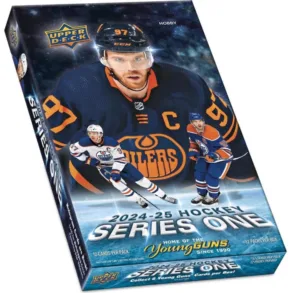 Upper Deck did not disappear. That is worth saying plainly. The company survived, restructured, and found its footing around what it genuinely still does better than almost anyone: hockey cards.Today, Upper Deck produces a full calendar of NHL-licensed products including their flagship Series 1 and Series 2 base sets, Artifacts (memorabilia and autograph-focused), SP Authentic, O-Pee-Chee, OPC Platinum, and Allure, among others. The Young Guns brand remains the most coveted rookie card format in hockey. Upper Deck also produces sets for the PWHL (Professional Women’s Hockey League), the Women’s National Team program, and Canadian university sports.The company has also pushed hard into entertainment. They hold the DC Comics license and have released sets including Skybox Metal Universe Batman, DC Annual, and Fleer Ultra Superman. They produce sets based on AEW wrestling, Tiny Tina’s Wonderlands, and Call of Duty.Upper Deck also runs e-Pack, a digital collecting platform where you can open packs online, trade digitally, and request physical redemptions for selected cards. It is an interesting concept that has found a loyal audience among collectors who want the pack-opening experience without the shipping delays.
2026 Upper Deck Golf: 25 Years and a Tiger Woods Buyback Worth Watching
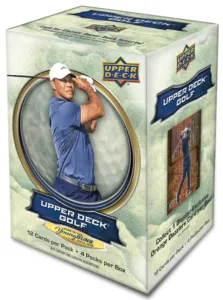 Upper Deck entered golf cards in 2001 with a set headlined by a Tiger Woods rookie, and that debut release quietly became one of the most collectible non-sport sets the company ever produced. The 2026 anniversary edition leans into that history directly. Upper Deck sourced exactly 25 copies of the original 2001 Tiger Woods rookie card, had Woods sign each one, numbered them to /25, and stamped every copy with a commemorative 25th anniversary seal. Alongside the signed rookies, 25 numbered sets of the Tiger’s Tales insert from 2001 were produced, and 25 complete numbered sets of the full 200-card 2001 base set round out the anniversary program. None of these are parallels or reprints. These are the original cards, signed and sealed decades later, which puts them in a category that very few modern releases can touch.The 2026 base set brings Young Guns to golf for the second consecutive year, with a rookie checklist that includes Nelly Korda, Hideki Matsuyama, Lydia Ko, and top amateurs Jackson Koivun and Miles Russell. The most interesting addition is the Retrospective Rookies insert, a set designed for elite golfers who never had a Young Guns card the first time around. Tiger Woods appears here alongside Collin Morikawa, Jim Furyk, Annika Sorenstam, Michelle Wie West, and Lexi Thompson, each card carrying the Young Guns design from their debut year. It is a genuinely clever concept that gives long-time collectors a reason to care beyond chasing the newest faces. The set released February 18, 2026 through Certified Diamond dealers and mass retailers, with Allure Golf (the first chromium golf product Upper Deck has produced), Fleer Ultra Golf, and Artifacts Golf all planned for later in the year.If any of the 2026 Upper Deck Golf anniversary pieces have already hit the secondary market, eBay is where you will find them:
The Most Valuable Upper Deck Trading Cards Worth Knowing About
If you are thinking about collecting Upper Deck, either as a hobbyist or with an eye on value, here are the cards and products that matter most:1989 Upper Deck Ken Griffey Jr. #1 (Baseball)
The one that started everything. Raw copies in decent shape sell in the $80 to $150 range. Top-grade PSA 10 examples have sold for several thousand dollars. Signed PSA 10 versions have been widely reported selling well into five figures. For a card produced in the millions, the combination of nostalgia and genuine iconography keeps demand consistent. It is one of the few junk-era cards that has real long-term collector appeal across generations.Upper Deck Young Guns Rookie Cards (Hockey)
The top Young Guns cards from franchise-level rookies are consistently among the most traded hockey cards on the secondary market. Connor McDavid, Sidney Crosby, and other generational talents have Young Guns cards that hold their value extremely well in high grade. If you follow hockey at all, keeping an eye on each season’s crop of Young Guns is worth your time.Upper Deck SP and SP Authentic (Baseball and Hockey)
The SP brand introduced super-premium cards to the hobby in 1993. SP Authentic Baseball, when it was still being produced, consistently generated high-value autograph cards of top prospects. The early SP Baseball issues from the mid-1990s, particularly autographed versions of future Hall of Famers, have strong collector followings.Upper Deck Exquisite Collection (Basketball, Football, Hockey)
Launched in 2003, Exquisite Collection was Upper Deck’s most premium product at the point of its introduction. The LeBron James 2003-04 Exquisite rookie autograph patch card is among the most valuable modern basketball cards in existence, widely reported selling for multiple millions at auction in recent years. Upper Deck produced Exquisite across multiple sports and it remains one of the most recognizable premium card brands in hobby history, even though Upper Deck no longer holds the NBA or NFL licenses that made the original releases possible.Whatever Upper Deck cards you are chasing, protect them properly. PSA submissions require clean, unsleeved cards, but for storage between now and grading day, semi-rigid holders and toploaders are the standard:Shop toploaders and card holders on AmazonWhat Collectors Should Take From the Upper Deck Story
The story of Upper Deck trading cards is not just interesting as hobby history. It has some practical lessons worth keeping in mind.Licensing matters enormously. When Upper Deck held the major licenses in every sport, it could produce the most desirable products in every category. When those licenses moved to Topps and Panini, Upper Deck’s relevance in baseball, basketball, and football faded quickly. The cards from its licensed years still carry value. The unlicensed replacement products mostly do not.Brand trust, once broken, is slow to rebuild. The Yu-Gi-Oh counterfeiting scandal and the MLB license dispute damaged Upper Deck’s reputation in ways that still linger. Collectors who experienced those years tend to have long memories. Newer collectors who know Upper Deck only through hockey products tend to trust the brand more comfortably.Survival is not guaranteed, but it is possible. Upper Deck could easily have folded entirely after 2010. Instead, it retrenched around hockey, where it still has genuine strength, and it has found new licensing opportunities in entertainment cards. That is a different company than the one that dominated the 1990s hobby, but it is a real company making real products that collectors actually want.For anyone who picks up a 1989 Upper Deck pack today, which sealed boxes are still out there and still being opened, the experience is a time machine. Those foil wrappers, that card stock, that hologram on the back. Whatever happened after, the original product was genuinely special. And card number one in the set is still the smiling face of a 19-year-old kid who had not played a big-league game yet, but who was about to become the best player in baseball.That is a good card. Upper Deck made a lot of good cards. The story of how it nearly threw all of that away is one of the most interesting in the hobby.Frequently Asked Questions
What happened to Upper Deck?
Upper Deck lost its MLB, NBA, and NFL licenses between 2009 and 2010 following a counterfeiting scandal involving Yu-Gi-Oh cards and a series of legal disputes with major sports leagues. The company’s international division filed for bankruptcy in 2012. Upper Deck survived by focusing on NHL hockey cards, where it retains a strong license, and has since expanded into entertainment properties including DC Comics, AEW wrestling, and golf.How much is a 1989 Upper Deck Ken Griffey Jr. rookie card worth?
Raw copies in solid condition typically sell in the $80 to $150 range. PSA 10 graded examples have sold for several thousand dollars. Signed PSA 10 versions have been widely reported selling well into five figures. Value depends heavily on condition and grade, so a card in poor shape may fetch only a few dollars while a pristine graded copy commands a significant premium.Does Upper Deck still make baseball cards?
Not officially licensed MLB cards. Upper Deck lost its MLB license in 2009 when Topps was awarded an exclusive deal. Upper Deck can still produce cards featuring player likenesses under a separate MLBPA agreement, but cannot use team logos, uniforms, or other MLB trademarks. For all practical purposes, Upper Deck exited baseball card collecting as collectors know it.What are Upper Deck Young Guns cards?
Young Guns are the premier rookie card subset in Upper Deck’s annual NHL hockey sets, introduced in the 1990-91 Upper Deck hockey release. They are the most sought-after rookie card format in hockey collecting, featuring top first-year players in a consistent design that collectors have tracked and valued for over three decades. Top Young Guns cards from franchise-level players like Connor McDavid and Sidney Crosby carry significant secondary market value in high grade.What was the Upper Deck counterfeiting scandal?
Upper Deck, which had built its brand on fighting counterfeit cards, was sued by Konami in 2008 after counterfeit Yu-Gi-Oh cards were traced back to Upper Deck itself. In a 2009 deposition, Upper Deck’s CEO admitted the company had produced more than 600,000 unauthorized counterfeit cards. Federal Judge Valerie Baker Fairbank ruled against Upper Deck in December 2009. The settlement amount was confidential, but the reputational and financial damage contributed directly to the loss of the company’s major sports licenses.Want to Start or Expand Your Upper Deck Collection?
Whether you are chasing a 1989 Griffey, hunting Young Guns rookies, or building a run of SP Authentic autos, eBay is still the best single place to find Upper Deck cards across every era and product line.For card supplies, sleeves, toploaders, and binders to protect everything you pull:Shop card storage and binders on AmazonIf you found this useful, check out our posts on the full history of trading cards and our deep-dive on Formula 1 trading cards. Both cover some of the same era and some of the same companies, and together they give you a solid picture of how the modern card hobby got to where it is today.
In the works
A weekly card rundown is coming
Market movers, set drops, and what is worth watching. Sign-ups open soon — the guides stay free either way.

Cards Mania Editorial Team
Cards Mania is an independent trading card media project covering sports cards, Pokémon, TCG, vintage cards, grading, collecting, card storage and hobby news. Articles are produced by the Cards Mania Editorial Team.
Related reads
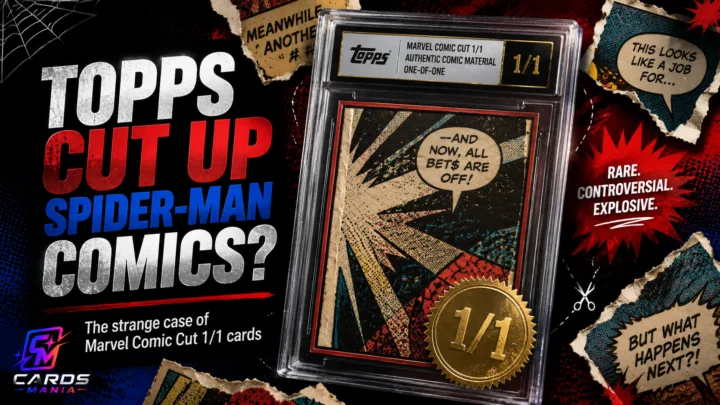
Card History
Would You Cut Up a Classic Spider-Man Comic for a 1/1 Card? Topps Did
Topps turned pieces from 15 classic Spider-Man comic issues into 1/1 Comic Cut cards for 2026 Mint Marvel. We traced the source…
Read more →
News & Trends
2026 Topps Chrome x Jennie: Checklist, Odds, Autos & Relics
Topps Chrome x Jennie brings K-pop photocard culture into the traditional trading card hobby with Refractors, numbered parallels, on-card autographs and concert-worn…
Read more →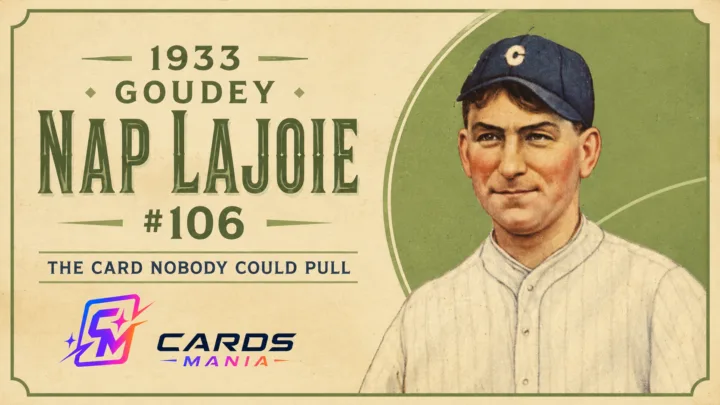
Baseball Cards
1933 Goudey Nap Lajoie #106: The Card Nobody Could Pull
Collectors could pull Babe Ruth and Lou Gehrig from 1933 Goudey packs, but card #106 was missing. Nap Lajoie #106 was printed…
Read more →
Great article – long time collector who learned something – very interesting!
Thank You Craig! Appreciate it. If You see any “wrongs” or have any suggestions, do not hesitate to highlight them! I love to learn as well 🙂