Formula 1 Trading Cards: The Complete Collector’s Guide
 Cards Mania Editorial Team
·
·
28 min read
Cards Mania Editorial Team
·
·
28 min read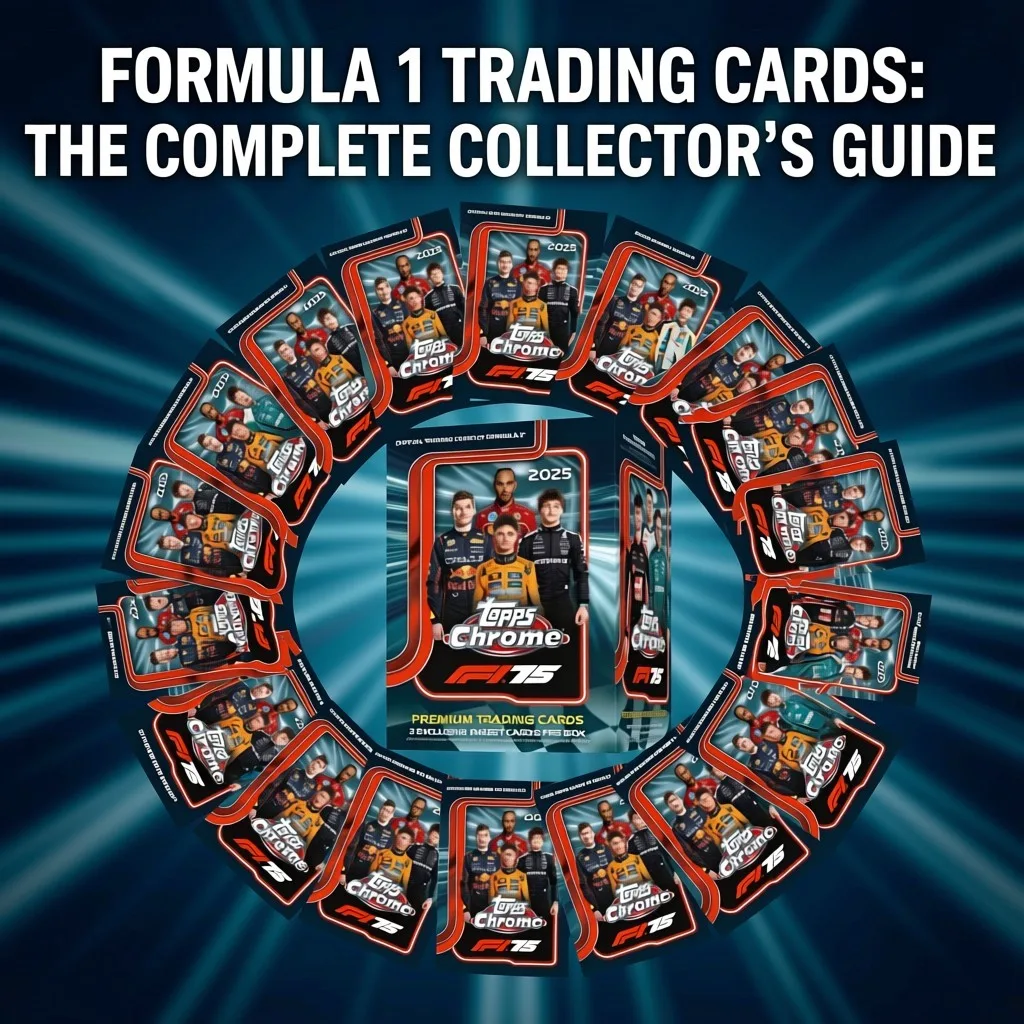
Disclosure:
This post may contain affiliate links. If you buy through them, Cards Mania may earn a small commission at no extra cost to you. We only point you toward stuff we would actually spend our own money on. Read our full affiliate disclosure
Formula 1 has always been about speed, precision, and breathtaking moments. The trading card hobby that grew up around it shares all three qualities, including how fast prices move when a driver wins a world title.F1 trading cards went from a niche European curiosity to a genuinely global collecting category in roughly five years. New fans who found the sport through Drive to Survive on Netflix came looking for cards, and the market shifted hard to meet them. Vintage Panini stickers that had sat quietly in attics suddenly had buyers. The 2020 Topps Chrome set became one of the most talked-about modern card releases across any sport. And some of those early Topps Superfractors reached prices that would make a baseball collector’s jaw drop.This guide covers all of it: the history, every major product, the key drivers, what actually drives value, where the hobby gets murky, and how to start collecting without expensive beginner mistakes. Whether you’re a longtime F1 fan just discovering the card side of things, or a card collector crossing over from another sport, you’re in the right place.Formula 1 trading cards are officially licensed collectible cards featuring F1 drivers, teams, and race moments. In the modern era, they are produced under a global licensing agreement between Formula 1 and Topps, covering physical products such as Topps Chrome, Topps Dynasty, and Turbo Attax, as well as digital and print-on-demand formats. Cards range from affordable entry-level packs to ultra-premium one-of-one autograph relics numbered to a single copy. If you want to see what collectors are actually buying right now:Browse live Formula 1 card listings on eBayPrices can move quickly after race weekends. Checking completed sales gives you the real benchmark, not seller optimism.
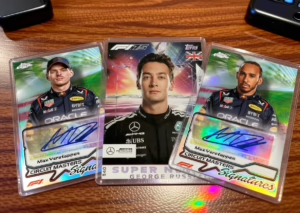
Key Takeaways
- The modern F1 card era began in 2020 when Topps became the sport’s official licensed card and sticker partner. The first Topps-produced card under the partnership was a Topps NOW card commemorating Pierre Gasly’s win at Monza. Topps Chrome, Topps Dynasty, and Topps Chrome Sapphire followed later that season.
- Topps Chrome Formula 1 is widely considered the most important modern set. It has the most liquid secondary market and carries the official RC (rookie card) designation for drivers entering F1 from 2021 onward.
- The 2020 collection holds a special market status. Because those were the first officially licensed Topps cards for established drivers like Hamilton and Verstappen, the hobby treats them as their “first Topps” cards. This is a market convention, not an official RC designation.
- F1 rookie cards are genuinely complicated before 2020. No universal standard exists, and multiple pre-Topps sets are cited by collectors as rookies for key drivers. Always verify before paying a premium based on that framing.
- The top of the modern F1 market is anchored by 2020 Superfractors and ultra-limited Dynasty cards. Reported sales on key 1-of-1 cards have reached into the hundreds of thousands of dollars.
- F1 does not have a meaningful error card culture compared to baseball. Collector focus centers on parallels, autographs, patch relics, and first-card debates instead.
A Brief History of Formula 1 Trading Cards
F1 didn’t get the structured, decades-long licensed trading card treatment that baseball or basketball enjoyed. For most of the sport’s history, official collectibles meant sticker albums, and those came primarily from Panini.The Panini Sticker Era
Panini produced F1 sticker albums from the 1980s onward, and those stickers now carry serious collector value. The format evolved over time. Early releases featured translucent stickers with minimal rear content, while later series like Panini Supersports included proper driver bios on the back. The world champions of that era (Ayrton Senna, Alain Prost, Niki Lauda, Nelson Piquet) are the most sought-after names from this period.Vintage Panini F1 stickers in high grade carry real premiums today. Hobbyist sources have reported sales of key Senna and Lauda stickers in the hundreds to low thousands of dollars, depending on grade and specific card. Prices for vintage stickers are not consistently tracked the way modern card sales are, so treat any specific figure you encounter as a data point, not a fixed benchmark.Condition sensitivity on these stickers is extreme. Most were peeled into albums by kids who had no idea they’d be worth anything. Unaffixed examples are the exception rather than the rule.The Pre-Topps Landscape: Fragmented and Regional
Between the sticker era and the modern Topps partnership, F1 cards existed in a fragmented, largely regional market with no single dominant producer. A handful of sets are discussed by collectors today:The 1991 Pro Trac’s set and the 1992 Grid Formula 1 set are among the most referenced pre-Topps releases. The Grid set is widely cited by collectors as the home of Schumacher’s key early card, and it’s often treated in hobby discussions as his rookie-era issue. That said, as with all pre-Topps claims, collector convention is as strong as the designation gets. There is no official governing body confirming this.Futera, a licensed publisher, produced F1 card sets in the mid-1990s and again in the 2000s. Their releases covering Michael Schumacher and Fernando Alonso tend to draw the most collector attention among Futera releases. A 2006 Futera collection reportedly included a Lewis Hamilton card from his GP2 championship season, making it notable for Hamilton collectors as among his earliest widely discussed card appearances. It was not an F1 card, and applying “rookie” framing to it is a considerable stretch.Australian publisher Scanlens also produced racing cards, distributed primarily in their home market. The Top Trumps F1 Grand Prix card game released in 2016 includes a Max Verstappen issue that some collectors cite as his earliest widely discussed card appearance. Worth scrutinizing before paying any premium based on it: Top Trumps is a card game, not a traditional trading card set.The key takeaway from the pre-Topps era: licensing was inconsistent, distribution was often regional, and no single set dominated the hobby the way modern Topps Chrome does. This is one reason rookie card debates for pre-2020 drivers remain genuinely unsettled.The 2020 Turning Point
In 2020, Formula 1 and Topps announced an exclusive global licensing partnership, making Topps the official sticker and trading card partner for the sport. The timing was significant: the 2019 season of Drive to Survive had already introduced F1 to a massive new audience, particularly in North America, and demand for licensed F1 products was growing with nothing to meet it.The first Topps-produced card released under the F1 partnership was a Topps NOW card commemorating Pierre Gasly’s dramatic win at Monza, marking the start of what became a broader product launch later that season. Topps Chrome Formula 1, Topps Dynasty F1, and Topps Chrome Sapphire F1 all followed. What Topps built over the next five years became the backbone of the modern F1 card hobby.The Modern Product Lineup: What Topps Makes and Why It Matters
One of the most common points of confusion for new collectors is figuring out which F1 product is which. Topps releases multiple sets each year at very different price points. Quick orientation: Turbo Attax is the budget entry point, Topps Chrome is the standard collector set, Sapphire is a scarcer premium version of Chrome, and Dynasty is the ultra-premium product where every card is a numbered autograph relic. Here’s the full breakdown.| Product | Price Point | Best For | Key Feature |
|---|---|---|---|
| Turbo Attax | Budget | Beginners, casual fans | Wide availability, low-cost parallels |
| Topps Flagship (paper) | Entry-mid | Set builders, budget relic hunters | Accessible relic cards |
| Topps NOW | Entry (per card) | Fans of specific race moments | Print-on-demand, event-tied |
| Topps Chrome | Mid-premium | Most collectors | RC designations, refractor rainbow, autos |
| Topps Finest | Mid-premium | Design-focused collectors | Bold abstract design, broader checklist |
| Topps Chrome Sapphire | Premium | Parallel chasers, set collectors | Lower population, distinctive finish |
| Topps Dynasty | Ultra-premium | High-end collectors | On-card autos, premium relics, all numbered /10 or lower |
Topps Chrome Formula 1
Chrome is the set most collectors mean when they say “F1 cards.” It launched as part of the 2020 Topps F1 product range alongside Dynasty and Sapphire, and it has been the de facto flagship of the hobby ever since. The base set contains 200 cards covering current F1 drivers, F2 and F3 prospects, team cars, and more. All base cards come on chrome-finish stock with nearly 30 different parallel variations, from standard Refractors down to Superfractors numbered 1-of-1.The parallel rainbow will be familiar to anyone who has collected Topps Chrome in another sport: Green Refractors (/99), Gold (/50), Orange (/25), Red (/5), and Superfractors (1/1) make up the scarcest end. Autograph cards are available but not guaranteed in every box. Hobby boxes offer the best odds; Qualifying Lap boxes (the rebranded Hobby Lite format) are more affordable and include some exclusive content.Topps Chrome is also where official RC-designated rookie cards live. From 2021 onward, drivers entering F1 for the first time get a card stamped with the RC logo. The 2021 set brought officially stamped rookies for Yuki Tsunoda and Mick Schumacher. The 2022 set added Zhou Guanyu. The 2023 set brought Oscar Piastri.Topps Dynasty F1
Dynasty sits at the top end of the product line. Each hobby box contains exactly one card, guaranteed to include an on-card autograph and a premium memorabilia piece: race-worn suit material, glove patches, suit zippers, flag swatches, or nameplates. Nothing in Dynasty is numbered higher than /10, and most are significantly lower.Dynasty launched as part of the 2020 Topps F1 range, and cards from that year featuring top drivers are among the most valuable modern F1 cards in existence. The product costs well over $1,000 per box at retail. The variance is real: a top driver with a desirable relic patch can exceed box cost, but a lower-tier driver or a team principal relic often won’t come close. For most collectors, buying Dynasty cards individually on the secondary market is the smarter approach.Topps Chrome Sapphire F1
Sapphire is a premium version of Chrome with a more distinctive finish: a shattered mirror-style colored background rather than standard chrome stock. Population is lower than base Chrome, making cards inherently scarcer. Starting with the 2023 edition, Sapphire added autograph cards and inserts. The 2020 Padparadscha parallel (a rare pinkish-orange refractor) is one of the most visually distinctive cards in modern F1 collecting, with 1-of-1 examples from that year widely reported in hobby coverage at six-figure prices.Topps Finest F1
Finest takes a different visual approach: bold, abstract design work instead of Chrome’s photography-forward look. The base set is tiered (Common, Uncommon, Rare), covers F1, F2, and F3 drivers, and carries the standard Refractor rainbow including Superfractors. It runs a broader checklist than most other sets and includes more standard memorabilia cards alongside autographs.Turbo Attax
Turbo Attax is the most accessible F1 product and the most widely available internationally, particularly in Europe and India. Technically designed around a card game, in practice almost no one plays it. Collectors just collect the cards. Print runs are high, secondary market values are low, and that’s exactly why it’s a reasonable entry point. You can pull a parallel of your favorite driver without much spend, and nothing financially painful is at stake.Topps Flagship Formula 1 (Paper)
Introduced in 2021, the paper flagship set sits below Chrome in price and is the most accessible route to relic cards: cards with small fabric swatches embedded. Standard paper card stock rather than chrome finish makes these less desirable for serious collectors and graders, but they’re a reasonable option for beginners who want to hold a relic card without Chrome box prices.Topps NOW F1
Print-on-demand cards released to mark specific race moments throughout the season. Print runs are determined by sales volume during the purchase window, making lower-demand events inherently lower-population. Not typically where high-value cards live, but a fun way to mark a specific win or milestone as it happens. The first Topps-produced card under the F1 partnership was a Topps NOW release.Comparing sealed box prices before you buy?Browse current Topps Chrome F1 box listings on eBaySecondary market prices on hobby boxes often undercut retail after a few months. Sort by sold listings to see where prices actually are.
The Drivers That Move the Market
F1 card values are driven primarily by who’s on the card. Set, parallel, and condition all matter, but driver is the first variable.Lewis Hamilton
Hamilton’s cards span both the pre-Topps era and the modern one, which is unusual for any driver. His 2020 Topps Chrome Superfractor is the single most expensive modern F1 card cited in hobby coverage, widely reported at around $900,000. As with any high-end private sale, exact figures should be treated as reference points rather than guarantees. Even his base cards from the 2020 set carry premiums based on how the market treats that year. His move to Ferrari opened a new chapter: the first Hamilton-Ferrari cards represent a collecting category that simply didn’t exist before.Max Verstappen
Verstappen is the other pillar of the modern market. His 2020 Topps Dynasty F1 Patch Auto Gold (1/1) is widely reported in hobby coverage at around $170,000, and multiple other 2020 ultra-rare parallels have been reported at six figures. The ongoing debate about what his earliest significant card actually is adds a layer of complexity that keeps collectors engaged and arguing. Multiple world championships have only reinforced his market position.Charles Leclerc
Leclerc’s 2020 Topps Chrome Superfractor is widely reported at around $264,000. He has strong collector appeal particularly in Europe, and his longer-term ceiling depends heavily on whether a world championship follows. His card values have tracked Ferrari’s trajectory and his own results closely.Lando Norris and Oscar Piastri
These two represent the current rising-value wave. Norris has grown into one of the sport’s most marketable personalities, and his card premiums have reflected that. Piastri’s 2023 Chrome rookie cards are among the most closely watched in the hobby. A future title would make them among the most significant cards of the current era to have picked up early.The Vintage Icons
Ayrton Senna, Michael Schumacher, and Niki Lauda represent the vintage collecting tier. Senna’s early Panini stickers in high grade are genuinely scarce, condition-sensitive, and rarely found unaffixed. The 1992 Grid Formula 1 card is widely cited by collectors as Schumacher’s key early card and is often treated in hobby discussions as his rookie-era issue. For both drivers, finding near-mint examples is the real challenge.The Grails: Most Valuable Modern F1 Cards
The top end of modern F1 card values is anchored by 2020 Topps Chrome Superfractors. These were the first officially licensed Topps cards for major established drivers, and in 1-of-1 Superfractor form they combine scarcity, historical significance, and market-assigned “first Topps card” status. That combination produced some of the highest reported sales in modern racing cards.Reported sales widely cited across hobby sources:- 2020 Topps Chrome F1 Superfractor Lewis Hamilton (#1/1): widely reported at around $900,000
- 2020 Topps Chrome F1 Auto Superfractor Max Verstappen (#1/1): widely reported at around $534,000
- 2020 Topps Chrome F1 Superfractor Charles Leclerc (#1/1): widely reported at around $264,000
- 2020 Topps Chrome Sapphire Padparadscha Max Verstappen (#1/1): widely reported at around $195,200
- 2020 Topps Dynasty F1 Patch Auto Gold Max Verstappen (#1/1): widely reported at around $170,400
The Rookie Card Question (It’s Genuinely Complicated)
If there’s one thing that reliably trips up new F1 collectors, it’s the rookie card situation. Unlike basketball or American football, where grading companies and publishers have developed somewhat standardized RC designations, F1 card rookies have been messier to define from the start.The 2020 Non-RC Problem
The drivers who were on the F1 grid in 2020 (Hamilton, Verstappen, Leclerc, Norris, and the rest of the established field) don’t have RC-stamped cards in that year’s Topps sets. Topps didn’t have the designation system in place yet. The market treats the 2020 collection as the “first Topps” set for those drivers, which carries significant value. But this is a market convention, not an official rookie designation. That distinction matters when you’re deciding how much premium to pay.RC Designations from 2021 Onward
From 2021 onward, Topps introduced the RC stamp for drivers entering F1 for the first time under the Topps license. These are the unambiguous cases: Tsunoda and Mick Schumacher in 2021, Zhou Guanyu in 2022, Piastri in 2023. Post-2020 rookies have officially designated RC cards, and the hobby treats them accordingly.The Pre-2020 Gray Zone
For drivers who entered F1 before the Topps era, the picture is messier. The 1992 Grid Formula 1 card is widely cited by collectors as Schumacher’s key early card and is often treated in hobby discussions as his rookie-era issue. For Hamilton, the 2006 Futera card from his GP2 season is among his earliest widely discussed appearances as a featured driver, but it was not an F1 card, and “rookie” framing applied to it is loose at best. For Verstappen, some collectors cite the 2016 Top Trumps F1 Grand Prix issue as his earliest card appearance; others treat the 2020 Topps Chrome as the only version worth calling his rookie in any meaningful market context. None of this is standardized. Verify independently before paying a premium based on “rookie” claims attached to any pre-Topps card.Hobby Oddities, Gray Areas, and Things Nobody Warned You About
Every card category has its quirks. F1 has more than most, largely because the modern licensed era is only five years old and the pre-Topps landscape was genuinely chaotic. These are the things that catch collectors out.The Fragmented Pre-Topps Landscape
Before 2020, there was no dominant, consistent F1 card producer. Panini stickers, Futera sets, regional releases, card games that doubled as collectibles: the ecosystem was scattered. Pre-Topps cards lack the liquidity and clear market structure that Topps products have. Grading companies see far less volume on vintage F1 material, which makes pop reports less useful as benchmarks. Prices are spottier. Fakes and overgraded examples exist, as they do in any thin vintage market.The “Earliest Appearance” vs. “First Licensed Card” Distinction
These are not the same thing. A driver can appear on a card (in a game, a sticker album, a regional release) before they have an officially licensed trading card in the hobby sense. Top Trumps is a card game, not a trading card set. Panini sticker albums are not trading cards in the conventional collector sense. Futera sets were limited-production licensed products with minimal hobby infrastructure behind them. When someone calls any of these a “rookie card,” understand what they mean and what they don’t.F2 Future Stars Cards and Their Value
From 2020 onward, Topps Chrome sets include F2 Future Stars cards for drivers who haven’t yet entered F1. These sometimes become more sought-after than the driver’s official F1 rookie card. Zhou Guanyu’s F2 card from the 2020 Chrome set is a notable example, as is Oscar Piastri’s 2021 F2 appearance. If a driver becomes a champion, their F2 Future Stars card is often the scarcest early Topps-produced option.The Turbo Attax Parallel Trap
Turbo Attax has parallels too. New collectors sometimes pull a shiny Turbo Attax parallel and assume it carries significant value because it looks rare. In almost all cases, Turbo Attax parallels trade for very little on the secondary market due to high print runs and limited collector demand. Visual appeal and scarcity value are completely different things.Regional and Non-Standard Releases
Some F1 cards were produced specifically for certain markets and never widely distributed elsewhere. This makes finding, pricing, and authenticating them significantly harder. Scanlens cards in Australia are a good example. If you’re buying regional releases, factor in the difficulty of verifying authenticity and the limited buyer pool if you ever want to sell.Error Cards in Formula 1: An Honest Assessment
Some card categories have rich, well-documented error card traditions. Baseball is famous for them: misspelled names, wrong photos, incorrect statistics, recalled prints. Collectors seek them specifically. Formula 1 trading cards, particularly in the modern Topps era, do not have that culture.The Topps F1 line has not produced any widely recognized error cards that have become significant collector targets. This is partly because the product line is young (only five seasons old) and partly because collector attention in F1 centers on entirely different variables: parallel scarcity, autographs, patch relics, graded condition, and first-card debates.Production anomalies do exist in any card line: miscuts, printing variations, off-color parallels. These occasionally surface and can generate individual collector interest. But if you’re coming from baseball or football expecting a documented canon of famous F1 error cards, that’s not what this hobby looks like. The focus is elsewhere, and knowing that before you go looking saves time.What Actually Drives Value in F1 Cards
F1 card values aren’t random. Several factors combine to determine where any given card sits on the price spectrum.Driver Performance and Market Profile
This is the dominant factor. When a driver wins a world championship, card prices move quickly. Piastri’s 2023 rookies are watched closely because a future title would make them retrospectively significant. Wins at high-profile events (Monaco, Silverstone, Monza) generate short-term spikes. Larger storylines (Hamilton to Ferrari, a young champion emerging) create sustained collector interest beyond race results alone.Serial Numbering and Parallel Scarcity
A card numbered /25 is worth more than /99. A /5 is worth more than /25. A 1-of-1 Superfractor sits above all of them. This is consistent and predictable across all sets. Learn the print run hierarchy before buying anything significant.Autographs and Memorabilia Quality
On-card autographs command a significant premium over sticker autos. Dynasty cards are all on-card, which is part of what justifies their price point. For relic cards, identifiable patch pieces (team logos, sponsor lettering, banding stripes) trade at a premium over generic single-color fabric swatches.Grade
PSA 10 cards trade at a substantial premium over ungraded versions. PSA handles the most volume of F1 grading; Beckett and SGC are also used. For vintage Panini stickers, condition sensitivity is extreme: tiny surface scratches or print defects can be the difference between a grade of 7 and a grade of 9, with a meaningful price gap between them. If you’re new to grading, our beginner’s guide to card grading covers the full process.Timing and Market Cycles
The broader sports card market runs cycles. F1 cards peaked during the general card boom of 2020-2021, pulled back, and have settled since. Being aware of where the cycle sits helps contextualize prices. A “deal” during peak market conditions is sometimes just normal pricing once things normalize.Looking for graded F1 cards? Check current prices before you pay a premium:Browse graded F1 cards on eBay
Best Formula 1 Cards for Beginners
Collector tip: Before you spend significantly, spend 30 days watching completed eBay sales. Learn what actually sells and what sits unsold. You’ll buy better once you understand what the market values versus what sellers hope it values.
Here are the best starting points for a new F1 collector, by use case:Best for opening packs without financial stress: Turbo Attax. Widely available, affordable packs, fun to open. Zero pressure, nothing expensive at stake. Good for casual fans and kids who want the pack-opening experience.Best for holding a genuine collector card: Topps Flagship (paper). The most affordable route to a relic card: an actual piece of race-worn material embedded in the card. Not high-value, but a satisfying physical object for someone just entering the hobby.Best all-around starting set: A Topps Chrome Qualifying Lap box. Affordable enough to justify as a first purchase, contains Chrome-finish cards with proper refractor parallels, and gives you a realistic taste of the modern hobby structure without Dynasty-level financial commitment.Best for building a driver collection: Buy singles on eBay. If you want a Lando Norris Chrome base, an Oscar Piastri RC, or a Hamilton refractor, buying it directly is almost always cheaper than pulling it from packs. The math works heavily against pack-breaking when you know exactly what you want.Best for understanding value quickly: The 2020 Topps Chrome base set. Not expensive per card, widely available, and it illustrates in concrete terms why parallel and print run matter. A base Verstappen from 2020 costs a few dollars. A numbered parallel of the same card can cost hundreds. Same year, same image, completely different market.Ready to start? See what’s available for your budget:Browse Topps Chrome F1 singles on eBayFilter by driver name, sort by sold listings, and you’ll have a real price picture in about ten minutes.
Sealed Boxes vs. Singles: Which Way to Go
This debate comes up in every card category. The honest answer depends on what you’re trying to accomplish.Buy singles if you want a specific card, a specific driver, a specific parallel. The math works against you in pack breaks when you’re chasing a target. Buying it directly on the secondary market is almost always more cost-efficient.Buy sealed if you enjoy the experience of opening packs, want a complete base set, or you’re comfortable with the odds and the variance. Opening a hobby box of Topps Chrome F1 is genuinely fun. There are worse ways to spend an evening. Just don’t go in expecting the contents to make money. The expected value of a box is almost always below its purchase price after accounting for what’s inside at market rates.Dynasty boxes deserve specific mention: at over $1,000 per box and one card inside, this is the highest-variance F1 product available. A top driver with a premium relic patch can beat the box cost. Most pulls won’t. Buying individual Dynasty cards as singles is the smarter move for the vast majority of collectors.Storing and Protecting Your F1 Cards
Card protection is the difference between a PSA 10 and a PSA 8 over time. On the right card, that gap is worth real money. For a full rundown of storage options across all budgets, see our guide to the best card storage supplies.The basic setup every F1 collector needs:- Penny sleeves: Go on first, always. They protect card surfaces during handling and insertion into toploaders.
- Toploaders: Standard 35pt fits base Chrome cards. Dynasty and relic cards with thick memorabilia pieces need 108pt or higher.
- 9-pocket binder pages: Good for set building and browsing. Use binders with rigid backing to prevent edge damage.
- One-touch magnetic holders: The premium display option for valuable singles. Worth it for anything you’d consider submitting for grading.
These are the basic supplies worth having before your first cards arrive:
One practical note: don’t store valuable cards loosely even inside toploaders. Use a rigid card storage box that prevents movement during transport. Cards can scratch each other through toploaders if they shift around.- Penny sleeves (bulk packs) – buy more than you think you need
- 35pt toploaders – standard size for Chrome cards
- 108pt toploaders – for Dynasty and thick relic cards
- One-touch magnetic holders – for high-value singles and display
- 9-pocket binder pages – for browsable set collections
Common Mistakes New F1 Collectors Make
Heads up: The F1 card space has jargon, product complexity, and pricing nuance that catches new collectors off guard. These mistakes cost money, and most of them are avoidable.
Overpaying for 2020 base cards. The 2020 set is historically significant, but the base cards without serial numbers or autographs are not scarce. Topps printed plenty of them. The value in 2020 lives in the numbered parallels, autos, and 1-of-1 cards, not in raw base copies.Treating rookie card claims as settled. The pre-2020 era has no clean RC structure. The 2020 set has no RC stamps. Verify any “rookie” claim independently before paying a premium on it.Cracking Dynasty boxes without understanding the checklist. Over $1,000 for one card is a specific kind of gamble. Knowing who’s on the checklist and what relics are possible matters before you buy in.Confusing Turbo Attax parallels with Chrome parallels. A shiny Turbo Attax card is not the same thing as a Chrome Refractor. Print runs and secondary market demand are completely different.Skipping storage until it’s too late. Chrome surfaces scratch easily. A card that arrives perfect and gets handled without a sleeve is a worse card. Protect from day one.Not checking pop reports before paying grade premiums. PSA’s grading database shows how many copies of a given card have been submitted and at what grades. Before paying PSA 10 prices, check the actual population at that grade.The Long-Term Outlook for F1 Cards
F1’s global audience has grown significantly over the past several years, and a large portion of that growth came from markets (particularly the US) with a strong existing sports card culture. That crossover has been genuinely positive for the hobby.As of the 2025 season, the incoming class of rookies (including Kimi Antonelli at Mercedes, Oliver Bearman, and Liam Lawson) are already appearing in sets. If any of them develop into champions, their early cards will follow the same trajectory Piastri’s 2023 rookies are currently on. Hamilton’s move to Ferrari created new collector interest in a category that simply didn’t exist before: Hamilton in red. Drivers, storylines, and team changes will continue to shape which cards the market pays attention to. That’s been true since the sticker album era and it won’t change.The F1 card hobby in its current licensed form is relatively young. Compared to baseball, where collecting culture spans generations, there’s genuine room for growth in both the collector base and the depth of available products.The same caution applies as in any card category: buy what you genuinely love, understand what you’re paying for, and don’t treat speculative card values as a financial plan.F1 Card Glossary: Quick Definitions
If you’re new to the hobby, these are the terms that come up constantly in F1 card discussions.- Superfractor
- A 1-of-1 parallel in Topps Chrome sets featuring a gold metallic refractor finish. Only one copy exists per driver per set. The rarest and typically most valuable card in any Chrome release.
- Refractor
- A card printed on light-refracting metallic stock that produces a rainbow shimmer effect. Topps Chrome parallels come in multiple refractor color variants, each numbered to a different print run. A standard Refractor is the most common; Superfractor is the rarest.
- Sapphire
- Topps Chrome Sapphire Edition: a premium version of Chrome with a shattered mirror-style colored card background, lower print run, and (from 2023 onward) autograph and insert content. Cards are scarcer than standard Chrome and generally traded at a premium.
- Dynasty
- Topps’ ultra-premium F1 product. Every card includes an on-card autograph and a premium memorabilia piece. Nothing is numbered higher than /10. One card per box. The highest price point in the Topps F1 line.
- RC (Rookie Card)
- The official Topps-designated first trading card for a driver entering F1 for the first time. Stamped with the RC logo. Applies to drivers from 2021 onward under the Topps licensing era. Not applied retroactively to 2020 set cards.
- Topps NOW
- Print-on-demand single cards released to mark specific race moments throughout the F1 season. Print runs are determined by demand during the purchase window. The first Topps-produced card under the F1 partnership was a Topps NOW card, commemorating Pierre Gasly’s 2020 Monza win.
- Pop Report
- Short for “population report.” A grading company’s database (typically PSA’s) showing how many copies of a given card have been submitted and what grades they received. Essential context before paying grade premiums.
- Serial Number / Print Run
- The number printed on the card face indicating how many copies of that specific parallel exist. “/25” means 25 copies total. Lower numbers mean scarcer cards and, generally, higher value.
Frequently Asked Questions About Formula 1 Trading Cards
What are the best Formula 1 trading cards to collect?
Topps Chrome Formula 1 is widely considered the most important modern set. It has the most liquid secondary market, the clearest parallel structure, and official RC designations from 2021 onward. For high-end collecting, Topps Dynasty F1 offers on-card autographs and premium relics, all numbered /10 or lower. For vintage, early Panini Senna stickers in high grade and the 1992 Grid Formula 1 set are the most widely discussed targets among collectors.When did Topps start making F1 cards?
Topps became the official F1 card and sticker licensee in 2020. The first Topps-produced card under the partnership was a Topps NOW card commemorating Pierre Gasly’s win at Monza. Later in 2020, Topps launched Topps Chrome Formula 1, Topps Dynasty F1, and Topps Chrome Sapphire F1 as the main sets. The paper flagship set was introduced from 2021 onward.What is Max Verstappen’s rookie card?
There is no universal consensus. The 2020 Topps Chrome F1 set is the most market-recognized option: his first officially licensed Topps card, which the hobby treats as his “first Topps” card. Some collectors cite a 2016 Top Trumps F1 Grand Prix issue as his earliest card appearance, though Top Trumps is a card game rather than a traditional trading card set. Verify any “rookie” claim and the actual market demand before paying a premium based on that framing.What is a Superfractor in F1 cards?
A Superfractor is a 1-of-1 parallel in Topps Chrome sets. Only one copy exists in the world. It features a distinctive gold metallic refractor finish. The 2020 Lewis Hamilton Superfractor is the highest-priced modern F1 card cited in hobby coverage, widely reported at around $900,000.Is Topps Dynasty F1 worth buying?
That depends entirely on what you pull. Each box costs well over $1,000 and contains exactly one card. A top driver with a premium identifiable relic can exceed box cost. A lower-demand driver or generic swatch usually won’t. For most collectors, buying individual Dynasty cards as singles on the secondary market is a more efficient approach than cracking boxes.Are F1 cards a good investment?
Cards can hold or appreciate in value, but they carry real risk as investment vehicles. Market cycles, driver performance, and collector sentiment all affect prices. The sensible approach is collecting what you genuinely enjoy, understanding the market before large purchases, and never spending money you can’t afford to hold long-term. CardsMania doesn’t provide investment advice.What is Turbo Attax F1?
Turbo Attax is Topps’ entry-level F1 product, technically built around a card game that almost no one plays. High print runs, wide international availability (especially in Europe and India), and low secondary market values make it a reasonable starting point. Don’t expect Turbo Attax parallels to carry the same value as Chrome refractors. The print runs and market demand are completely different.Do F1 trading cards have famous error cards?
No, not in any meaningful sense. Unlike baseball, which has a documented culture of error cards that collectors actively seek, Formula 1 trading cards (particularly in the modern Topps era) have not produced widely recognized error cards as collector targets. Collector focus in F1 centers on parallels, autographs, patch relics, serial numbering, and first-card debates rather than production errors.Who made F1 cards before Topps?
Panini produced F1 sticker albums from the 1980s onward. Other notable pre-Topps releases include Futera (mid-1990s and 2000s), the 1992 Grid Formula 1 set, 1991 Pro Trac’s cards, and regional releases from Scanlens in Australia. The licensing landscape before 2020 was fragmented, with no single producer holding a consistent global license.Formula 1 trading cards have come a long way from translucent stickers peeled into albums by kids in the 1980s. The modern hobby has real depth: multiple product tiers, a clear parallel structure, genuine memorabilia, and a global collector base that’s still growing into the sport’s new audience. Whether you’re here because you love F1 or because you love collecting, the overlap between those two things is a genuinely interesting place to be.Start with what you know, build toward what you want, protect everything from day one, and let the market teach you the rest.