
1968 Topps 3-D Test Set: Checklist, Values and Fakes
 Cards Mania Editorial Team
·
·
7 min read
Cards Mania Editorial Team
·
·
7 min read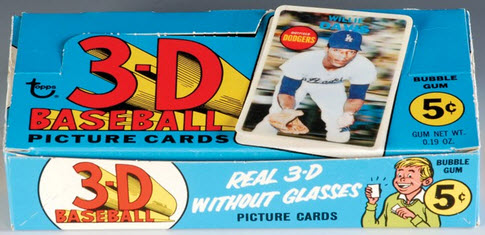
Updated: August 16, 2026
The 1968 Topps 3-D baseball set is a 12-card test issue printed on narrow, rounded-corner lenticular stock. Tilt one and the player appears sharp against a blurred background with visible depth. Roberto Clemente is the key card, but every subject is scarce enough to demand careful authentication and realistic price research.
What was the 1968 Topps 3-D test set?
Topps used a lenticular process that placed a sharp player image over a deliberately blurred ballpark background. A thin ribbed plastic layer directs different parts of the image to each eye, producing the illusion of depth without special glasses. The cards are a quarter-inch narrower than a standard modern trading card.
PSA describes the issue as a limited test. Hobby accounts say a small number of packs appeared in selected Brooklyn stores, and some packs may have included a cardboard easel. The evidence is less tidy than the familiar story suggests. PSA notes that nearly every surviving item can be traced to someone who worked for Topps or Xograph. There is no verified public print run, pack price or complete retail-distribution record.
That distinction matters. The Brooklyn store story is plausible and repeated by experienced hobby sources, but details such as two cards for a nickel, a stick of gum or a fixed display-box count should not be treated as settled without surviving packaging or a contemporary Topps document.
Complete 1968 Topps 3-D checklist
The confirmed base set has 12 unnumbered subjects. Roberto Clemente and Tony Perez are the two Baseball Hall of Fame members.
- Roberto Clemente, Pittsburgh Pirates
- Willie Davis, Los Angeles Dodgers
- Ron Fairly, Los Angeles Dodgers
- Curt Flood, St. Louis Cardinals
- Jim Lonborg, Boston Red Sox
- Jim Maloney, Cincinnati Reds
- Tony Perez, Cincinnati Reds
- Boog Powell, Baltimore Orioles
- Bill Robinson, New York Yankees
- Rusty Staub, Houston Astros
- Mel Stottlemyre, New York Yankees
- Ron Swoboda, New York Mets
Clemente dominates demand. His card is substantially scarcer than his regular 1955 Topps rookie in PSA’s recorded population, but rarity and rookie status are different qualities. The 1955 card remains the recognized rookie. The 1968 3-D is an experimental later-career issue.
Blank backs, stamped backs and prototypes
Blank-back base cards
The standard 12-card issue has a plain white back. Rounded corners and the narrow 2.25-inch width are expected.
XOGRAPH-stamped cards
Some examples carry an experimental notice in red or black ink stating that the card was not for public circulation, distribution or resale and should be returned to Visual Panographics in New York.
Photo and print variations
Specialists document crop and production differences. These expand a completionist collection beyond the basic 12, but the base checklist itself does not change.
Prototype material
Proofs and unissued subjects exist outside the base set. Square corners or missing player text can be legitimate on documented prototypes, so base-card rules should not be applied blindly.
The XOGRAPH notice is a production clue, not an ordinary card-back design. PSA says stamped examples may have been among the first produced. The stamp reads in part: “This is an experimental XOGRAPH card produced as a limited edition. Not for public circulation or distribution. Not for resale.”
Prototype pieces occupy a separate market. Heritage sold a PSA Authentic Brooks Robinson prototype, described as one of three PSA-graded examples, for $134,200 on October 26, 2025. That result should not be used to value a regular blank-back card. Provenance, format and grader description are central.
What are 1968 Topps 3-D cards worth?
This is a thin market, not a deeply liquid one. A few major sales can make averages look smoother than the real buying experience. Check the exact player, grade, back type and sale terms.
| Card | Grade | Date | Price | Venue |
|---|---|---|---|---|
| Roberto Clemente | PSA 10, XOGRAPH stamp | March 1, 2026 | $109,948.84 | Heritage Auctions |
| Roberto Clemente | PSA 5 | April 4, 2026 | $28,060 | Heritage Auctions |
| Roberto Clemente | PSA 3 | December 20, 2025 | $18,910 | Heritage Auctions |
| Boog Powell | PSA 9 | March 1, 2026 | $21,350 | Heritage Auctions |
| Willie Davis | PSA 8 | July 6, 2026 | $970 | eBay auction recorded by PSA |
The gap between Clemente, a difficult high-grade Powell and a Willie Davis shows why a generic “1968 Topps 3-D value” is not useful. PSA’s published price guide can help establish a range, but a current completed sale is stronger evidence for a specific card.
Current PSA population context
PSA’s set population page showed 943 total grading entries when checked on August 16, 2026. Its Clemente CardFacts page showed 86 total entries, including six PSA 10s. These are grading records, not a count of all surviving cards. Cracked holders, crossovers and resubmissions can affect population reports.
The old claim that Gem Mint Clemente cards are nearly nonexistent is not accurate. Six PSA 10 entries is still a small number, but the grade exists and has appeared at major auctions. Population data should always carry a date because it changes.
How to check an authentic 1968 Topps 3-D card
- Measure it. A regular base card should be 2.25 by 3.5 inches, not the standard 2.5-inch width.
- Check the corners. Base cards have rounded corners. Documented proofs can be square-cornered, which is why a single rule cannot authenticate prototype material.
- Inspect the back. Expect a blank white back or a documented XOGRAPH experimental stamp. Other printed backs need expert explanation.
- Look at the lenticular surface. The player should remain crisp against a background designed to blur by depth. Flat printed copies and modern reproductions will not reproduce the original construction exactly.
- Examine condition under angled light. Scratches, crazing, cracks, curling and edge fractures are common. Heavy damage can be authentic while still reducing the grade.
- Use professional authentication. For a purchase that can reach four or five figures, rely on a major grader or a specialist auction house, not an online checklist alone.
Our card grading guide explains what numeric grades do and do not mean. For other unusual production pieces, see error cards and misprints. The broader context appears in our history of trading cards.
The link to Kellogg’s and later lenticular cards
The 1968 experiment predates Kellogg’s first 3-D baseball set by two years. PSA and major auction descriptions connect the Xograph process with the Kellogg’s cards that followed. Later products such as Sportflics and 1995 Topps D3 used lenticular effects too.
That is a real design lineage. It does not mean every chrome, refractor or foil card descends technically from the 1968 test. Those products use different materials and optical effects, so the safer connection is creative: Topps showed early that surface technology could become part of the card’s appeal.
Is the set worth collecting?
For advanced vintage collectors, it is a short checklist with unusual technology, a Clemente centerpiece and enough production mystery to stay interesting. It is also expensive, condition-sensitive and slow to assemble. A base-12 project is more realistic than chasing every stamp, crop difference and proof.
Start by choosing a scope and budget. A single non-star example can show the effect without committing to a full set. If Clemente is the goal, compare several auction archives and understand that a stamp, grade or unusual provenance can change the market dramatically.
Compare current listings:
Search 1968 Topps 3-D on TCGplayer
1968 Topps 3-D FAQ
How many cards are in the 1968 Topps 3-D set?
The confirmed base set contains 12 unnumbered cards. Proofs, prototypes, stamped backs and specialist variations sit outside a straightforward base-12 checklist.
What size is a 1968 Topps 3-D card?
A base card measures 2.25 by 3.5 inches. It is a quarter-inch narrower than a standard trading card and has rounded corners.
What is the most valuable 1968 Topps 3-D card?
Roberto Clemente is the key base-set card. A PSA 10 with an XOGRAPH stamp sold for $109,948.84 at Heritage Auctions on March 1, 2026.
Did Topps sell the cards in Brooklyn stores?
Hobby accounts say a few boxes appeared in selected Brooklyn stores, but PSA notes that nearly every known piece can be traced to Topps or Xograph employees. The exact retail story remains partly unverified.
Why do 1968 Topps 3-D cards crack?
The aging lenticular surface is susceptible to scratches, curling and cracks, especially after heat, sunlight or poor storage. Condition problems are common even on genuine cards.
Sources
- PSA CardFacts: 1968 Topps 3-D set profile
- PSA Population Report: 1968 Topps 3-D
- PSA Auction Prices: 1968 Topps 3-D Clemente
- Heritage Auctions archive: Topps 3-D
A weekly card rundown is coming
Market movers, set drops, and what is worth watching. Sign-ups open soon — the guides stay free either way.

Cards Mania Editorial Team
Cards Mania is an independent trading card media project covering sports cards, Pokémon, TCG, vintage cards, grading, collecting, card storage and hobby news. Articles are produced by the Cards Mania Editorial Team.
Related reads
Find The Reggie: The 1990 Upper Deck Reggie Jackson Autograph Story
In 1990, Upper Deck hid 2,500 hand-numbered Reggie Jackson autographs inside High Series packs and told collectors to Find The Reggie. The…
Read more →
Did Topps Really Dump Millions of 1952 Baseball Cards Into the Ocean?
Sy Berger said Topps sent hundreds of cases of unwanted 1952 high-number baseball cards into the Atlantic, including cards from the series…
Read more →
What Is a Rookie Card? Meaning, Examples and Collector Value
A rookie card is generally one of an athlete’s first mainstream cards after reaching the top professional level, but licensing, set type…
Read more →