
Topps Test Issues That Never Reached Retail
 Cards Mania Editorial Team
·
·
7 min read
Cards Mania Editorial Team
·
·
7 min read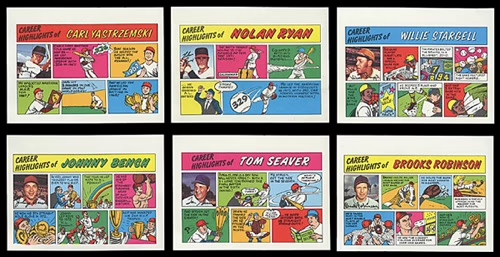
Updated August 16, 2026. Auction results and grading populations are dated because the surviving supply is tiny and the market is thin.
The so-called lost Topps sets are not legends that suddenly appeared from nowhere. They are documented test issues that never became normal retail releases. Three of the best examples are the Topps Dice Game baseball cards, the 1967-68 basketball test and the 1973 Topps Comics gum wrappers.
Three Topps test issues compared
| Issue | Checklist | Format | What survived | Dating note |
|---|---|---|---|---|
| Topps Dice Game | 18 baseball players | Black-and-white player portrait with dice-game outcomes on the back | A very small number of cut cards and one documented 18-card sheet | Cataloged as 1961, but evidence points to production around 1962 or 1963 |
| Topps Basketball Test | 22 NBA players | Black-and-white cards with pieces of a Wilt Chamberlain puzzle on the backs | Cut cards, at least one opened pack or wrapper group and a 44-card uncut sheet | Often called 1968 or 1968-69, but team details place it in the 1967-68 season |
| 1973 Topps Comics | 24 baseball players | Thin wax-paper comic and facsimile signature paired with gum-wrapper graphics | Individual pieces, near sets, complete sets and gum packs | 1973 |
Topps Dice Game: the 18-card baseball experiment
The issue collectors call 1961 Topps Dice Game contains 18 black-and-white cards. The front shows a player portrait. The back turns dice rolls and a selected pitch into baseball outcomes. The checklist includes Mickey Mantle, Willie Mays, Stan Musial, Frank Robinson, Al Kaline, Brooks Robinson and other stars.
The familiar 1961 date is not settled production history. The 2025 uncut-sheet catalog used both 1961 and 1963, and player-performance clues have led researchers to argue for 1962 or 1963. It is safest to use the recognized catalog name while explaining the uncertainty.
The sheet was not unknown until 2018 or 2025. A January 1978 hobby advertisement by Larry Fritsch offered what was described as a complete set, apparently to test the market. PSA later connected that story to the 18-card sheet held by the Fritsch family. The same sheet reached Collect Auctions in March 2025 and sold for $252,000 including buyer’s premium.
Topps reported in 2026 that only 35 cut examples were known across the issue and that three players had never been found as individual cut cards. In December 2025, a PSA 5 Willie Mays sold for $156,000. Those results describe exceptional, thinly traded pieces. They are not a general price guide for every test card.
The 1967-68 Topps basketball test
This 22-card black-and-white issue is commonly labeled 1968 or 1968-69 Topps Basketball Test. The checklist includes Wilt Chamberlain, Bill Russell, Jerry West, Oscar Robertson and John Havlicek. It predates Topps’ 1969-70 tall-boy NBA release, and Havlicek’s card is treated as his first Topps NBA card.
The team information narrows the date. Zelmo Beaty, Bill Bridges and Lenny Wilkens appear with the St. Louis Hawks, which moved to Atlanta for the 1968-69 season. Chamberlain still appears with Philadelphia even though he moved to Los Angeles in summer 1968. The cards therefore reflect the 1967-68 season, even when a grading label uses the traditional 1968-69 name.
A 44-card sheet containing two copies of each player came to Heritage in February 2025. It came from the home of a former Topps employee and showed the complete Chamberlain puzzle on the back. Sports Collectors Daily reported that PSA had graded just over 200 cut cards across the set at that time. Individual cards and packaging were already documented decades earlier, so the sheet added important evidence rather than proving the set for the first time.
Packaging matters here. An opened test pack with cards and a “How To Play Better Basketball” booklet sold for $4,521.60 in September 2017. A complete 22-card set had sold for $26,400 in a 2006 Sotheby’s and SCP auction. These dated results are more useful than calling every example priceless.
1973 Topps Comics: 24 wrappers, not a normal card set
The 1973 Topps Comics test issue has 24 thin wax-paper pieces measuring about 3 7/16 by 4 5/8 inches. One side carries gum-wrapper graphics with a Johnny Bench teaser. The other has a player comic, short biographical material and a facsimile signature.
The checklist includes Hank Aaron, Johnny Bench, Steve Carlton, Reggie Jackson, Harmon Killebrew, Willie McCovey, Nolan Ryan, Tom Seaver, Willie Stargell, Joe Torre, Billy Williams and Carl Yastrzemski. Topps printed the pieces and packaged at least some with gum, but the product did not receive a normal public release.
The detailed 1973 Topps Comics overview records several useful sales. Heritage sold a complete PSA-graded set for $20,315 in May 2008. REA sold a complete raw set for $17,625 in spring 2010, while a PSA Registry group containing 23 of 24 pieces sold for $13,200 in fall 2023. Grade, completeness and the missing player matter when comparing a near set.
Why these pieces are not interchangeable
A cut card, printer’s proof, uncut sheet, wrapper and unopened test pack can come from the same project but have different physical histories. A sheet cut after leaving the factory is not automatically equivalent to a pack-issued card. A proof on different stock may be genuine Topps material without belonging in the same population as the finished version.
This is why the word “prototype” should not be used as a blanket upgrade. The label needs support from the item’s stock, dimensions, printing, cut, provenance and established catalog treatment.
How to evaluate a claimed Topps test issue
- Identify the form. Is it a cut card, wrapper, proof, pack, sheet or later reprint?
- Match the exact catalog entry. Compare dimensions, checklist, front and back design, stock and recognized name.
- Check provenance. Former Topps employees, long-held hobby collections and documented auction history are meaningful for material that never reached retail.
- Verify the holder. Confirm the certification number and variety wording with the grading company. The holder must match the physical item.
- Study the edges. Factory-cut cards, hand-cut sheets and later trimming should not be treated as the same object.
- Use population reports carefully. Counts can change, and older holders may use different issue names.
- Compare realized sales. Match the same player, format, grade and date. Do not price a common subject from a Mantle or Mays result.
Rare Topps material appears at specialist auctions and occasionally in eBay test-issue listings. Reference material can help with terminology, and collectors can browse vintage card reference guides, but an old book or marketplace description should not override the physical evidence.
Primary and specialist references
- Topps: Dice Game sheet, known population and Mays sale
- PSA: 1961 Topps Dice Game research
- Collect Auctions: April 2025 Dice Game sheet result
- Sports Collectors Daily: 1968 basketball test sheet
- PSA CardFacts: 1973 Topps Comics checklist and format
- PostWarCards: 1973 Topps Comics sales history
Browse current vintage Topps listings
Topps test issues FAQ
What is a Topps test issue?
A Topps test issue is a limited product made to evaluate a format, license, package or market before full release. It may survive as cut cards, proofs, wrappers, packs or uncut sheets, and those forms should not be treated as interchangeable.
Was the Topps Dice Game definitely made in 1961?
No. Collectors and grading catalogs use the name 1961 Topps Dice Game, but player and production evidence points to a possible 1962 or 1963 date. Use the catalog name while keeping the dating uncertainty clear.
How many cards are in the Topps basketball test set?
The checklist has 22 players. A documented 44-card uncut sheet contains two copies of each player, and the backs combine to form a Wilt Chamberlain puzzle.
What are 1973 Topps Comics?
They are 24 thin wax-paper test pieces with gum-wrapper graphics on one side and a baseball player comic with a facsimile signature on the other. They were produced and some were packaged with gum, but the product was not normally released to the public.
How do you authenticate an unreleased Topps item?
Match the stock, dimensions, printing, cut and front-back design to documented examples. Check provenance, certification wording and auction history. For expensive material, use a specialist or grading service familiar with the exact test issue.
Bottom line: these three Topps projects are real, but “lost set” is only a convenient headline. The useful questions are what Topps produced, which form survived, how it left the company and whether the exact item can be documented.
A weekly card rundown is coming
Market movers, set drops, and what is worth watching. Sign-ups open soon — the guides stay free either way.

Cards Mania Editorial Team
Cards Mania is an independent trading card media project covering sports cards, Pokémon, TCG, vintage cards, grading, collecting, card storage and hobby news. Articles are produced by the Cards Mania Editorial Team.
Related reads
Find The Reggie: The 1990 Upper Deck Reggie Jackson Autograph Story
In 1990, Upper Deck hid 2,500 hand-numbered Reggie Jackson autographs inside High Series packs and told collectors to Find The Reggie. The…
Read more →
Did Topps Really Dump Millions of 1952 Baseball Cards Into the Ocean?
Sy Berger said Topps sent hundreds of cases of unwanted 1952 high-number baseball cards into the Atlantic, including cards from the series…
Read more →
What Is a Rookie Card? Meaning, Examples and Collector Value
A rookie card is generally one of an athlete’s first mainstream cards after reaching the top professional level, but licensing, set type…
Read more →