Star Wars Trading Cards History: From Blue Borders to Chrome – A Collector’s Journey
Cards Mania Editorial Team··14 min read
Disclosure:
This post may contain affiliate links. If you buy through them, Cards Mania may earn a small commission at no extra cost to you. We only point you toward stuff we would actually spend our own money on. Read our full affiliate disclosure
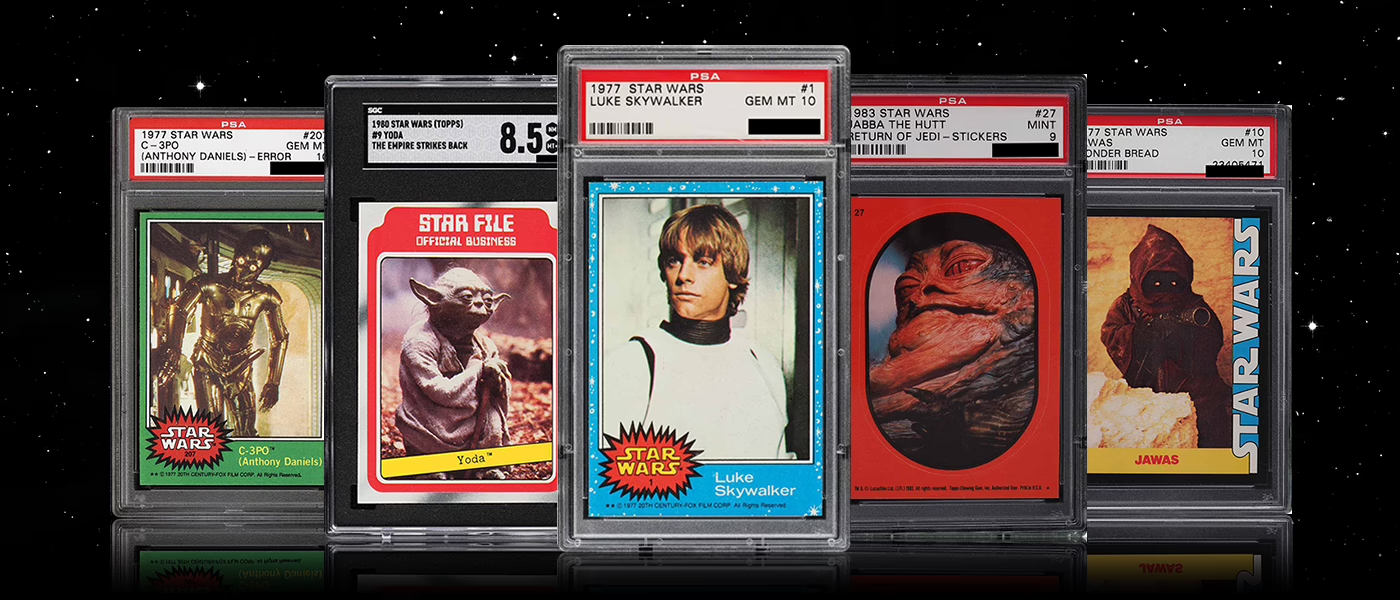
The Star Wars trading cards history began in 1977 and, since then, has documented our obsession with a galaxy far, far away. From playground trades to quarter‑million‑dollar auction hammers, Star Wars trading cards history spans vintage blue borders, quirky promos, art‑driven sets, and modern Chrome refractors. Grab your lightsaber (or at least your wallet) and let’s dive into the cardboard empire that changed collecting forever.
1977: The Year Everything Changed (Blue Borders and Questionable Gum)
Picture this: It’s 1977. Disco is fading, punk rock is rising, and a little space opera called Star Wars is absolutely demolishing box office records. Kids are losing their minds over X‑Wings and lightsabers, and Topps, the trading card kingpins, smell opportunity like a Hutt smells profit.The first set dropped with Series 1 sporting those iconic blue borders. Then came red, yellow, green, and orange borders across five series totaling 330 cards and 55 stickers. If you managed to collect them all, you weren’t just a fan, you were the undisputed Jedi Master of the playground. Each pack came with a piece of that legendary Topps gum, a chalky stick that tasted like it had been aged in carbonite and could probably survive a proton torpedo strike.
But here’s where it gets interesting. These weren’t just movie stills slapped on cardboard. The backs of the cards formed puzzle pieces of the famous Hildebrandt brothers’ poster art. Collect enough cards, flip them over, and boom: you’ve got yourself a mini poster. It was brilliant marketing, and it kept kids buying packs like they were chasing the Millennium Falcon. Therefore, this moment marks a crucial chapter in Star Wars trading cards history.
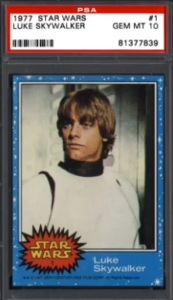
Investment Alert: In October 2025, a PSA 10 graded 1977 Topps Star Wars #1 Luke Skywalker card sold for a jaw‑dropping $268,400 at Heritage Auctions. Out of more than 4,600 graded copies, only nine have achieved Gem Mint 10 status. That’s right, a card that once came with gum is now worth more than most houses.
C‑3PO Card #207: How a Production Still Became a Hobby Legend
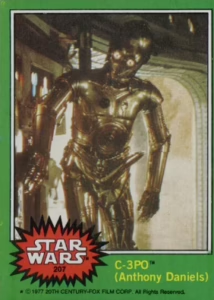
Let’s address the womp rat in the room: Card #207, featuring C‑3PO during the oil bath scene. This card has achieved legendary status in the hobby, rivaling the Billy Ripken error card in baseball as one of the most infamous print anomalies in trading card history. And no, it wasn’t a prank, it was pure, unfortunate timing.Here’s what actually happened: During filming of the oil bath scene in A New Hope, C‑3PO’s costume had thin plastic components held together with gold tape. When Anthony Daniels stepped into the oil, the adhesive was affected and the costume shifted, creating an unintended visual artifact in the still. The camera kept rolling, the production still was captured, and Topps printed it on card #207 without anyone noticing the issue in time.Collectors have dubbed it a “notorious error,” and it’s become one of the most sought‑after pieces in the hobby. In 2019, Anthony Daniels confirmed the general story behind the image, putting to rest decades of playground rumors. The irony? The error version is more common than the corrected version. Over 1,800 error cards have been graded by PSA, while fewer than 800 corrected versions exist. PSA 10 examples of the error card regularly sell for $4,000 to $5,000, making it the second‑most graded card from the entire 1977 set. Consequently, this episode remains a memorable page in Star Wars trading cards history.
In 1977, Star Wars wasn’t content with just conquering toy stores and movie theaters, it invaded your kitchen. Wonder Bread, in a stroke of marketing genius (or madness), started slipping black‑bordered Star Wars cards into loaves of bread. Sixteen cards total, each one a small treasure nestled between slices of squishy white bread.If you were lucky, you pulled Darth Vader with your PB&J. If you weren’t, you got edge wear from the bread bag, oil stains from butter, or worse, your mom threw out the card thinking it was trash. These cards are incredibly rare today because, let’s face it, most of them ended up in the garbage or got destroyed by enthusiastic six‑year‑olds making sandwiches. Finding a high‑grade Wonder Bread card now is like finding the Death Star plans, except arguably more valuable. In short, these promos add flavor (pun intended) to Star Wars trading cards history.
Empire Strikes Back and Return of the Jedi: The Sequel Trilogy Gets Its Cards
By 1980, Topps knew Star Wars wasn’t a fluke. The Empire Strikes Back landed with three series totaling 352 cards, bringing us Yoda, Boba Fett, and that infamous “I am your father” reveal (which, yes, was spoiled on trading cards before many kids even saw the movie, thanks, Topps).The design shifted to red borders for this set, and the quality of the photography improved significantly. You could actually see details now instead of grainy stills that looked like they’d been photocopied in a Mos Eisley cantina. The stickers continued, and that gum was still there, still tasting like sugary cardboard.Return of the Jedi followed in 1983 with two series and 220 cards. This set gave us Ewoks (divisive then, divisive now), the Emperor in all his wrinkly glory, and the climactic space battle that every kid recreated with their action figures. The Jedi cards marked the end of the original trilogy era, and for a decade after, Star Wars cards went quiet. The franchise seemed to be winding down, the toys stopped selling, and collectors moved on to other properties. Little did anyone know, this was just the Empire retreating to regroup, and another chapter in Star Wars trading cards history waiting to be written.
For ten years, Star Wars cards were dormant. Then, in 1993, Topps launched Star Wars Galaxy, and holy Sarlacc pit, did it change the game. This wasn’t just another set of movie stills. Galaxy was an art showcase featuring work from legendary fantasy and comic artists like Boris Vallejo, Julie Bell, Dave Dorman, Jim Steranko, and Mike Mignola.The set featured 140 base cards, but the real stars were the “New Visions” subset, where artists reimagined Star Wars scenes in their own styles. You had Vallejo painting Luke, Han, and Vader with his trademark muscle‑bound fantasy aesthetic. You had Steranko bringing his psychedelic comic book flair. You had artists treating Star Wars like fine art, not just licensed merchandise.
The inserts were groundbreaking too. Walter Simonson created six Etched Foil cards that fit together to form a puzzle, a concept Topps would repeat for years. The factory sets came in Millennium Falcon‑shaped containers (yes, really), and each set included a random artist autograph card. These weren’t just signatures slapped on reprints; these were original sketches and base cards signed by the artists themselves.Galaxy revived Star Wars collecting and proved that trading cards could be art. It paved the way for everything that followed and reminded fans that Star Wars wasn’t dead, it was just hibernating like Han in carbonite. Accordingly, this era reshaped Star Wars trading cards history in a bold, artistic direction.
In 1995, Topps dropped Widevision, and suddenly your binder pages needed an upgrade. These cards were shaped like actual movie frames, 2.5 inches by 5 inches, capturing the widescreen format of the films. Holding a Widevision card felt like holding a tiny piece of the movie itself.The set covered the original trilogy with stunning clarity, using film frames instead of promotional stills. Each card was a mini screenshot, and when you arranged them in order, you could literally watch the story unfold. It was like having the entire trilogy in your pocket, minus the sound and motion.Widevision sets became incredibly popular, spawning releases for all six films eventually. They remain a collector favorite because of their unique format and visual impact. Plus, they actually fit the movies’ aspect ratio, unlike those old square cards that cropped out half the action. As a result, Widevision cemented its place in Star Wars trading cards history as the most cinematic format.
In 2004, Topps went full circle with Star Wars Heritage. This was pure nostalgia packaged in cellophane. The cards mimicked the vintage designs from the original trilogy sets: blue borders for A New Hope and Phantom Menace, red for Empire and Attack of the Clones, and Return of the Jedi’s classic look for the final films.The card stock was gray and vintage‑looking, and yes, they brought back the gum, that same chalky, tooth‑threatening gum that tasted like memories and regret. Heritage was the first set to cover all six theatrical films (the prequels had just wrapped up), making it a comprehensive collection of the entire saga at that point.
But the real treasures were the autographs. Mark Hamill signed his first certified autograph cards for this set, and they’re astronomically rare. His cards were inserted at odds of 1:6,824 packs in Wave 1 and 1:6,980 in Wave 2. Carrie Fisher’s autographs were nearly as rare at 1:2,963 packs, and James Earl Jones came in at a relatively common 1:802 packs.These autograph cards have appreciated significantly. Hamill’s Heritage autograph regularly sells for thousands of dollars, and Fisher’s cards, especially after her passing in 2016, have become highly sought‑after memorial pieces. Heritage proved that Star Wars collectors weren’t just chasing new releases, they wanted to relive the magic of those original wax packs from 1977. Therefore, Heritage occupies a sentimental and valuable, space in Star Wars trading cards history.
Collector’s Note: The Heritage autographs are among the most valuable modern Star Wars cards. Mark Hamill’s first certified autograph from this set can fetch $3,000 to $8,000 depending on condition. Carrie Fisher’s cards have similarly appreciated, especially after 2016.
In 2015, Topps made a bold move: they launched Star Wars Card Trader, a digital collecting app. Suddenly, you could rip packs on your phone while waiting in line, no gum stains required, no storage boxes needed, no arguing with your spouse about binder space.The app brought pack‑cracking to the smartphone generation. Digital cards could move, shimmer, and do things physical cards never could. Motion cards showed film clips, parallels came in endless color variants, and rare inserts had odds that would make casino owners proud. The thrill of pulling a rare digital card felt surprisingly similar to pulling a physical hit, and the app exploded in popularity.Card Trader proved that collecting wasn’t about the physical cardboard, it was about the hunt, the community, and the joy of building sets. While physical collectors initially scoffed, many eventually embraced the digital side as a complement to their traditional collections. Now, it’s common for collectors to chase both physical and digital cards, doubling their opportunities to yell “YESSS!” at three in the morning when they finally pull that rare insert. In addition, this shift extended Star Wars trading cards history into the mobile era.
Modern Era (2016–2025): Chrome, Masterwork, and Big Money
The last decade has seen Star Wars trading cards explode in variety, quality, and value. Topps has released sets for every new film, TV show, and Disney+ series, giving collectors an endless stream of cardboard to chase. Here’s what’s been dominating the hobby:Chrome Sets: These have become the flagship Star Wars releases. Chrome cards feature refractor technology, creating rainbow‑like finishes that shimmer under light. Each year brings new Chrome releases tied to current shows and films. In 2024–2025, we’ve seen Chrome sets for The Acolyte, Skeleton Crew, and Chrome Hyperspace, a planet‑focused set. The 2025 Chrome Galaxy celebrated the 20th anniversary of Revenge of the Sith with retro‑inspired designs.
The parallels are where Chrome gets crazy. Base cards come in standard refractor finishes, but then you have Gold refractors, Orange refractors, Red refractors, and the holy grail: Superfractors, printed as true one‑of‑ones. Landing a Superfractor of a major character is like winning the lottery, except instead of cash, you get a shiny piece of cardboard worth thousands of dollars.Masterwork (2024): These high‑end releases feature thick card stock, premium printing, and autographs from actors across the franchise. Boxes retail for $100 or more, and each pack contains just a few cards. It’s quality over quantity, targeting serious collectors willing to pay for museum‑quality pieces. Masterwork autographs have included sequel trilogy actors, animated series voice actors, and occasional surprises from original trilogy legends.Sketch Cards: These hand‑drawn, one‑of‑one cards have become incredibly popular. Artists create original artwork directly on blank cards, making each one unique. Some sketch cards are simple pencil drawings, while others are full‑color paintings worth hundreds or thousands of dollars. Opening a pack and finding an original sketch card is like finding a Picasso in your cereal box, if Picasso had painted Wookiees.
Market Snapshot 2025: The Star Wars trading card market is stronger than ever. Vintage cards from 1977–1983 continue to appreciate, especially in high grades. Modern Chrome Superfractors of popular characters regularly sell for $5,000 to $20,000. Autograph cards from deceased actors like Carrie Fisher and Peter Mayhew have become memorial pieces, increasing in value while also serving as emotional tributes.
In March 2024, Fantasy Flight Games launched Star Wars: Unlimited, a new trading card game that’s quickly becoming a major force in the hobby. Unlike Topps’ collectible sets, Unlimited is a playable TCG where you build decks and battle opponents using characters, ships, and events from across the Star Wars universe.The game features stunning artwork, strategic gameplay, and strong tournament support. Early releases have sold out rapidly, and the secondary market for rare and alternate‑art cards is heating up. If you’re a fan of games like Magic: The Gathering or Pokémon, Unlimited offers a Star Wars‑themed alternative with deep strategy and gorgeous card designs.While it’s too early to predict long‑term value, the initial response suggests Unlimited could become a major player in both the gaming and collecting spaces. Some rare cards are already selling for $100 or more, and the game’s competitive scene is growing quickly. Therefore, the Star Wars trading cards history now includes a robust TCG component.
If you’re serious about Star Wars cards as investments, you need to understand grading. Professional grading companies like PSA (Professional Sports Authenticator), BGS (Beckett Grading Services), and CGC (Certified Guaranty Company) evaluate cards on a 1–10 scale, with 10 being “Gem Mint” perfection.Grading protects the card in a sealed case, verifies its authenticity, and, most importantly, establishes its condition. A raw 1977 Topps Luke Skywalker might sell for $50. A PSA 9 version could fetch $500. A PSA 10? As we’ve seen, over $268,000.The grading boom has transformed Star Wars collecting from a casual hobby into a serious investment market. High‑grade vintage cards are treated like stocks, tracked on price indexes, and bought by investors who’ve never seen the movies. Meanwhile, modern releases are immediately submitted for grading, with collectors hoping to capture pristine examples before they get dinged or scratched.
If you’re considering grading your cards, focus on vintage pieces from 1977–1983, rare inserts from the 1990s, autographs from major actors, and modern Superfractors or low‑numbered parallels. Those are the cards most likely to justify the $30 to $100+ grading fees. Hence, understanding grading is essential to navigating Star Wars trading cards history as an investor.
Market movers, set drops, and what is worth watching. Sign-ups open soon — the guides stay free either way.
Cards Mania Editorial Team
Cards Mania is an independent trading card media project covering sports cards, Pokémon, TCG, vintage cards, grading, collecting, card storage and hobby news. Articles are produced by the Cards Mania Editorial Team.
Black Lotus is Magic’s defining trophy card, led by the original Alpha, Beta and Unlimited printings. This guide covers print estimates, authenticity,…
Used to monitor number of Google Analytics server requests when using Google Tag Manager
1 minute
_gid
ID used to identify users for 24 hours after last activity
24 hours
_ga_
ID used to identify users
2 years
_gali
Used by Google Analytics to determine which links on a page are being clicked
30 seconds
__utmx
Used to determine whether a user is included in an A / B or Multivariate test.
18 months
__utmv
Contains custom information set by the web developer via the _setCustomVar method in Google Analytics. This cookie is updated every time new data is sent to the Google Analytics server.
2 years after last activity
_gac_
Contains information related to marketing campaigns of the user. These are shared with Google AdWords / Google Ads when the Google Ads and Google Analytics accounts are linked together.
90 days
__utmz
Contains information about the traffic source or campaign that directed user to the website. The cookie is set when the GA.js javascript is loaded and updated when data is sent to the Google Anaytics server
6 months after last activity
__utmc
Used only with old Urchin versions of Google Analytics and not with GA.js. Was used to distinguish between new sessions and visits at the end of a session.
End of session (browser)
__utmb
Used to distinguish new sessions and visits. This cookie is set when the GA.js javascript library is loaded and there is no existing __utmb cookie. The cookie is updated every time data is sent to the Google Analytics server.
30 minutes after last activity
__utmt
Used to monitor number of Google Analytics server requests