Licensing is the invisible rulebook that decides which sports cards look “official,” which rookies become long-term anchors, and why some products feel like they belong to the hobby’s main timeline while others live on a side quest.
If you have ever pulled a beautiful autograph only to notice the jersey logo looks suspiciously airbrushed, you have already met licensing in the wild.
Quick answer: A “licensed” card maker has permission to use league/team trademarks (logos, names, uniforms). A separate agreement (usually via a players association) controls player names and likeness. The products that combine both usually become the hobby’s most liquid, mainstream reference points over time.
Start here: If you want league-specific detail and buying tips, read
Licensed vs Unlicensed Trading Cards: The 2026 Collector’s Complete Guide.
If you want the NFL transition timeline, read
NFL in Topps Hands: How the 2026 Handoff Reshapes Football Cards.
What licensing actually covers
In sports cards, licensing is permission to use intellectual property. That includes league marks, team logos, uniforms, team names, and branding that makes a card instantly recognizable as part of an official product ecosystem.
Collectors often treat licensing like a moral issue (“real vs fake”), but it is mainly a commercial and legal boundary. The practical question is not whether a product exists, it is what role that product plays in long-term collecting history.
Think of licensing as the difference between a movie poster that can use the studio’s official art and one that must redraw everything to avoid protected images. Both can be cool. Only one becomes the default reference most people recognize.
League rights vs player rights (why both matter)
Licensing in sports cards often comes down to two separate “permission gates.” Understanding the split explains nearly every confusing product you will ever see.
| Rights type | Controls | What it looks like on cards |
| League / Team trademarks | Logos, team names, uniforms, league marks | Clean logos, official jerseys, recognizable branding |
| Players association rights | Player name and likeness | Real player images and names, even if team marks are missing |
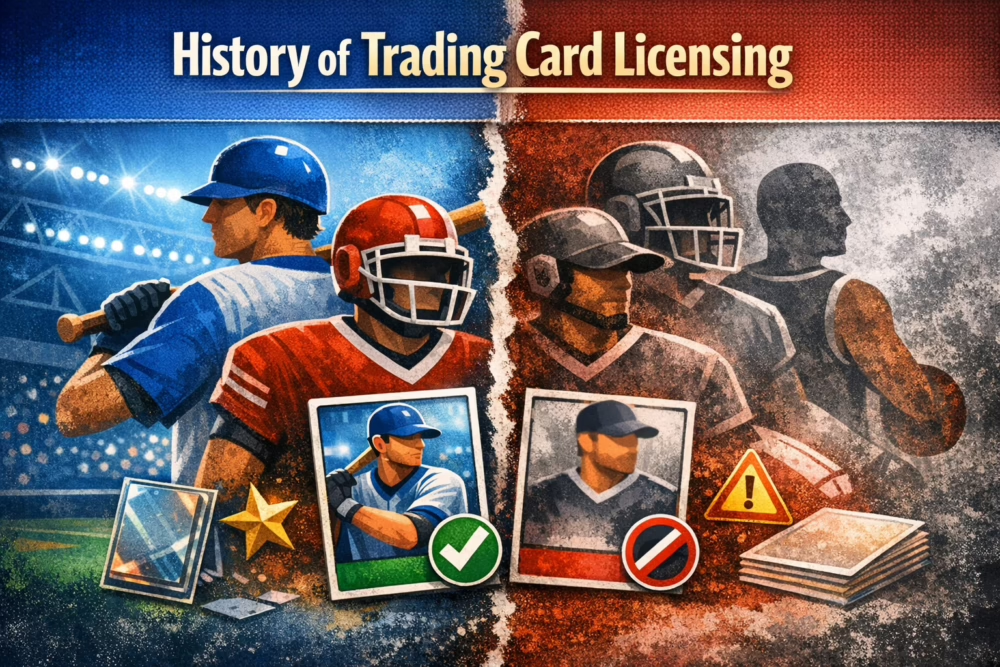
When a product lacks league/team trademark rights, you may still see real players, but uniforms can look generic, airbrushed, or oddly edited. That is not always “bad.” It is simply a signal: this card is outside the official team-branded lane.
Deep guide: For real-world examples and the 2026 landscape, read
Licensed vs Unlicensed Trading Cards: The 2026 Collector’s Complete Guide.
History of Trading Card Licensing: How MLB, NBA, NFL, NHL (and Marvel/DC/Star Wars) Rights Evolved
Sports: League Marks vs Player Likenesses (Why Licensing Is Complicated)
Modern sports cards sit on two overlapping sets of rights: league/team trademarks (logos, team names, uniform designs) and player publicity rights (name, image/likeness) that are commonly administered via a players association’s group licensing. The reason collectors see “airbrushed” jerseys is simple: a product can be legal and real, but still lack permission to show protected team marks.
MLB is a clean example of the separation. MLB’s legal notices spell out that team names, logos, uniform designs, and other marks are trademarks that require permission. MLBPA materials describe a group licensing program for active players’ publicity rights (names, likenesses, etc.). The same two-track model appears in the NFLPA, NHLPA, and NBPA licensing frameworks: one entity controls team/league marks, and a separate entity manages group player rights.
MLB Licensing Timeline (Early Era → Modern Exclusives)
2010: MLB marks become exclusive to Topps (modern turning point). MLB Properties and Topps announced an exclusive multi-year deal with exclusivity beginning January 1, 2010 for MLB and club trademarks and logos on baseball cards and related categories. That’s the modern “flag planted” moment for MLB-branded cards in the U.S.
2022: Fanatics acquires Topps’ sports & entertainment trading card business. Fanatics announced it completed the acquisition of Topps’ sports & entertainment trading cards business (physical + digital). Practically, Topps-branded baseball continues within a new ownership structure, which matters because licensing is about who holds the rights and the ability to execute at scale.
NBA Licensing Timeline
2009–10: Panini becomes the NBA’s exclusive trading card licensee. The NBA announced a multi-year exclusive relationship with Panini beginning with the 2009–10 season, making Panini the league’s exclusive trading card and sticker partner.
2025–26: Topps returns as the NBA & NBPA’s official exclusive trading card licensee. The NBA and NBPA announced a multiyear partnership with Fanatics Collectibles, returning Topps as the official exclusive licensee and launching with 2025–26 Topps Basketball. For collectors, this is a textbook “era line”: brands and rookie anchors can shift because the exclusive partner changed.
NFL Licensing Timeline
2016: Panini becomes the sole manufacturer of NFL & NFLPA licensed traditional cards/stickers. The NFL and Panini America announced a long-term agreement effective in advance of the 2016 NFL Draft making Panini the sole manufacturer of traditional trading cards and stickers licensed by the NFL and NFLPA (with separate digital rights language).
2026 and beyond: player-rights exclusivity shifts (reported). Public reporting described Fanatics receiving an NFLPA-exclusive trading card license beginning in 2026, and later coverage reported the NFLPA moved from Panini to Fanatics earlier than originally scheduled. For collectors, the key concept is still the same: a “fully licensed look” requires both player rights and league/team marks, so transitions can come in stages.
NHL Licensing Timeline
Upper Deck and long-term exclusivity. The NHL and NHLPA announced long-term extensions with Upper Deck as the exclusive licensed manufacturer of physical trading cards, and noted Upper Deck has maintained NHL and NHLPA trading card licenses since the 1990–91 season. Earlier coverage also described an exclusive deal returning to Upper Deck effective after the Panini stretch in the early 2010s.
Entertainment: Marvel, DC, Star Wars (Card Sets and License Transitions)
Entertainment cards use the same core idea: you need permission from the IP owner (publisher/studio) to use characters, logos, and often actor likenesses. The difference is that instead of “league vs union,” it’s “licensor vs manufacturer,” and licenses can change hands over time.
Marvel: Hobby and grading references widely document early Marvel trading card milestones like 1966 Donruss Marvel Super Heroes, and later booms (especially in the early 1990s) turned comic cards into a parallel universe of flagship sets and chase cultures.
DC: Vintage entertainment references highlight Topps’ multiple Batman trading card sets released in 1966, and later DC storylines and events (like The Death of Superman) were adapted into trading card formats by manufacturers such as SkyBox.
Star Wars: In the U.S., 1977 Topps Star Wars trading cards are widely documented in hobby references as the franchise’s foundational trading card release, and they remain a template example of how licensed entertainment cards become “the baseline” set collectors use to define a property’s card history.
Modern Shift: Exclusives, Digital, and the Fanatics Era
Over the last 15+ years, the major U.S. sports have trended toward exclusivity: MLB’s exclusive marks deal starting 2010, the NBA’s exclusive Panini era starting 2009–10, the NFL’s sole-manufacturer deal effective in 2016, and the NHL’s exclusive physical trading card positioning with Upper Deck. The newer twist is consolidation and digital: Fanatics’ acquisition of Topps combines a legacy card manufacturer with a broader sports commerce platform, and leagues/unions increasingly emphasize integrated physical + digital collecting ecosystems.
Collector Takeaway: Licensing changes what exists, what can be shown, and what becomes the “default timeline” of a sport or entertainment property.
- Product availability: Exclusives usually reduce the number of “official” manufacturers, concentrating flagship products.
- Logos & uniforms: Missing marks often means no league/team trademark rights (expect edits).
- Rookie anchors: Fully licensed flagship rookies tend to become the easiest-to-sell “reference” cards over time.
- Entertainment parallels: The earliest widely documented licensed sets often become the baseline for a property’s card “canon.”
How to tell if a card is licensed (fast checks)
Collectors do not need a legal degree to spot licensing status. A few quick checks usually tell the story in seconds:
- Team logos present? If logos are missing, blurred, or replaced, the product likely lacks team trademark rights.
- Uniform details: Blank helmets, no patches, generic wordmarks — all common tells.
- Packaging language: Fully licensed products usually advertise league/team marks openly.
- Brand context: In most sports, the flagship lines in a licensed era become consistent “anchor” sets year after year.
One warning: do not confuse licensing edits with printing mistakes. Misprints are accidental. Licensing edits are intentional. If you enjoy error hunting, this distinction matters.
How licensing affects value (what collectors feel)
Licensing does not automatically make a card valuable — but it strongly influences where demand concentrates. Over time, collectors tend to agree on a small number of “official-looking” anchor rookie sets for each era, and those anchors become the most liquid cards to buy and sell.
Unlicensed products can still be desirable. Their value tends to rely on different drivers:
- On-card autographs and signer quality
- Scarcity that is real (not just “lots of parallels”)
- Design, art, or niche collector demand
- Prospect speculation and early player exposure
In short: licensed cards usually win the “mainstream history” lane. Unlicensed cards can win the “autograph/art/scarcity” lane. A smart collector knows which lane they are buying in.
Transition years: why “firsts” and “lasts” matter
Collectors love “firsts” and “lasts.” The first fully licensed rookies in a new era can become long-term reference points. The last licensed releases of an outgoing era can become “end-of-era” pieces — especially if a player’s career arc turns legendary.
But transition-year markets often behave like this:
- Phase 1: hype spikes and preorders fly
- Phase 2: checklists reveal the real hit structure
- Phase 3: collectors settle on the sets that actually define the era
The best collectors do not panic-buy headlines. They wait for reality: confirmed checklists, confirmed signers, and confirmed product identity.
Collector playbook (practical strategy)
Licensing knowledge is not for arguments. It is for smarter decisions.
1) Decide your goal first
- Long-term value / liquidity: prioritize fully licensed flagship rookies
- Autographs / uniqueness: unlicensed can be excellent if the signer list is strong
- Set building: licensed products usually feel more “complete” and consistent
- Pure enjoyment: buy what you like, but understand how the market will treat it
2) Use licensing as a filter, not a religion
Licensed does not mean “must buy.” Unlicensed does not mean “trash.” The point is knowing what you are buying and what the hobby is likely to reward later.
3) Transition years: move slower
When licensing changes, the market often misprices early. Wait for checklists. Wait for odds. Then decide which sets are truly the new era’s pillars.
Support article:
Licensed vs Unlicensed Trading Cards: The 2026 Collector’s Complete Guide.
Licensing glossary (collector terms)
- Licensed: has league/team trademark rights; usually shows logos and official uniforms.
- Unlicensed: lacks team trademark rights; uniforms/logos may be removed or edited.
- Flagship set: the core brand line collectors treat as the era’s main record.
- Rookie anchor: the rookie card(s) that become the most recognized and liquid over time.
- Transition year: a season where licenses shift, causing “first/last” collector behavior.
Licensing FAQ
Why do some cards show real players but no team logos?
Because player publicity rights and league/team trademarks are separate permissions. A product can have rights to depict players, but not permission to show logos/uniform marks, leading to “airbrushed” or generic presentation.
When did modern exclusive licensing become common?
It became increasingly common in the late 2000s and 2010s as leagues moved toward exclusive partners: NBA exclusivity beginning 2009–10, MLB marks exclusivity beginning 2010, and NFL sole-manufacturer rights effective 2016.
How should collectors treat “first licensed set” claims for entertainment cards?
Use “earliest widely documented licensed set” unless you have a primary licensor record. Hobby references commonly treat 1977 Topps as the foundational U.S. Star Wars trading card set.
What does “licensed” mean in sports cards?
It means the manufacturer has permission to use league/team trademarks like logos, names, and uniforms. Often this is combined with player-likeness rights, which allow player names and images.
Are unlicensed cards fake?
Not automatically. “Unlicensed” usually means the product lacks team trademark rights. The cards can still be legitimate products — they just live outside official team-branded presentation.
Why do licensed rookies usually hold value better?
Over time, collectors tend to use fully licensed flagship rookies as the default historical record for a season. That tends to concentrate demand and liquidity there.
How can I tell if a card is unlicensed quickly?
Missing or blurred logos, generic uniforms, and packaging that avoids league/team marks are the fastest tells.
Final thought
Licensing is not the whole hobby — but it decides the shape of the hobby’s “official memory.” If you understand it, you can collect with clearer eyes: when to chase the mainstream anchor, when to enjoy the niche lane, and when to wait out the noise of a transition year.

Leave a Reply