
Industrial Trading Cards: History, Types and Value
 Cards Mania Editorial Team
·
·
7 min read
Cards Mania Editorial Team
·
·
7 min read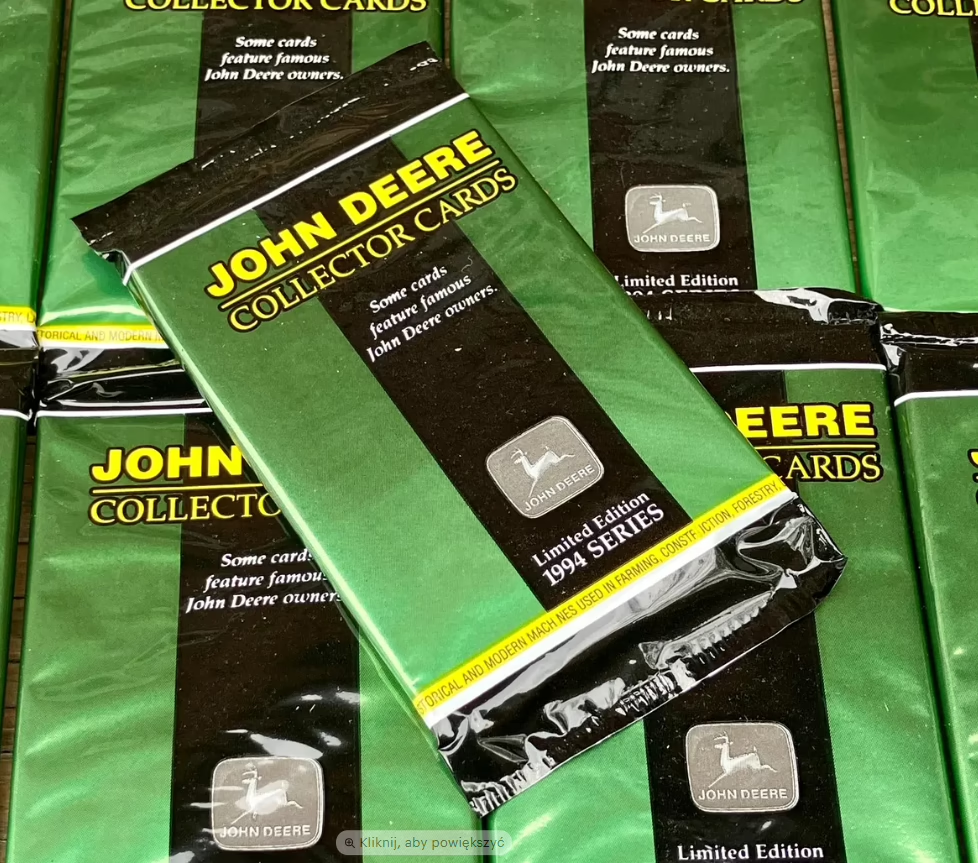
Updated August 16, 2026. This post previously displayed an unrelated digital-versus-physical article. It has been rebuilt around documented advertising and company cards.
Industrial trading cards are better known to historians as advertising trade cards, company cards or business ephemera. Manufacturers and retailers handed them out to promote products, explain machinery, identify employees or keep a company name in a customer’s pocket. Some were made as collectible series. Others were single advertisements that collectors later grouped by industry, printer or subject.
Trade card, trading card or business card?
| Object | Primary job | Typical content | Collector clue |
|---|---|---|---|
| Advertising trade card | Promote a product or merchant | Color image on one side, advertising copy or dealer imprint on the other | Often found in Victorian scrapbooks and business-ephemera archives |
| Insert trading card | Encourage repeat purchases and set building | Numbered or repeatable subjects packed with tobacco, gum or food | Checklist structure, shared design and package connection |
| Business card | Identify a person or firm | Name, address, role and contact details | Usually less illustration and no set-building purpose |
| Company or employee card | Commemorate staff, products, equipment or a corporate event | Portraits, job titles, factories, vehicles or product lines | May have internal distribution and little public documentation |
Why nineteenth-century trade cards became collectible
Trade cards existed earlier, but their popularity expanded sharply in the United States after the Civil War. The New York Public Library credits multicolor lithography and small, reusable card formats with making vivid advertising affordable. Louis Prang and other printers helped popularize the form.
Businesses distributed cards at exhibitions, fairs, store counters, through the mail and inside packages. Smithsonian collections include advertising for patent medicines, soap, hotels, railroads, cigars, textiles, seeds, food, tools and machinery. The same stock illustration could be overprinted for different merchants, which is why two cards can share art but advertise unrelated businesses.
Collectors pasted the cards into scrapbooks, traded duplicates and arranged sets by subject. That behavior helped turn a disposable advertisement into a collectible object. It also explains a common condition problem today: paper loss and album residue on the back.
Five industrial and advertising themes to collect
1. Tools, machinery and factories
Cards for stoves, sewing machines, farm equipment, printing presses and industrial exhibitions sit closest to the modern “industrial card” label. Some show the machine itself. Others use colorful stock art on the front and place technical claims or a local dealer address on the back.
2. Transport and infrastructure
Railroad, steamship, hotel and travel cards connect business history with transport collecting. Check whether the card was issued by the operator, a ticket agent, a local merchant or a printer using generic travel art. Similar pictures do not guarantee the same issuer.
3. Food and household products
Coffee, cocoa, meat extract, baking products, soap and thread companies used colorful series to encourage repeat visits and purchases. Smithsonian research on late nineteenth-century cocoa cards describes grocers giving the cards to customers and families collecting and sharing them.
4. Patent medicine and health advertising
These cards are visually rich but should be read as advertisements, not medical evidence. Period claims can be exaggerated, unsafe or offensive. The issuer, product, address and testimonial wording can still make them important records of consumer and public-health history.
5. Employee and corporate history cards
Twentieth-century companies sometimes created cards for workers, sales teams, anniversaries, equipment fleets or product education. Documentation may be thin because distribution was internal. A company logo alone does not prove official issue. Packaging, employee provenance, a dated newsletter or a matched company archive is stronger evidence.
How an advertising card connects to modern collecting
Early trade cards were advertising first. Insert cards added a stronger set-building reason to buy the product again. Tobacco firms later paired collectible subjects with cigarette packages, while gum and food companies carried the model into the twentieth century. The Smithsonian’s National Postal Museum describes sports and trading cards as products that moved from tobacco packages to gum, cookies, soft drinks, baked goods and hot dogs.
This is a lineage, not a claim that every modern booster pack descends from one printer or company. Advertising, premiums, package stiffeners, games and entertainment sets developed through overlapping experiments.
How to identify an old trade card
- Read both sides. Record the company, product, address, printer, patent date, copyright line and dealer imprint exactly.
- Search the issuer, not only the picture. Stock images were reused for many advertisers.
- Check the printing method. Period chromolithography uses layered color and should not look like a modern inkjet copy under magnification.
- Measure the card. Compare dimensions, paper thickness and cut with archived examples from the same issuer or series.
- Inspect the back for album damage. Glue, paper lift and trimming are common because collectors mounted cards in scrapbooks.
- Look for a series relationship. Numbering, shared captions, repeated borders or a product checklist can separate a set from a one-off ad.
- Save provenance. An old album, employee estate or company collection can explain distribution and support authenticity.
Reprints, reproductions and fantasy cards
A reproduction can be useful for decoration, but it should not be sold as an original. Watch for modern dot patterns, bright optical-white paper, uniform artificial aging, cropped printer marks and groups of supposedly rare cards with identical wear.
A genuine period card can still have a later alteration. Trimming removes the original edge. A dealer stamp can be added later. A card removed from a scrapbook can lose advertising text. When value is meaningful, compare a museum scan or recognized catalog and ask a specialist in paper ephemera, not only a sports-card seller.
What makes industrial and trade cards valuable?
- Issuer: a famous company, local business or historically important manufacturer can attract focused demand.
- Subject: baseball, transport, machinery, Black history, women’s history and local scenes may have collector crossover.
- Rarity: a card can be scarce because the business was small, distribution was internal or few examples survived.
- Series position: a missing card needed to complete a known set can outperform a prettier common design.
- Condition: stains, creases, trimming, glue and back loss can matter more than minor corner wear.
- Provenance: a documented company or employee connection can make an otherwise obscure card understandable.
- Demand: rarity without buyers does not guarantee a high price.
Do not price a card from the highest asking result. Match issuer, image, back imprint, size, condition and whether the sale actually completed. Generic trading-card marketplaces can help, but specialist ephemera auctions and institutional collections often use better terminology.
Where to research industrial cards
- Smithsonian: trade card scrapbook and definition
- Smithsonian Gardens: trade-card distribution and printing history
- New York Public Library: chromolithography and trade cards
- Library of Congress: early trade-card history
- National Postal Museum: sports and trading-card history
If your interest is actually digital ownership rather than company ephemera, the old post’s Sorare referral page remains available. A second Sorare link is preserved for readers comparing digital card platforms, but Sorare cards are not industrial trade cards.
Browse current card marketplaces carefully
Industrial trading cards FAQ
What are industrial trading cards?
They are promotional cards issued by companies, factories, retailers or service businesses. Historians usually call nineteenth-century examples advertising trade cards, while modern collectors may use industrial cards for machinery, factory, transport, employee or corporate-history subjects.
Are trade cards the same as trading cards?
Not exactly. A trade card was primarily an advertisement for a business or product. Some repeatable insert series encouraged collecting and helped shape the later trading-card model, but many trade cards were one-off ads rather than checklist-based sets.
How old are Victorian trade cards?
Trade cards have earlier roots, but their broad U.S. popularity peaked in the late nineteenth century after advances in color lithography made attractive small advertisements affordable to many businesses.
How can I tell if a trade card is original?
Compare the issuer, dealer imprint, dimensions, stock, printing pattern and front-back design with an institutional or cataloged example. Modern paper, inkjet dots, cropped marks and identical artificial wear can indicate a reproduction.
Are industrial trading cards valuable?
Some are, but value depends on issuer, subject, scarcity, series demand, condition and provenance. An obscure card can be rare and still have few buyers. Use matched realized sales rather than the highest asking price.
Bottom line: these cards are business history in pocket size. Start with the issuer and original purpose, then identify the printing, series and provenance before discussing price.
A weekly card rundown is coming
Market movers, set drops, and what is worth watching. Sign-ups open soon — the guides stay free either way.

Cards Mania Editorial Team
Cards Mania is an independent trading card media project covering sports cards, Pokémon, TCG, vintage cards, grading, collecting, card storage and hobby news. Articles are produced by the Cards Mania Editorial Team.
Related reads
Would You Cut Up a Classic Spider-Man Comic for a 1/1 Card? Topps Did
Topps turned pieces from 15 classic Spider-Man comic issues into 1/1 Comic Cut cards for 2026 Mint Marvel. We traced the source…
Read more →
Black Lotus Card: Price, History, Rarity and Record Sales Explained
Black Lotus is Magic’s defining trophy card, led by the original Alpha, Beta and Unlimited printings. This guide covers print estimates, authenticity,…
Read more →
1987 Terrorist Attack Trading Cards: The Real Story Behind the Fake Candy Company
The 35-card 1987 Terrorist Attack set used the fictional Piedmont Candy Company name, but creator Charles Mandel was behind it. Contemporary sources…
Read more →